
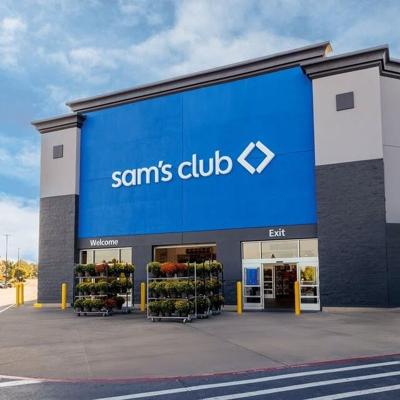


Sam’s Club, O’Fallon, Illinois
EAST ST. LOUIS — A federal judge won’t let Sam’s Club take a lawsuit out of St. Clair County Circuit Court from a delivery driver who fell in the loading dock area of the chain’s O’Fallon store, as the judge didn't buy Sam's Club's contention the driver's lawyers had "fraudulently" added the store managers as defendants in an apparent tactic to keep the case in the Illinois state court.
Christen Wesley said he slipped and fell in April 2024 as a result of standing water, debris and algae. His personal injury lawsuit named Sam’s Club, as well as O’Fallon Sam’s Club store managers Wanda Koonce and David Heaton, as defendants liable for his back, neck, head and leg injuries resulting in a permanent disability declaration.
Koonce and Heaton moved to dismiss the claims they faced, arguing Wesley only named as them as defendants in order to defeat the jurisdictional claims that would allow the case to be removed to federal court. Wesley argued against the attempted venue change, asking for a remand to state court.
In an opinion filed March 18, federal Magistrate Judge Gilbert Sison granted Wesley’s request.
Sison noted Wesley’s complaint alleged only negligence under Illinois law. But Sam’s argued its status as a legal Arkansas entity means a federal court is the proper venue despite the incident occurring in Illinois and the plaintiff living in that state. Wesley argued neither Koonce nor Heaton were added fraudulently given the possibility a state court could rule against them under state law.
The jurisdictional decision can carry heavy risks for both parties.
Illinois state courts, and St. Clair County Circuit Court, in particular, are perennially regarded as some of the most plaintiff-friendly jurisdictions in the U.S.
St. Clair County, for instance, has been rated by the American Tort Reform Association as one of the country's worst "Judicial Hellholes." ATRA tags such designations on court systems it believes are the most likely to be stacked against employers and other business defendants hit with lawsuits.
Further, Illinois state courts operate under different court rules, such as the standards governing which evidence and testimony are considered admissible in court. Those standards and rules are generally considered more favorable to plaintiffs than those used in federal courts.
In the case against Sam's Club, as an initial matter, Judge Sison pointed to a February 2026 U.S. Supreme Court opinion, Hain Celestial Group v. Palmquist, to note the propriety of the phrase “improper joinder” when, as with Wesley’s lawsuit, there is no fraud allegation. He then said a defendant bears the “heavy burden” of showing there is no reasonable possibility the claims against the Illinois residents might succeed.
“This determination is made by referencing state law on the claims made,” Sison wrote. Here, Illinois state law on negligence is pertinent, and both parties agree Illinois law allows store employees to be held liable for their workplace negligence” when certain conditions are met.
Koonce and Heaton argued “they served only managerial functions with respect to the alleged injury,” but Sison took note of Wesley’s allegations that Sam’s managers “drive around the club, including the parking lot and the area of (his) alleged fall every morning to look for trash, displaced objects and report any sightings to the cart associate on duty each morning.”
Unlike the 2010 Northern District of Illinois case, Hoidas v. Wal-Mart, in which a judge found a store manager owed no duty of care to the plaintiff, Sison said Wesley’s case is more comparable to Lambert v. Wal-Mart, a 2015 case from Illinois’ Southern District, where a store manager was found liable because a subordinate employee knew about a hazard that preceded an actionable injury. As such, Sison continued, Wesley’s claims do have a chance to succeed, which means the managers are proper defendants and there is a lack of complete diversity among all the parties to the litigation.
However, Sison added, there is one sentence in Wesley’s motion for remand that identifies him as a Louisiana resident. If that’s the case, there is complete diversity, he said. But the so-called forum defendant rule would still bar Sam’s from removing the proceedings to federal court. He further explained: “The forum defendant rule ensures in-state defendants cannot avoid state court, as the risk of local bias is not a concern when the defendants themselves are local.”
Finally, Sison said although courts have the power to award legal fees to a party that prevails on a remand motion, the entitlement only exists a defendant can’t show objectively reasonable logic for seeking the venue change.
Here, he said, Koonce and Heaton are correct there is a chance they aren’t liable under the Illinois negligence law, so although he granted the remand he didn’t find their arguments to be baseless.
Sison directed the case be sent back to St. Clair County Circuit Court for further proceedings.
Wesley is represented in the action by attorney Steven Katzman, of the firm of Katzman & Sugden, of Belleville.
Sam's Club is represented by attorneys with the firm of Heyl Royster Voelker & Allen, of Edwardsville.
Jonathan Bilyk contributed to this report.