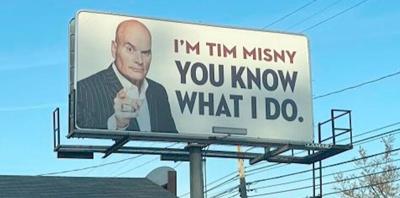


Attorney Tim Misny’s billboards are famous in Cleveland, fueling his self-described “relentless repetition” marketing campaign.
A Cleveland lawyer whose face is plastered on billboards throughout northern Ohio has released a book that critics say inadvertently shines a light on a practice driving up insurance premiums nationwide – attorney referrals to cooperative physicians.
Midway through The Misny Method, Tim Misny writes about a client who was unhappy with a $15,000 settlement. “He said, I needed every bit of twenty grand. I have to have twenty grand,” Misny recounts.
To get to that figure, Misny says he told his office manager to call the doctor on the case and tell him he needs to cut his fee. “And if he doesn’t, I won’t refer him any more business,” Misny writes.
That scenario, repeated endlessly across the country, illustrates how medical providers can become dependent upon personal-injury lawyers for referrals and feel pressure to do what those lawyers ask. That can include submitting inflated bills as evidence in court to drive higher verdicts and settlements, which are passed through to consumers in their insurance premiums.
The passage in the book “is a window into the transactional ecosystem that sits beneath the surface of the personal injury industry,” said Protecting American Consumers Together, or PACT, an advocacy group that supports tort reform measures to reduce insurance costs.
“Doctors are not independent medical professionals in this world,” PACT said in a recent blog post. “They are referral partners, and referral partners who do not cooperate can be cut off. The threat is explicit.”
Legal Newsline has written extensively about how lawyers use client referrals to favored medical providers to obtain higher damages. In Georgia, insurers have identified several law firms that even convince their clients to drop their cases to avoid revealing the details of their relationships with doctors in court.
In New York, lawyers have been accused of recruiting illegal immigrants to stage traffic and workplace accidents, then referring them to doctors who perform unnecessary surgeries.
Misny writes proudly of getting his client $20,000 by cutting his fee and convincing the doctor to cut his fees as well. Most lawyers would just take their fee and move on, he writes.
“I am the bulldozer. Nobody pushes me around,” he writes. “In the vast majority of my cases, we file a lawsuit to send a message to the insurance company. We become the aggressor.”
The book is mostly a how-to guide for aggressive marketing, and Misny acknowledges he is a marketer first and almost never appears in a courtroom. He boasts his office takes in 3,000 potential client calls a week based on his ubiquitous presence, eyebrow lifted, catchphrase “Make them pay.”
That’s another pattern that groups like PACT criticize. Billboard lawyers draw in clients in volume and often sell their cases to other firms for a percentage of any fees.
“Consumers are not choosing the best lawyer,” PACT said. “They are choosing the most advertised one.”
Misny would not entirely disagree. A simple message and “relentless repetition” are more important for getting clients than courtroom skills, he writes. Appearing on local news segments and having his own bobblehead night at a Cleveland State University basketball game are parts of that effort.
“The market does not reward the most technically precise individual,” he writes. “It rewards the most easily recalled one.”