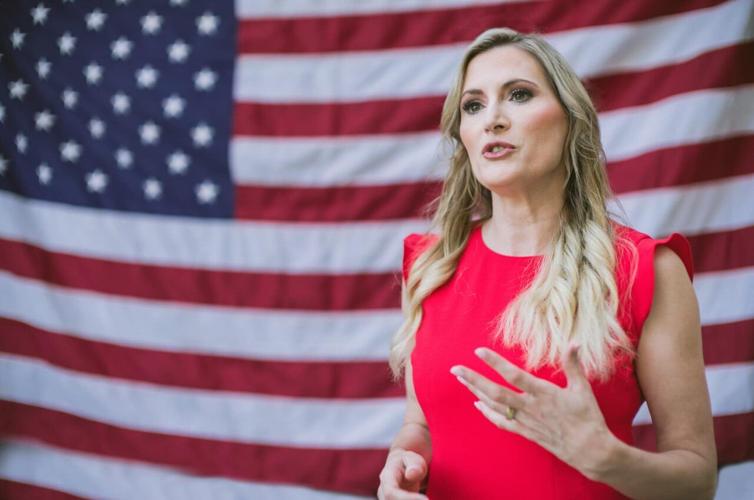





Laurel Lee (R-Florida)
WASHINGTON – The sponsor of a joint resolution that would amend the U.S. Constitution to establish a clear requirement that only United States citizens can vote in federal elections feels confident in its passage.
Rep. Laurel Lee, a Republican from Florida, introduced the joint resolution in March. Other sponsors include Rep. Lance Gooden (R-Texas), Rep. Mike Haridopolis (R-Florida), Rep. Julia Letlow (R-Louisiana), Rep. Wesley Hunt (R-Texas) and Rep. Russell Fry (R-South Carolina).
House Joint Resolution 152 would codify in the Constitution that only U.S. citizens are eligible to vote in elections for president and vice president as well as members of Congress. It would close a longstanding constitutional gap, ensuring a uniform national standard.
Lee said the issue is simple.
“H.J.Res. 152 would place a straightforward principle in the Constitution: American elections should be decided by American citizens,” Lee told The Florida Record. “This principle enjoys broad support across party lines.
“In fact, last year 56 House Democrats joined Republicans in voting to prohibit noncitizen voting in Washington, D.C. That vote reflects what most Americans believe: citizenship matters, and voting in our elections is one of the fundamental rights and responsibilities of citizenship.”
Lee is referring to a vote last July in which 56 Democrats voted with Republicans to end legal non-citizen voting in local D.C. elections. If those 56 were to vote for HJR152, it would need at least 14 more Democrats to pass because it deals with federal elections and would need to reach the required two-thirds majority for a constitutional amendment to pass the House.
“Constitutional amendments are intentionally difficult to pass, but I believe that this resolution can earn the necessary bipartisan support,” Lee told The Record. “I am hopeful it will receive consideration in the Judiciary Committee and on the House floor in the near future.
“Ultimately, members of Congress should be able to explain to their constituents whether they believe only American citizens should vote in American elections.”
While it commonly assumed that individuals who are not citizens of the United States cannot legally vote in federal elections, there is nothing in the U.S. Constitution that backs that conclusion up.
Under current law, federal statute prohibits non-citizens from voting in federal elections, but Article 1 Section 2 and the 17th Amendment to the U.S. Constitution allow states to legalize non-citizen voting in federal elections.
HJR152 has been assigned to the House Judiciary Committee where it awaits a hearing. Chairman Jim Jordan (R-Ohio) and Constitution Subcommittee Chairman Chip Roy (R-Texas) will make that decision.
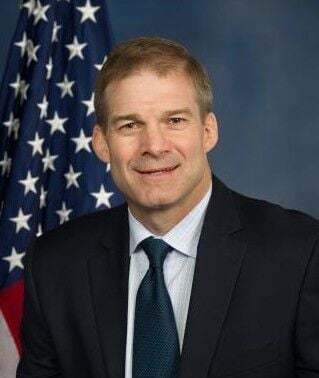
Jordan
Jordan has said he supports Lee’s resolution.
“It’s simple: only Americans should vote in American elections,” Jordan said. “Congresswoman Lee’s amendment is a common-sense proposal that creates a uniform, nationwide standard that will protect federal elections permanently.”
Still, no hearings currently are scheduled for the resolution.

Fortenberry
“Fifty-six House Democrats voted to stop municipal non-citizen voting in D.C.,” said Avi Fortenberry, president of Americans for Citizen Voting. “It’s not unreasonable to expect that there are many more who don’t want noncitizens voting in federal elections which affect them.
“There are many Democrats who do not support non-citizen voting, but voted against the ending D.C.’s municipal non-citizen voting because they didn’t want to meddle in local decision-making. We expect those members to vote for HJR 152 because it addresses federal elections, their elections”
In recent years, several states have passed constitutional amendments to ensure non-citizens don’t vote in state elections. West Virginia, for example, has an amendment on the ballot in this fall’s election.
ACV has worked to have similar measures adopted in states as well. Texas voters approved a similar measure in November. And in 2024, eight states (Idaho, Iowa, Kentucky, Missouri, North Carolina, Oklahoma, South Carolina and Wisconsin) passed laws to keep non-citizens from voting.
Including Texas, 21 states now have laws ensuring only American citizens can vote in those states, and several other states are actively considering such legislation.
Legislatures in Arkansas, Kansas and South Dakota also have placed amendments on the 2026 ballot.
“Relying on statute alone leaves this principle subject to future changes that could undermine this long-standing principle,” Lee said. “This amendment ensures that no matter what happens in Washington or at the state level, federal elections will remain reserved for United States citizens.”
Rep. Johana Hayes (D-Connecticut) voted against the D.C. voting bill. In explaining her rationale, she said she doesn’t think non-citizens should vote.
“I believe that voting is a privilege that comes with being a U.S. citizen,” Hayes said. “As such, I do not think non-citizens should vote in elections.
“However, before I could even consider that issue, I had to think about Congress overriding decisions made by local citizens.”
Fortenberry said Congress needs to fix the loophole that could allow non-citizens to vote.
“It is undeniable that there is a simple path for states to allow legal non-citizen voting in federal elections, and the only way to close that path is by amending the U.S. Constitution,” she said. “Congress is aware of this loophole.
“If they refuse to close the loophole, it is very difficult to believe that they want only citizens voting in federal elections.”
Polling also supports the idea.
A 2025 poll by Remington Research Group shows that 90% of those surveyed believe only U.S. citizens should be able to vote in elections for Congress and the president. And 76 percent support an amendment like the one Lee introduced.
Under current law, federal statute prohibits non-citizens from voting in federal elections. However, federal law alone is not permanent. It can be repealed, weakened or challenged, and the Constitution leaves voter qualifications primarily to the states. As a result, the current framework does not guarantee a lasting nationwide standard.
Lee’s proposed amendment does not alter state authority over state or local elections, and it doesn’t change existing constitutional protections related to voting rights, including those based on race, sex, or age. Instead, it focuses narrowly on federal elections, reinforcing the longstanding expectation that participation in choosing national leaders is reserved for U.S. citizens.
“Most people think the Constitution requires that voters be citizens of this country,” Fortenberry said. “In fact, the Constitution leaves voter eligibility entirely to each state to decide. One state could decide that non-citizens in that state are allowed to vote in federal elections, and that decision would affect us all.”