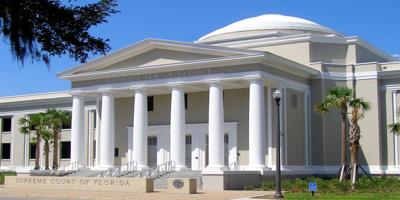


Florida Supreme Court
A dispute over whether the state-run Citizens Property Insurance Corp.’s arbitration mandate to settle claims run afoul of policyholders’ due-process rights has been fast-tracked to the Florida Supreme Court.
Last week, the Third District Court of Appeal certified to the high court that the case in question – Victoria Quintana and Luis Rodriguez v. Citizens Property Insurance – is a matter of great public importance that should be resolved immediately.
Citizens appealed to the Third District Court after a Miami trial court judge, Milton Hirsch, decided that the insurer’s policy of requiring binding arbitration at the state Division of Administrative Hearings (DOAH) to resolve property damage claims created the appearance of impropriety.
“In Florida, neither plaintiffs nor insureds who seek to sue Citizens have any choice at all in the constitution of the arbitration panel,” Hirsch said in his May 7 ruling. “Quite the opposite: The arbitrating body is DOAH, a sister agency to Citizens within Florida’s executive branch, and Citizens is the very adversary whom plaintiffs and like-kind litigants oppose.”
Because Citizens pays DOAH for its arbitration services to resolve insurance claims and that revenue is substantial, the appearance of impartiality is eroded, according to Hirsch. He also indicated that the Citizens dispute-resolution process excludes trial by jury and is at odds with due-process rights outlined in the Florida Constitution.
But Citizens defends the way it handles claims as speedier, less expensive than the civil court process and in line with the state Legislature’s goals when it established a state-run insurer of last resort.
“The Division of Administrative Hearings has been settling disputes between state entities like Citizens and the people of Florida for more than 50 years,” Citizens spokesman Michael Peltier told the Florida Record in an email. “It is a well-established, fair, transparent and constitutional process. We look forward to a review by the Florida Supreme Court.”.
Citizens’ arguments submitted to the appeals court say the binding arbitration process should be upheld for two key reasons: The trial court erred in not applying well-founded contract principles that arbitration rules are legitimate waivers of constitutional protections, including the right to a jury trial.
“Second, the court impermissibly expanded the narrow circumstances where the structure of the tribunal overcomes the threshold presumption of impartiality and rises to a constitutional level that facially violates procedural due process,” Citizens’ attorneys said in a brief to the appeals court.
In addition, the arbitration policy is consistent with stated public purposes outlined by state lawmakers, according to Citizens.
“The issues in this appeal will decide the validity of the Florida Legislature’s decision to authorize Citizens to adopt arbitration endorsements allowing for the binding arbitration at DOAH to resolve claim disputes quicker and less costly than trial court litigation …” Citizens’ attorneys argued.
Claimants have already burdened the administration of civil courts by flooding them with hundreds of emergency motions to enjoin DOAH arbitration proceedings, according to Citizens. Such motions serve to delay the cases of other civil litigants, the insurer said.
“The Florida Supreme Court’s immediate resolution of the issues in this appeal would help alleviate the strain on judicial resources,” Citizens’ attorneys argued in a filing to the appeals court.