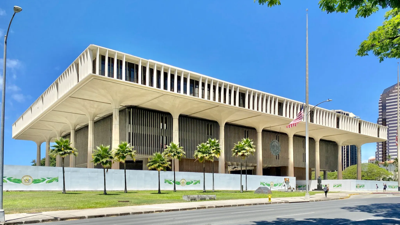



The Hawaii State Capitol stands on Beretania Street in Honolulu.
HONOLULU – A Hawaii state election once decided by a selection between two Easter eggs did not deserve that unusual tiebreaker, the state Supreme Court has ruled in sending voters back to the polls.
Sheila Medeiros and Kanani Souza each received 842 votes, then had their names placed in two capsules, “the kind that holds candy in a plastic Easter egg,” the court wrote Sept. 4. Medeiros’ capsule was picked by the state’s chief election officer from a lauhala basket, giving her the win in District 43’s Republican primary for state representative.
With no Democratic opponent, Medeiros was set to take office. But two more ballots were counted in a precinct than voters cast there.
“A tie must be real before it can be broken,” Justice Todd Eddins wrote. “Two ballots from outside the district put this one in doubt.”
In a state that votes largely by mail, it turns out that two District 40 voters received District 43 ballots and made their choices between Medeiros and Souza. Though it’s possible one voted for Medeiros and one for Souza, which would preserve the tie among District 43 voters, that couldn’t be confirmed.
At a hearing, election officials said there is no way to know whether the ballots were counted and whose names were picked, leading the court to decide Souza has shown that the mistake “unsettles the outcome.”
The court also agreed with Souza that Chief Election Officer Scott Nago’s procedure for breaking the tie was invalid. State law says a tied election must be resolved “by lot,” but picking eggs out of a basket was a rule his office implemented without going through administrative rulemaking procedures, Eddins said.
Picking eggs from a basket is used to set the order of political parties on ballots in Hawaii, and Nago said his tiebreaker idea was an established practice and an “adjudication” rather than a new rule.
“Rulemaking is legislative and looks forward,” Eddins wrote. “Adjudication resolves ‘past and present rights and liabilities’ on ‘sharply controverted’ facts.’ Measured that way, the tie-break is a rule.”
It was actually the second time he’d picked an Easter egg that day, with Senate District 20 also finishing in a tie. In ordering a new election for District 43, the court did not suggest a new tiebreaker, should it happen again.