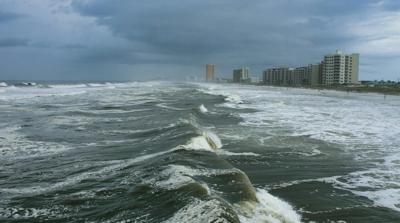


Rough surf rolls toward Panama City Beach, Fla., with high-rise condos along the shoreline under dark storm clouds, in 2021.
It’s become a standard feature of news articles and lawsuits against oil companies: After a devastating storm, wildfire or heat wave, experts blame billions of dollars in damage on human-induced climate change.
It’s called “extreme event attribution” or “fraction of attributable risk” and is based on the idea that the cost of a natural disaster attributable to fossil fuels can be calculated down to a specific dollar amount. Cities and counties across the country have cited it in lawsuits seeking billions of dollars in damages from ExxonMobil, Chevron and other oil and gas producers, and the U.S. Supreme Court is currently deciding whether they can proceed.
The problem is EEA is built on a fundamental misunderstanding of science, say experts including climatologists at the National Academies of Sciences. While there is nearly universal agreement that the greenhouse gases produced from burning fossil fuels are warming the atmosphere, there is no agreement on how that affects any individual storm.
Government officials in Puerto Rico tried to sue oil companies over 2017’s Hurricane Maria, but a federal judge ruled the case was filed too late. Most EEA studies assume the effects of climate change are proportional to the probability increase of an event, so that a 10% increase in the likelihood of a storm meant 10% of the cost of a $1 billion storm was due to human factors.
“There is little basis, however, to conclude that changes in the frequency of an extreme event type correspond to changes in the magnitude of impacts,” the National Academies of Sciences concluded in a report issued earlier this year.
A 2020 paper used cost estimates from insurance companies for Hurricane Harvey to conclude human-driven greenhouse gas emissions were responsible for $67 billion, or 75% of the damage, with a range of $30 billion to $72 billion. But that calculation is based on a fundamental flaw in reasoning: That in a world without global warming, the storm wouldn’t have happened at all.
“A storm made marginally worse by warming is still just a storm. If warming turned a 249-millimeter rainfall into a 250-millimeter rainfall, the attributable damages are only those caused by the additional millimeter of rainfall, not the damage done by the whole storm,” said the Breakthrough Institute in a recent publication. The organization favors a balance between controls on greenhouse gas emissions and affordable energy and has critiqued climate litigation as counterproductive.
The National Academies agrees, to an extent. In the July 2026 report on EEA, the organization concluded that human-induced global warming has “a direct and well-understood impact on extreme temperatures, extreme rainfall and compound hot-dry events.”
The group expressed much lower confidence in EEA accuracy for severe thunderstorms that often produce tornadoes, extreme snow and ice, wildfires and tropical cyclones. Few of the studies consider other factors affecting the climate such as aerosols, irrigation and land-use changes, all of which complicate the job of putting a dollar figure on the cost attributable to fossil fuels, the National Academies said.
Many of the pending climate lawsuits cite a report by the Climate Accountability Institute that totals the greenhouse gases emitted by burning fossil fuels sold by each of the major energy companies. Plaintiff lawyers use these figures to assign liability to the companies, a market-share approach they have used for decades in toxic-tort litigation like asbestos.
That approach doesn’t say anything about how much of a given county or state’s climate-related costs are attributable to a specific company, however, wrote Alex Trembath and Elizabeth McCartny in the Breakthrough Institute article. That raises the risk of companies being bankrupted by numbers a jury decides based on flawed science, they said.
“A court that lets one of these cases go forward will eventually have to pick a number, and it has no good way to do it,” the authors wrote.
“If they reach trial, a judge will decide whether an expert’s method for pricing the damage is reliable enough to put before a jury, and the jury will pick a number. Once one court accepts a method, lawyers in the next case will point to it,” they concluded.