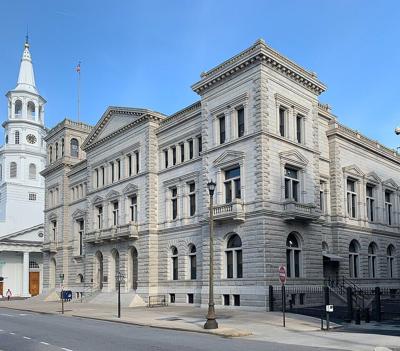



U.S. Post Office and Courthouse in Charleston, S.C.
CHARLESTON, S.C. - Plaintiff lawyers who used an advertising blitz to recruit tens of thousands of clients to sue over PFAS “forever chemicals” now admit they can’t reach many of them, as defendants push the court to dismiss cases for lack of evidence.
In a filing this week, 3M, Bayer and other chemical companies said at least 8,000 plaintiffs have failed to file required fact sheets with the federal court hearing the multidistrict litigation in South Carolina. In many cases, plaintiff lawyers say the reason the fact sheets are incomplete is they can’t reach their clients.
“Plaintiffs’ counsel report that—after having chosen to file claims on behalf of these thousands of plaintiffs—despite consistent efforts to contact plaintiffs, plaintiffs have been unresponsive,” the defendants said in a July 6 filing.
Multidistrict litigation scoops up thousands of individual lawsuits over the same products and places it before a single judge for pretrial procedures. Defendants have long complained the process overwhelms the courts and their lawyers with cases, forcing mass settlements when many of the underlying claims are without merit.
To level the playing field, MDL judges increasingly require plaintiffs to submit questionnaires with basic information to support their claims, such as medical records and details about where and when they were exposed to the product they are suing over.
Judge Richard Gergel set up that process early in the PFAS MDL, which once held more than 20,000 lawsuits claiming injury from the long-lasting chemicals found in firefighting foam and numerous products. But in a February order, the judge said “a number of plaintiffs asserting personal injury claims in this MDL have not complied” with existing orders. He tightened the deadlines for compliance, allowing the defendants to move to dismiss mass numbers of cases lacking documentation.
Since then, the court docket shows a flood of voluntary dismissals. Plaintiff lawyers have sought to preserve some cases, saying they are still trying to reach their clients to obtain required information. In a June 30 filing, for example, attorney Craig Carlson asked the court to postpone dismissing the case of Jason Sigman, saying he had tried to contact his client with phone calls, text messages, emails and mailed letters.
“Despite counsel’s efforts, plaintiff has been unable to provide medical records, thus requests the court deny the motion to dismiss for this plaintiff so counsel can continue their communication efforts,” Carlson said.
Critics of the MDL process say it gives plaintiff lawyers an incentive to advertise for large numbers of clients, even if they lack the capacity to represent all of them on an individual basis. University of Georgia Law School Professor Elizabeth Burch has written extensively on the conflicts and abuses in MDLs, including a book that details how lawyers convinced women to undergo unnecessary surgery to enhance the value of their pelvic-mesh lawsuits.
There are different types of plaintiffs in the MDL. In addition to private individuals, public water systems have alleged damages and scored huge settlements. BASF paid $316.5 million, Tyco $750 million, DuPont $1.2 billion and 3M 10.5 billion.