
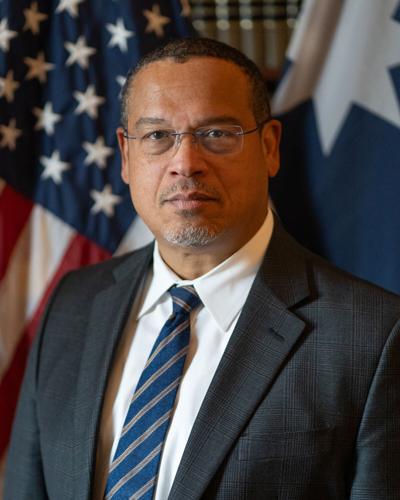


Minnesota Attorney General Keith Ellison
SAINT PAUL, Minn. – Minnesota Attorney General Keith Ellison is defending the state’s new law regarding “nudification” – AI-generated sexual images for which companies like X can now be heavily penalized.
xAI challenged the law July 27 in federal court citing free speech concerns, hoping to invalidate a law that opens it to penalties of $500,000 per instance. The company says it already prohibits Grok Imagine users from generating nude or sexualized images of people without their consent and has gone to court to sue those who have violated its policies.
Judge Donovan Frank has yet to rule on the company’s motion for a temporary restraining order, and the law was set to take effect Aug. 1.
“First,” AG Ellison’s office wrote July 31, “X.AI’s lack of diligence confirms that a TRO is unnecessary. The company waited until the last minute to sue.
“Second, X.AI has not shown that it will suffer irreparable harm because the main alleged injury is financial – not to mention minimal and unsubstantiated.”
And the State has a compelling interest in protecting the public from AI-generated sexual images, he said, noting a slew of recent lawsuits against the company. Five children are plaintiffs in a class action lawsuit brought in California by lawyers at Lieff Cabraser.
One girl says in December she received a message from an anonymous Instagram account that alerted her to someone she knew spreading AI-generated sexual images and a video of her on Discord.
“[O]ther than the fact that she knew she had never been in those situations or done those things, she could not visually distinguish these images and video as fake; they resembled real-life content in every way,” the complaint says.
Two families have sued xAI in Arkansas, though AI companies aren’t the only ones facing legal problems. In Pennsylvania, a private school is accused of failing to respond to fake pornographic images of at least 59 female students.
“Minnesota’s Nudification Ban prohibits the tools that allow these types of AI-generated sexual images to proliferate and flourish, and X.AI’s motion for a TRO to block Minnesota’s law should be denied,” Ellison’s office wrote.
xAI called Minnesota’s law “clumsy,” claiming its definition of “intimate part” is too broad and borrowed from a criminal statute that was drafted for nonconsensual touching. It covers the breasts of both men and women, in addition to the inner thigh and buttocks.
“HF 1606 accordingly bans ordinary depictions of men without shirts, people in shorts or swimsuits, and other body parts routinely displayed in public – far beyond what an ordinary person would consider ‘nudificiation,’” the complaint says.
Minnesota and the federal government already have take-it-down laws targeting deepfake images, xAI says. The company had to restrict Grok’s editing features in the lead-up to the law taking effect.
xAI is unlikely to prevail in the case, Ellison said in calling for the TRO to be rejected. The First Amendment concerns belong to its users, not the company, the AG’s office said, and AI-generated sexual images of children are not entitled to free-speech protections.
“Minnesota’s nudification ban does not regulate content; instead, it regulates conduct – whether a technical tool can have a certain feature,” it added.