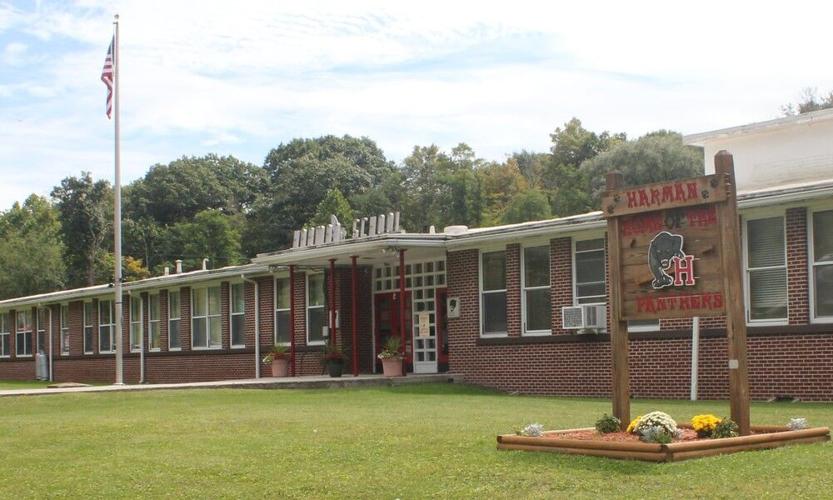


ELKINS – A nonprofit has filed a lawsuit seeking to reopen the former Harman K-12 School and invalidate the board’s $10 transfer of the property to a community group planning to operate a Christian microschool there.
Hometown Hope filed its complaint September 17 in Randolph Circuit Court against the Randolph County Board of Education and Superintendent Derek Lambert.
In the complaint, the group alleges the closure unlawfully subjected Harman students to bus rides of more than an hour each way, while the board’s private conveyance of the school property violated the state’s required public sale process. The lawsuit also challenges, as applied, West Virginia’s expanded Hope Scholarship program and contends the program has contributed to fiscal harm for public schools.
The complaint says former Harman students now attending schools in Elkins must first be driven by parents or others to a central stop at the State Road Shed. From there, they board a bus at 5:57 a.m. for a trip the plaintiffs say lasts 1 hour and 23 minutes one way in clear weather.
The students could spend more than two hours on the bus each way during harsh winter weather, according to the lawsuit.

Toriseva
“The Board of Education and superintendent sought to close Harman because they couldn’t balance the budget,” attorney Teresa Toriseva told The West Virginia Record. “But closing it means Harman students get bused 1 hour and 23 minutes on a clear day to Elkins to go to school. That bus ride will be much longer across two mountains during the snowy Randolph County winters.
“Some kids including very young students will be getting out bed at 4 a.m. to go to school. It’s shocking and unacceptable, and it violates state law. Harman School must re-open.”
In the complaint, the nonprofit says it is composed of Randolph County taxpayers and parents of public school students, including families affected by the closure of Harman School. It seeks declaratory and injunctive relief but no monetary damages.
The group asked the court to declare the school closure “illegal and unauthorized,” order the school reopened, direct the return of equipment removed from the building, reinstate teachers and staff, and declare the property transfer void.
The filing names Lambert, but much of the petition’s criticism is directed at former Superintendent Shawn Dilly, who resigned in March. Lambert was later appointed to lead the school system.
Hometown Hope contends the bus route violates West Virginia limits on bus rides for younger children after school closures or consolidations. The filing cites a 30-minute recommended one-way ride time for pre-kindergarten through fifth-grade students and argues state law bars newly created closure related routes that exceed that recommendation by more than 30 minutes.
The state Board of Education approved a waiver increasing the maximum ride time for Harman students from 30 minutes to 60 minutes, the complaint says. But the plaintiffs argue the waiver could not legally approve a route longer than an hour.
“A county board may not create, and the state board may not permit, any new bus route for PreK–Grade 5 students” that is longer than 60 minutes one way, the petition states.
It also says the route forces elementary students to get up during the 4 a.m. hour and harms students by limiting their ability to participate in school activities and remain connected to their community.
The Board of Education voted 4-1 in October 2025 to close Harman K-12 School, with the closure taking effect after the 2025-26 school year. The state Board of Education approved the closure in December 2025. Former Harman students were assigned to Jennings Randolph Elementary School, Elkins Middle School and Elkins High School.
Harman’s final public school classes ended in May. Its 2026 graduating class had four seniors.
The school closure came while Randolph County Schools was operating under a state of emergency, imposed in June 2025 amid declining enrollment, a reported $2.8 million fiscal-year 2025 shortfall, consolidation discussions and staffing concerns. The county later eliminated 46.5 positions as part of its financial recovery efforts.
The state Board of Education lifted the emergency designation in July, though the county remains under state monitoring. Lambert told the state board then that preliminary figures showed current expense revenues of $42.07 million as of June 30, exceeding expenditures by about $1.47 million before year-end closing activities. He also reported the county had adopted a balanced fiscal-year 2027 budget with the required 5% reserve.
Hometown Hope alleges the Harman closure was based on inflated financial and enrollment assumptions. The filing argues the closure has deprived Harman students of a local public school and created irreparable harm to students, faculty, families and the community.
The lawsuit also challenges the county board’s transfer of the Harman property to the Harman Education Association, or HEA, for $10.
The board voted 4-1 in June to convey the former school to HEA, a local organization that planned to convert it into a private microschool. HEA had sought control of the building alongside at least two other interested organizations, including the Harman School and Advancement Center and Urgent Care EMS Inc.
HEA later announced plans to open a Christian microschool in the former building Sept. 8, with the school also intended to be available for community events.
The petition says the board’s property disposition required the facility to continue being used for educational purposes, but contends the board failed to follow a separate state-law procedure for disposing of school property.
Under the lawsuit’s reading of state law, a county board must make a formal finding that the property is no longer needed for school purposes, publish notice and sell the property at a public auction to the highest responsible bidder. The plaintiffs contend a private sale is void.
“The sale and conveyance of the Harman School building was not done on the open public market at public auction as required by law,” the petition states.
The lawsuit asks the court to set aside the transfer and return the property to the Board of Education, which the plaintiffs say would allow the school to be reopened.
The filing also seeks a declaration that West Virginia’s Hope Scholarship program, as expanded for the 2026-27 school year, is unconstitutional as applied to the plaintiffs and public school system.
The Hope Scholarship is an education savings account program that can be used for private-school tuition, homeschooling curricula, tutoring and other eligible education expenses. The West Virginia Supreme Court of Appeals upheld the program against a facial constitutional challenge in 2022 in State v. Beaver.
Hometown Hope does not ask the court to revisit that facial ruling. Instead, it relies on language in the Beaver decision that, according to the complaint, left open a future challenge if decreased public school enrollment and insufficient legislative funding caused the state to fall short of its constitutional duty to provide a thorough and efficient public school system.
The filing contends those conditions are no longer speculative.
It alleges the program has grown from about 3,000 applicants and a $12.9 million estimated cost when Beaver was decided to a program appropriated at about $100 million in 2025-26 and expected to cost several hundred million dollars during the first year of universal eligibility.
A state education budget request for fiscal year 2027 included the governor’s recommendation of $230.1 million for the Hope Scholarship program, according to reporting on the state Department of Education’s budget presentation.
The petition also cites a RAND Corp. study commissioned by the House of Delegates. According to the lawsuit, RAND recommended increasing funding through the school aid formula, found that West Virginia under-allocates money to districts serving students with greater educational needs and advised against the 2026-27 universal eligibility expansion.
RAND estimated that roughly 36,000 additional school-age children would become newly eligible under the expansion and that participation by half of them could add about $105 million in annual costs, according to the petition. The report concluded that many newly eligible participants already were enrolled in private school or homeschooled and could use the scholarship to replace spending their families otherwise would have made, the filing says.
Hometown Hope is not asking the court to recover money already distributed to Hope Scholarship accounts or disturb scholarships already awarded. It seeks prospective relief focused on the 2026-27 universal eligibility expansion.
The plaintiffs say they are not seeking a temporary restraining order, acknowledging that reopening a school after the academic year has begun could require significant planning and might not be an immediate remedy for students. But they asked Wilfong to schedule an injunction hearing as soon as practicable.
Hometown Hope is being represented by Toriseva and Josh Miller of Toriseva Law in Wheeling. The case has been assigned to Circuit Judge Jaymie Wilfong.
Randolph Circuit Court case number 26-C-122