
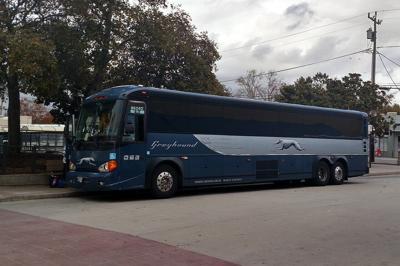


Greyhound bus
SAN FRANCISCO — The state of California can't force bus drivers to take meal and rest breaks more frequently than is required by federal transportation rules, a federal appeals court has ruled.
On June 4, a three-judge panel of the U.S. Ninth Circuit Court of Appeals rejected the attempt by California Attorney General Rob Bonta to claim the U.S. Secretary of Transportation can't use federal law to block California from enforcing its own rules on commercial drivers who drive buses or other vehicles designed to carry passengers.
In the ruling, the judges agreed with the U.S. Department of Transportation's determination that the rules would create a web of confusing and often contradictory rules, while doing little to actually improve transportation safety.
The case had pulled into federal court in 2020 after the USDOT declared California state rules, which seek to impose strict meal and break rules over buses operating in the state, improperly conflicted with federal rules and should be blocked.
That decision relied on principles of federal supremacy, under which the rules established through the federal Motor Carrier Safety Act (MCSA) should be considered superior to state rules.
California had enacted the wage rules in the 2000s, giving transportation employees, including bus drivers, who work more than five hours a day, a guaranteed "meal period of not less than 30 minutes." Drivers who work more than 10 hours per day are guaranteed "a second meal period."
The rules also entitle drivers to rest periods of 10 minutes for every four hours worked in compliance.
Workers who are not given those mandated breaks must be paid an addition hour of pay "for each workday that the meal or rest or recovery period is not provided."
In 2008, transportation companies asked the USDOT to review those rules, asserting they should not be allowed, as they are more strict than the rules imposed under federal rest and recovery rules for drivers and should be preempted by federal law.
The Federal Motor Carriers Safety Administration under former President Barack Obama initially rejected the petition, finding California's rules were "not regulations 'on commercial motor vehicle safety' subject to preemption" under the federal law.
In 2018, following the election of President Donald Trump, the motor carriers petitioned yet again, asking the FMCSA to reconsider. This time, the USDOT determined California's rules do conflict with federal law and should be preempted.
The FMCSA determined California's rules "did not provide any measurable safety benefit, were incompatible with federal regulations, and imposed an unreasonable burden on interstate commerce."
In 2020, the FMCSA specifically declared California could not apply its rules to bus drivers.
The FMCSA determined California's rules, again, did not increase roadway safety beyond federal rules, but still imposed "operational difficulties" on bus companies because they served to "create a 'patchwork of requirements' that place a burden on interstate operators."
That determination prompted the state of California to sue, asking federal courts to strike down the USDOT determination.
California asserted the federal regulators can't block California's rules, because the state was only imposing "general" meal and rest break rules to bus drivers, not specifically targeting drivers or bus companies.
And the state argued the USDOT cannot preempt California's rules, because USDOT and FMCSA has not issued its own rules comparable to those California has issued.
Before the Ninth Circuit, the judges said California's legal arguments fall short.
While federal regulations don't specifically dictate when drivers must take breaks, the judges said the federal rules do still govern how long drivers may remain on the road "before a mandatory off-duty period."
"The State and federal regulations therefore share the same purpose of mandating off-duty periods as a form of ensuring commercial motor vehicle safety through fatigue management," the judges wrote. "That California has chosen a more stringent method of achieving this end does not mean that its rules are outside of the FMCSA's domain.
"Indeed, such a holding would run headlong into the statutory scheme providing the FMCSA with preemption authority when the Secretary (of Transportation) determines that a State law or regulation 'is additional to or more stringent than' a federal regulation."
And the judges further agreed the FMCSA was not incorrect to determine that California's rules provide minimal additional safety benefits, while greatly complicating the ability of bus companies to both comply with the rules and run their businesses.
The judges said the court's reasoning in deciding in a different case that the federal government can preempt state laws more stringently governing freight traffic should also apply in the dispute over bus driver regulations.
And the judges specifically rejected claims by California that its rules should be allowed to stand because the federal regulators had relied too much on the input of bus companies.
"The FMCSA took account of the 'costs and benefits' of California's (meal and rest break) rules and concluded that the 'federal regulations adequately and more appropriately balanced the competing interests between safety and economic burden,'" the judges wrote.
The decision was authored by Ninth Circuit Judge Holly A. Thomas. Judges Consuelo M. Callahan and Anthony D. Johnstone concurred in the decision.
Thomas and Johnstone were appointed by former President Joe Biden. Callaghan was appointed by former President George W. Bush.