
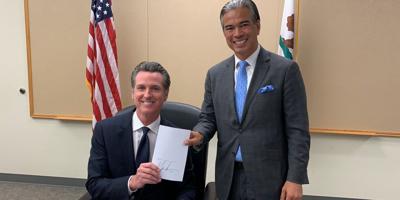


From left, California Gavin Newsom and California Attorney General Rob Bonta
WASHINGTON, D.C. — A D.C. federal judge has, for now, blocked the Trump administration from moving ahead with efforts to allow Congress to revoke the authority of an unelected California board to continue to essentially write and set vehicle emissions rules for the entire country.
On Sept. 2, U.S. District Judge Beryl A. Howell granted the state of California's request for a preliminary injunction against the U.S. Environmental Protection Agency (EPA) from submitting a report to Congress that would have allowed lawmakers to revoke so-called waivers, including several issued under the administrations of former presidents Barack Obama and Joe Biden, that allow California and at least a dozen other states to set vehicle emissions standards well beyond those otherwise allowed by federal law.
Howell was appointed to the federal bench by Obama.
In the ruling, Howell sides almost completely with the state of California, finding the EPA under President Donald Trump acted unlawfully in reclassifying the "waivers" as "rules," subject to review and potential revokation by Congress under a federal law known as the Congressional Review Act (CRA).
In the ruling, Howell instead asserts the Trump administration is bound by the determinations of the Obama and Biden administrations that the "waivers" are actually only an EPA agency action or agency order, that cannot be reviewed or rescinded by Congress.
And the EPA's attempts to defend its decision to reclassify the "waivers" as "rules" now amounts to "Orwellian doublethink," referring to George Orwell's dystopian novel, "1984."
Set in the fictional dictatorship of Oceania, the story recounts the misfortune of living under the tyranny of the one-party system known as "Big Brother," in which government dictates are absolute, but constantly fluctuating, words and history only mean what the government says they mean, and any "wrong think" is brutally repressed.
"Outside of Oceania, such an unreviewable power grab by a federal agency is not permitted," Howell said in her decision.
The ruling comes as the latest judicial foray into the multi-front legal fight over efforts by carmakers, oil companies and Republicans in Washington, D.C., to strip from California its outsized power over strict standards for vehicle fuel economy and emissions.
California and the Trump administration have been locked in the conflict in courts and on Capitol Hill for years, since California Democrats announced their intent to use their special legal powers to essentially force the rest of the country to follow California on its course to ultimately eliminating gas-powered internal combustion engines in the name of fighting so-called climate change.
Since 1967, California has enjoyed special privileges under the Clean Air Act. For the past five decades, Congress has allowed the EPA to grant California a "waiver," allowing the state to set vehicle emissions standards that exceed those set by federal law and EPA regulations, ostensibly to allow the state to reduce smog caused by large numbers of gas-powered vehicles operating in the Golden State's unique climatic conditions.
However, in recent years, California Democrats have moved far beyond those standards, empowering the California Air Resources Board (CARB) to move ahead with standards that would impose stringent regulations on automobiles and eventually force all cars to be "zero emission" by 2035, essentially outlawing traditional internal combustion-powered vehicles.
While the CARB rule would nominally apply only to vehicles sold in California, critics have long noted that California's standing as the largest and most economically powerful state in the U.S. essentially allows the state to force automakers to change their designs to meet the state's stringent standards.
So, while California's rules may only have force of law inside the Golden State, economic realities would mean California's rules would translate into sharply decreased vehicle choices throughout the rest of the country, at best, if not an outright elimination of most kinds of gas-powered vehicles in much of the country.
California's leverage to dictate emissions standards and consumer choices throughout the rest of the country, however, is only further magnified by the willingness of 17 other states and the District of Columbia to enact laws that link their state emissions standards to California's. Those states include Colorado, Nevada, New York, New Jersey, Washington, Oregon and Pennsylvania, among others. Collectively, California and its 17 follower states account for at least 40% of the U.S. population.
The threat posed by California's imposition of its anti-internal combustion rules has led to open conflict in court.
In 2019, for instance, during the first Trump administration, the EPA attempted to rescind California's "waiver."
However, California challenged that recission in court, arguing only Congress could revoke its emissions rule-setting abilities.
That legal action continued beyond the end of Trump's first term, and the Democratic Biden administration reinstated the waiver.
That, in turn, triggered legal challenges from oil and gas producers and Republican-led states, who argued the waiver granted to California has been unconstitutional from the start. The legal challenges have asserted the Constitution requires the federal government to treat all states the same, regardless of their size, market share or unique environmental conditions.
In 2025, the U.S. Supreme Court ruled to allow energy companies to continue that lawsuit after lower court judges had sided with California's bid to dismiss.
Meanwhile, Republicans in Congress and Trump moved ahead with action under the federal Congressional Review Act law to officially rescind the "waiver."
After Congress voted to rescind California's ongoing waiver under the CRA, California again sued, this time arguing Congress also can't rescind its special powers, because they weren't granted under an EPA agency rule reviewable by Congress.
That case remains pending in Oakland federal court.
At the same time, the EPA moved to also ask Congress to rescind previous waivers granted by the EPA under the Obama and Biden Democratic administrations. Those included a waiver granted in the final days of the Biden administration, in an apparent bid to get in front of the second Trump administration's likely decision to reject California's new "waiver."
As part of those actions, the agency asserted it had the authority to reclassify those waivers as "rules" reviewable by Congress, as it had with the state's most recent "waiver."
And that, in turn, prompted California to sue again, this time in D.C. federal court, seeking to block the EPA from referring the reclassified "rules" to Congress for review and potential recission.
In her decision, Howell did not address concerns that California's power would allow the state to essentially exceed its authority under the "waiver" to set vehicle rules for the entire country.
Rather, the judge painted the conflict as being between a state that merely seeks to enforce its own laws for its own citizens and promote clean air vs a duplicitous federal agency that has allied itself with self-serving oil and gas companies seeking to increase profits.
The judge further asserted the EPA under Trump was carrying out a political policy plan laid out in the so-called "Project 2025" presidential transition policy paper crafted by the conservative Heritage Foundation in 2023.
The judge further ruled that, while the CRA law shields congressional review of agency rules, the CRA law doesn't shield EPA's attempt to classify the "waivers" as "rules" from judicial review because the previous administrations classified the "waivers" as "orders" that resulted from "informal adjudications," rather than "rulemaking."
So, the judge said, federal law does not now allow the Trump administration to classify those "orders" as "rules" eligible for review under the CRA.
And since the EPA's decision to classify the "orders" as "rules" could result in Congress invalidating the waivers and taking away CARB's power to stringently regulate vehicle emissions beyond the limits of federal law, the judge said California has the right to sue and block the EPA from moving ahead with its plan.
The Trump administration has not yet indicated if it will appeal Howell's ruling.
Following the ruling, California Attorney General Rob Bonta called the decision "a key victory that rebuffs" the Trump administration's efforts to take away California's special emissions regulating powers.
Bonta asserted California views federal air pollution rules as a regulatory "baseline" that California should be free to greatly exceed, if it wishes.
