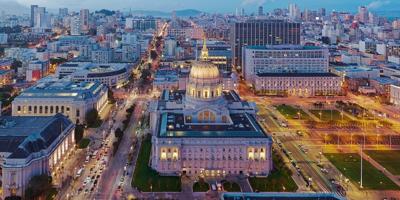


San Francisco City Hall
SAN FRANCISCO - A Muslim man who worked in a San Francisco city customer service call center should get his job back, because the city violated his religious rights when it fired him for refusing to receive a Covid shot in 2021 amid the city's "zeal" to enforce its Covid vaccine worker mandate, a judge has ruled.
On Dec. 18, U.S. District Judge Jeffrey S. White granted an injunction ordering the city and county of San Francisco to reinstate Thaddeus Saleem Shaheed to his city job.
In 2022, Shaheed was among a group of San Francisco city employees who sued the city after he and many others lost their jobs when the city refused to honor their request for religious exemptions from the city's workplace Covid vaccine order.
In his lawsuit, Shaheed said he worked as a customer service representative in the city's 3-1-1 call center, where he provided information and answered questions from city residents about municipal services.
In 2021, the city ordered all of its workers to receive an approved Covid vaccine or lose their jobs. The mandate mirrored similar orders imposed by a host of other government employers in the Bay Area and beyond.
In response, Shaheed and other workers filed for exemptions, claiming receiving such shots would violate their sincerely held religious beliefs.
In Shaheed's case, he claimed the vaccine mandate violated his Islamic faith. Like others, Shaheed asked the city to grant him accommodations, such as working from home and receiving regular Covid tests.
However, according to lawsuits from Shaheed and 124 others, the city government routinely rejected such exemption requests, even after allegedly acknowledging the workers had submitted otherwise valid religious exemption requests.
The city reportedly based that mandate on the belief that Covid shots represented the best way to control the spread of Covid-19 in its workforce.
The plaintiff workers, however, were among potentially hundreds of city workers who objected to the mandate. According to court documents, they contended they should be free to refuse the order because receiving the Covid vaccines would violate their religious beliefs and their conscience.
Further, the workers argued the Covid shots don't even do what the city and other public health professionals claimed, as evidence has shown the treatments only are shown to reduce the severity of individual Covid symptoms, and do not prevent infection or transmission of the coronavirus that causes Covid.
Rather, they argued the city's mandate ignored studies showing that naturally-acquired immunity from past infections presented the same or better protection against future infection and transmission and reduction of symptoms from future bouts of Covid.
So, the plaintiffs further argued the mandate is also arbitrary and unreasonable, as it requires workers to receive a medical treatment as a condition of employment, when the treatment does little to actually accomplish the city's stated goals.
Shaheed and other plaintiffs were represented by attorneys from the Pacific Justice Institute, a nonprofit constitutional rights advocacy group that specializes in religious freedom and parental rights claims.
In Shaheed's lawsuit, they blasted the city for allegedly putting those requesting exemptions through a "religious wringer," saying the city "zealously hunted for heretics and hypocrites among its workforce" to purge out objectors.
In 2022, Judge White rejected their request for an injunction, blasting the plaintiffs for arguing against "scientific consensus" as it stood at the time. He said the city workers had no legal basis to sue, pointing to the U.S. Supreme Court's 1905 decision in Jacobson v Massachusetts. White said that ruling established "well-settled law allowing for compulsory vaccination as a condition of employment."
And the judge scoffed at religious concerns over the Covid shots.
White's ruling, however, was overturned by the U.S. Ninth Circuit Court of Appeals. There, a panel of three judges said they believed the evidence showed San Francisco City Hall never "seriously considered any religious accommodation," potentially in violation of federal civil rights laws, despite the city having the ability to grant such accommodations without any "undue hardship."
And the judges said they believed Judge White improperly also was too quick to reject the workers' religious objections to the Covid shot mandate in finding the workers' loss of jobs and careers from the mandate did not amount to "irreparable harm."
The workers' "coerced decision between their faith and their livelihood imposed emotional damage which cannot now be fully undone," the appellate judges wrote.
When the cases arrived back in White's district court for further proceedings, questions centered on whether the city was required to rehire the workers or otherwise pay damages.
In Shaheed's case, Judge White said the evidence and case record shows he is entitled now, three years after he filed suit, and long after any Covid emergency ended, to get his job back.
Shaheed "has a bona fide religious belief that conflicted with the City’s vaccine policy as evidenced by the City’s determination of sincerity," White wrote.
"Plaintiff (Shaheed) informed his employer of the belief and the conflict by his submission of a request for a religious exemption and accommodation using the forms provided by the City. And it is undisputed that Plaintiff was terminated from his job as a result of the failure to get vaccinated or for the City to accommodate his refusal to vaccinate."
The judge further noted Shaheed's job involved few public in-person interactions, further undermining any claims the city may have asserted to continue to justify his termination.
"Even during the pandemic, there were alternative accommodations available to the City, especially considering that Plaintiff worked as a customer service agent and did not have physical contact with the public," White noted.
And just like the plaintiffs in the case that generated the appellate ruling, "So too here, (Shaheed) has made out a prima facie case for religious discrimination and is likely to succeed on the merits of his claim," White said.