
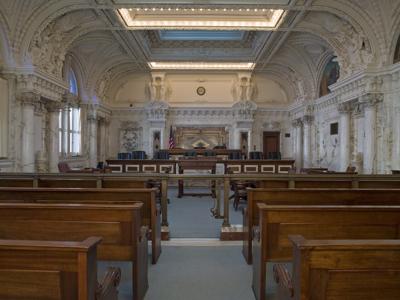


Courtroom One, James R. Browning Federal Courthouse, San Francisco, home of the U.S. Ninth Circuit Court of Appeals
SAN FRANCISCO — In light of a recent U.S. Supreme Court ruling on water jurisdiction, a federal appeals panel has given a Temescal Valley aggregate supplier a new chance to end a long-running lawsuit accusing it of polluting a nearby seasonal stream.
The Clean Water Act litigation pits environmentalist groups Inland Empire Waterkeeper and Orange County Coastkeeper against Corona Clay Company. The activists allege Corona Clay violated stormwater permit requirements related to recycling 20,000 tons of clay each year in proximity to Temescal Creek, which connects Lake Elsinore to the Santa Ana River along 22 miles.
The most recent development is a ruling from the U.S. Ninth Circuit Court of Appeals reframing the dispute in light of a 2023 U.S. Supreme Court opinion, Sackett v. EPA, and how it narrowed the way the Clean Water Act defines “water of the United States” subject to federal regulation.
Judge Danielle Forrest wrote the panel’s opinion, filed Aug. 5 and amended Sept. 3; Judges Jacqueline Nguyen and Lawrence VanDyke concurred.
“The law governing this case has undergone significant change in recent years,” Forrest wrote. “This appeal is the latest installment of what must now feel to the parties — and the district court — like an endless chain novel. Reluctantly, we conclude that the saga requires another chapter.”
The initial trial returned a verdict for Corona. But the Ninth Circuit in 2021 ordered a new trial because it said the Supreme Court — in 2020’s County of Maui v. Hawaii Wildlife Fund — held “indirect discharges are covered by the Clean Water Act if they are the ‘functional equivalent’ of a direct discharge, which was a departure from the prior rule that discharges need only be ‘fairly traceable from the point source.’ ”
On the second trial, under U.S. District Judge David Carter, the plaintiffs prevailed about six months before Sackett was announced. Corona — facing $1.8 million in penalties — then moved to dismiss the complaint by arguing Temescal Creek isn’t a "water of the United States," or to at least convene “a new trial so that the issue of whether the creek is covered by the Clean Water Act could be litigated,” Forrest wrote.
Forrest said the panel agreed a new trial is in order, because the question of how to define the creek is key to the case. The appeals judges agreed issues that aren’t raised before a district court issues a ruling can’t surface later. But they said “we do not expect parties to raise issues that are foreclosed under governing law. And when there is an intervening change in law that renders a previously foreclosed and bypassed issue viable, a new trial may be warranted where the court retains jurisdiction over the case and the issue is raised at the earliest opportunity.”
The panel detailed a decades-long history of establishing which bodies of water are under Clean Water Act protections, including rules from the Environmental Protection Agency and the Army Corps of Engineers, with Sackett ultimately explaining “that ‘waters of the United States’ includes ‘only those relatively permanent, standing or continuously flowing bodies of water forming geographical features that are described in ordinary parlance as streams, oceans, rivers, and lakes.’ ”
Although the Clean Water Act covers two types of permits, only the National Pollutant Discharge Elimination System is relevant to the Temescal Creek dispute. Under that system, private entitles can file civil lawsuits alleging certain violations at least 60 days after notifying the EPA, state government and alleged violator. Inland Empire Waterkeeper first issued an intent to sue notice in 2018 following a period from 2015 through 2017 when, Forrest wrote, “California regulators issued Corona several permit-violation notices, but they did not bring an enforcement action.”
Regardless of whether Temescal Creek is a “water of the United States,” Forrest wrote, Judge Carter had jurisdiction to hear the citizen complaint, explaining the allegation of violating the Clean Water Act is what places the matter in federal court and that “jurisdiction” in this context is one of regulatory authority.
Even through the second trial, Forrest said, the panel understood the legal “question to be ‘whether a seasonally intermittent stream which ultimately empties into a river that is a water of the United States can, itself, be a water of the United States.’ ” But Sackett, she wrote, placed “emphasis on relative permanence and a continuous surface connection to navigable water.”
Therefore, Corona deserves a chance to litigate Temescal Creek’s status as a means of possible avoiding financial penalties, she said.
“We recognize that Corona admitted that Temescal Creek is a water of the United States,” Forrest wrote. “But this admission is different than Corona’s admissions regarding Temescal Creek’s connection to the Santa Ana River. The latter are facts related to the natural world; the former is a legal construct. Facts of the natural world are certainly relevant to the inquiry, but whether a geographic feature is a ‘water of the United States’ is at least a mixed question of law and fact.”
The panel said it doesn’t have enough information to determine how the Clean Water Act defines Temescal Creek in light of Sackett, and so it’s proper to send the matter back to Judge Carter rather than amend his judgment.
Inland Empire Waterkeeper and Orange County Coastkeeper are represented by Environmental Advocates, of Sam Francisco, internal counsel and the Law Office of Jennifer F. Novak, of Rancho Palos Verdes.
Corona Clay is represented by Miller Barondess, of Los Angeles, and the Law Offices of Brian Neach, of Fountain Valley.
