
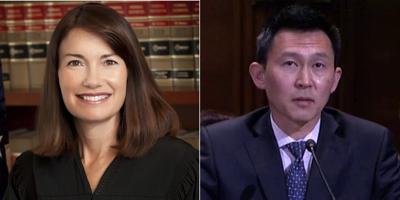



U.S. District Judge Josephine Staton and U.S. Ninth Circuit Court of Appeals Judge Kenneth K. Lee
LOS ANGELES - California's new congressional district map clearly enhances Latino political power, but still isn't an illegal "racial gerrymander," because California's voters approved it and Republicans didn't publicly criticize the plan on any grounds other than being a brazen partisan power grab, two Democrat-appointed federal judges have ruled.
In dissent, a Republican-appointed judge said the majority's reasoning amounts to allowing California Democrats to "smuggle" illegal pro-Latino racial gerrymandered districts past judicial review by falsely claiming the judges must evaluate the will of voters, rather than the intent and statements of those who actually drew the map, in defiance of the U.S. Supreme Court.
The 2-1 ruling was delivered Jan. 14 by a three-judge panel tasked specifically to evaluate California's special mid-decade new congressional district map and weigh a challenge to the map brought by California Republicans and the U.S. Justice Department.
The panel was appointed by the U.S. Ninth Circuit Court of Appeals, which is controlled by judges appointed by Democratic presidents.
The panel included U.S. District Judge Josephine Staton, an appointee of former President Barack Obama; U.S. District Judge Wesley Hsu, who was appointed by former President Joe Biden; and U.S. Ninth Circuit Court of Appeals Judge Kenneth K. Lee, who was appointed during the first term of President Donald Trump.
In the challenges filed by the Golden State Republicans and the Justice Department, the challengers assert Democrats brazenly redrew district lines with the stated intent to specifically increase the number of majority-Hispanic districts or districts in which it would be more likely to elect someone who is Hispanic or Latino to the U.S. House of Representatives, at the expense of Californians who are white, Asian, black or other ethnic or racial groups.
California Gov. Gavin Newsom Newsom and California Democrats launched the gerrymandering initiative in the summer of 2025, saying California Democrats needed to take emergency action to respond to a move by Republicans - and specifically, Republicans in Texas, with the support of President Trump - to redraw the Lone Star State's House districts to favor the election of Republicans in 2026 and reduce the chances of a midterm Democratic takeover of the U.S. House.
However, the new maps required Newsom and Democrats to first secure the approval of California voters at a special referendum. The question was submitted under the title of Proposition 50.
The measure asked voters to essentially amend the state constitution to "temporarily" give Democratic state lawmakers the power to redraw California's congressional districts in the middle of the decade.
Under the state constitution, the duty of redrawing those districts would normally be delegated at the beginning of each new decade to a nonpartisan independent redistricting commission. The commission is required to use criteria other than partisanship to create the state's congressional districts.
California's districts were most recently redrawn in 2020.
Voters approved Prop 50 in a special election at the beginning of November, appearing to clear the way for the map to be approved.
After the vote, California Republicans challenged the law, and were later joined by the Justice Department under Trump. The lawsuits both asserted the gerrymandered maps amounted to illegal racially discriminatory gerrymanders designed to favor Latinos.
While the U.S. Supreme Court has explicitly refused to strike down gerrymanders intended to increase partisan power, the court has indicated it could consider challenges based on accusations district maps are drawn to favor or dilute the political power of certain racial groups.
Plaintiffs noted the man credited with drawing the maps, identified as Paul Mitchell, explicitly and publicly said he and Democrats intended to use the Prop 50 process to create more majority Latino districts.
Those statements were also echoed by Democratic state lawmakers as the maps were advanced in Sacramento.
However, in their ruling, Staton and Hsu said those statements are irrelevant. They said California's constitutional system, which places "the people" and state legislature on equal footing and which required "the people" to approve Prop 50, means the courts must instead evaluate the intent of "the people."
And Staton and Hsu said they believed the evidence indicated "the people" of California intended to approve a map designed to increase the power of Democrats in Washington, D.C..
Thus, while a different three-judge panel struck down Texas' maps for being illegal and discriminatory against black and Latino voters, California's maps should still stand, even if the result are districts drawn specifically to increase the power of Latinos, because California voters signed off on the goal of increasing Democratic representation in Congress.
"... We reject the notion that voters’ intent does not matter. Instead, we employ well-understood tools to determine the voters’ intent in adopting the Proposition 50 Map, and after reviewing the evidence, we conclude that it was exactly as one would think: it was partisan," Staton and Hsu wrote.
"Indeed, the record contains a mountain of statements reflecting the partisan goals of Proposition 50, from which Challengers have culled a molehill of statements showing race consciousness on the part of the mapmaker and certain legislators."
Further, Staton and Hsu repeatedly and sardonically chided Republicans for not mentioning any concerns of racial gerrymandering before the Prop 50 vote. Instead, they noted Republicans campaigned against Prop 50 as a brazen Democratic power grab, without any references to any racial or discriminatory motivations.
They brushed aside arguments that their reasoning will essentially allow California or other states to "launder" equal protection violations against disfavored minorities using similar referendum processes, by asserting such minorities targeted for political oblivion should call it out and speak against it as it is happening, if they wish for their rights to be later respected by the courts.
In dissent, however, Judge Lee blasted his colleagues' reasoning.
He said the majority wrongly uses California's state constitutional structure to sidestep what he said is clear direction from the U.S. Supreme Court concerning how to evaluate such "racial gerrymandering" claims:
To look not at the intent of those who may ultimately approve the map, but at the intent of those who actually drew the map presented for a vote.
And in this case, Lee said, there is ample evidence demonstrating the Mitchell and other Democrats nakedly intended for the map to increase Latino racial political power.
Lee noted Latinos do not lack for political power in California and need no "special protection" in the Golden State.
Lee said instead proof is abundant that California lawmakers and Mitchell drew the maps as they did specifically to shore up Democratic support among Latino voters "as part of a racial spoils system to award a key constituency that may be drifting away from the Democratic party."
Among those pieces of evidence, Lee said, is California's new 13th Congressional District. Like plaintiffs, Lee noted the district was drawn specifically to increase the number of Latino voters in the district. If it had been drawn simply to increase Democratic power, he said, it would have included predominantly white and even more heavily Democratic communities nearby. Instead, the district specifically bypasses those communities to bring in more heavily Latino communities further away.
"To be sure, California’s main goal was to add more Democratic congressional seats. But that larger political gerrymandering plan does not allow California to smuggle in racially gerrymandered seats," Lee wrote. "In other words, a state can create a map with the larger goal of political gerrymandering but still run afoul of the Fourteenth Amendment if it relies on race as a predominant factor in drawing certain districts.
"... We cannot categorically look only at the so-called 'voters’ intent' — to the exclusion of other more probative evidence — in assessing racial gerrymandering claims. The reason is obvious: We cannot discern the intent of 11 million Californians for redrawing a single congressional district when they voted on a statewide referendum that changed all 52 congressional districts," Lee wrote.
Following the ruling, California Republicans said they intend to immediately appeal to the U.S. Supreme Court.
In a statement, California Republican Chairwoman Corrin Rankin said: “The California Republican Party will be seeking an emergency injunction from the Supreme Court of the United States. Although the majority of the three-judge panel did not side with our challenge to the Prop 50 map, we appreciate the thoughtful and timely work of all three judges.
“The well reasoned dissenting opinion better reflects our interpretation of the law and the facts, which we will reassert to the Supreme Court. The map drawer’s plain statements acknowledging that he racially gerrymandered the Proposition 50 maps, which he and the legislature refused to explain or deny, in addition to our experts’ testimony, established that the courts should stop the implementation of the Prop 50 map. We look forward to continuing this fight in the courts."