
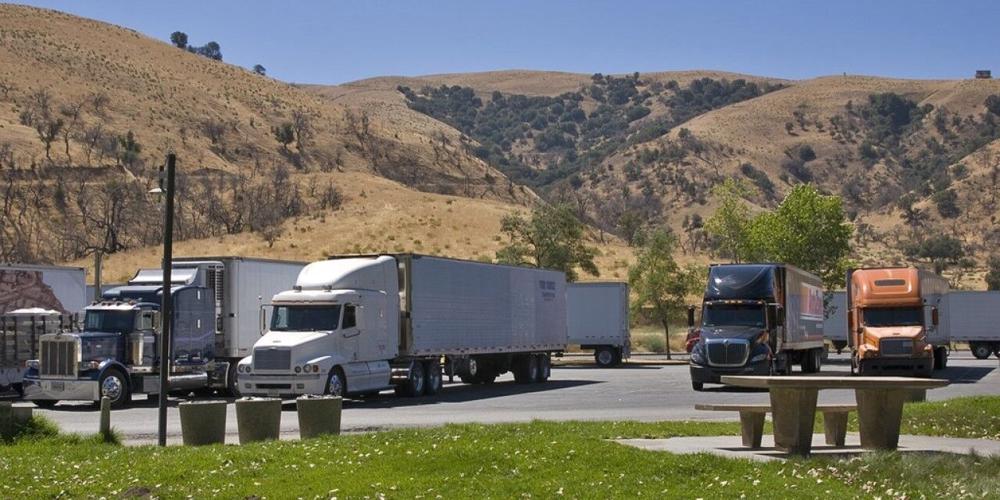



A group of semis at a truck stop in rural California.
OAKLAND - Groups representing immigrant truck drivers - and particularly immigrant truckers of Punjabi Sikh descent - have sued the state of California, asserting the state should be blocked from cancelling about 20,000 CDLs that the state allegedly wrongly issued with expiration dates that extend beyond the expiration of the immigrants' federal authorization to work in the U.S.
The class action lawsuit, filed Dec. 22, asks the court to order the state to instead review and correct the so-called "administrative" or "clerical errors" and ensure immigrant truckers can keep their licenses, despite federal concerns over whether those CDLs were ever properly issued in the first place.
The lawsuit was filed in Alameda County Superior Court by attorneys with the Sikh Coalition, of New York; the Asian Law Caucus, of San Francisco; and the firm of Weil Gotshal & Manges, of Redwood Shores, California.
"The state of California must help these 20,000 drivers because, at the end of the day, the clerical errors threatening their livelihoods are of the CA-DMV’s own making. If the court does not issue a stay, we will see a devastating wave of unemployment that harms individual families, as well as the destabilization of supply chains on which we all rely,” said Munmeeth Kaur, legal director of the Sikh Coalition, in a prepared statement in a release announcing the lawsuit.
Both Kaur and attorney Katherine Zhao, of the Asian Law Caucus, asserted the cancellation of the potentially illegal licenses would amount to "financial devastation" and "economic ruin" inflicted upon the drivers "through no fault of their own."
The lawsuit was filed on behalf of five unidentified "John and Jane Doe" truck drivers, as well as the Jakara Movement, a Fresno-based group that describes itself as "a grassroots community-building organization" dedicated to organizing and advancing the rights and standing of "working-class Punjabi Sikhs" in California and elsewhere in the U.S.
In a statement discussing the lawsuit, the Jakara Movement group said the lawsuit was intended to push back against "Trump's targeting both truckers and their immigration statuses."
"Commercial drivers, especially nondomiciled Sikh and Punjabi drivers, are not an abstract population to us," the Jakara Movement said in a statement posted to their site. "They are our family. They are our members. They sit in our meetings. Their children attend our programs. Their labor holds together supply chains, school districts, transit systems, and entire regional economies.
"When the state moved against them, neutrality was not an option."

Munmeeth Kaur
Following the filing of the lawsuit, California's Department of Motor Vehicles announced on Dec. 30 that it would put off the license cancellations until March 6.
The legal filings come as California state officials move to respond to regulatory actions taken by the U.S. Department of Transportation under the administration of President Donald Trump to crack down on commercial drivers licenses (CDLs) potentially illegally issued to immigrants.
The U.S. DOT under Transportation Secretary Sean Duffy has sought to slam the brakes on the issuance of CDLs to immigrants throughout the country amid a series of high-profile fatal crashes and other traffic incidents involving immigrant truck drivers, including some who government investigators determined cannot read or speak English proficiently enough to understand road signs or basic commands essential to safely operating large commercial vehicles on U.S. roadways.
Duffy's USDOT has particularly zeroed in on the issuance of so-called "non-domiciled CDLs" to non-citizen immigrant truckers.
State departments of motor vehicles are typically empowered by law to evaluate and issue CDLs, the class of drivers licenses which allow drivers to operate semi trucks and other large commercial vehicles.
However, CDL issuing standards and rules are largely set by the USDOT, as commercial trucking implicates interstate commerce, a realm reserved under the U.S. Constitution to the federal government to regulate.
U.S. citizens generally have a right to obtain a CDL, if they pass licensing tests and abide by other rules.
However, states are also authorized to issue CDLs to some immigrants who are not permanent residents of the U.S. under so-called "non-domiciled" classifications. Such non-domiciled CDLs can be issued to applicants who can pass U.S. CDL licensing exams, yet are citizens or legal permanent residents of countries other than the U.S., Canada or Mexico.
According to guidelines, such non-domiciled CDL holders must prove that they are in the U.S. legally, presenting immigration papers, including so-called work authorization documents.
However, the USDOT has reported in recent months that its ongoing audits of non-domiciled CDLs issued by states have revealed that a growing number of states have been issuing such non-domiciled CDLs to illegal recipients.
In response to regulatory pressure from USDOT, the California Department of Motor Vehicles issued notices to at least 20,000 immigrant truckers, saying the state intended to move in early January 2026 to cancel their CDLs because in many cases the expiration date of their CDLs extended beyond the date their legal authorization to work in the U.S. would end.
However, in their lawsuit and in public statements, the primarily Punjabi Sikh drivers claim the state is to blame for the problems with their CDLs, not the drivers themselves. They ask the court to order the state to fix the alleged "clerical errors" that allegedly caused the state to issue the alleged illegal non-domiciled CDLs with the illegally extended expiration date.
The lawsuit remains pending in Alameda County court.
The attorneys representing the Punjabi Sikh drivers thanked California state officials for the decision to put off the cancellation process for at least two more months.
However, that decision came under immediate fire from Duffy, who asserted in statements on social media that California lacks the legal authority and flexibility to forestall the CDL cancellations. Should the state continue to “extend” the process, Duffy threatened to cut off at least $160 million in federal transportation funds to the Golden State.
“The deadline to revoke illegally issued, unvetted foreign trucker licenses is still January 5,” Duffy said. “California does NOT have an ‘extension’ to keep breaking the law and putting Americans at risk on the roads.”

