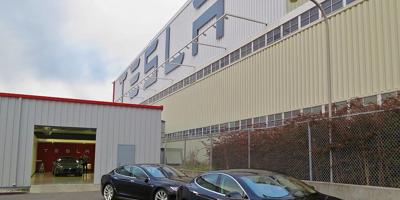


Tesla factory, Fremont, California
SAN JOSE — A California appeals court won't let a mom who was hit by her own Tesla after it was somehow activated and put in motion by her toddler child, can't sue the electric car maker over her injuries.
A three-justice panel of the California Sixth District Court of Appeal sided with Tesla in the lawsuit lodged by plaintiff Mallory Harcourt.
In the decision, the appeals panel specifically said Harcourt's lawsuit fails because it can't pass the so-called "consumer expectations test." Essentially, the justices said Tesla can't be held liable for the woman's injuries, because the car did not malfunction and the incident did not reveal any defects in the design, despite Harcourt's injuries.
"... Harcourt asserts that 'American consumers have . . . a reasonable expectation that two-year-old children will not be able to inadvertently operate ordinary passenger vehicles.' That may be true. However, it does not follow that the consumer expectations test applies here," the justices wrote in the decision.
"... Harcourt has not persuaded us that the everyday experience of consumes creates any safety assumptions concerning the sort of misuse involved in this case."
The case generated headlines when it was filed in Santa Clara County Superior Court in 2019 by attorneys Don Slavik, of Slavik Law, and Elise Sanguinetti, of Arias Sanguinetti.
According to court documents, Harcourt was injured by the vehicle in 2018, when she was pinned against her garage by her Tesla Model X SUV.
According to court documents, Harcourt, who was eight months pregnant at the time, had purchased the vehicle four days before the accident. On Dec. 23, 2018, she parked the vehicle in her home's driveway, but left her key fob in the car. According to the documents, she took her two-year-old son out of the car and started walking with him toward their house.
Before going inside, she realized she had left her purse containing the key fob in the car, and returned with the child to the car.
Then, she reportedly realized the child needed a diaper change, and opened a rear door to grab the diaper bag and then opened the driver's door to open her garage door.
She then reportedly walked with the child toward the garage, to change his diaper in the garage.
However, as she was setting up the changing pad, she suddenly realized the child was not with her, and simultaneously that her car was moving towards he. She reportedly stood in front of the vehicle attempting to make the vehicle detect her in its path and stop.
Instead, the vehicle hit her and pushed her until it pinned her against a wall.
According to court documents, she then saw her son "pop up inside the Model X."
According to court documents, she suffered broken bones in her legs and pelvis, among other injuries. Her unborn child, however, was unharmed and was delivered via induction a week later.
According to court documents, the vehicle's computer logs indicated her toddler son had somehow climbed into the driver's compartment, "pressed the brake pedal, ... shifted the car into drive by simultaneously pressing the brake pedal and moving the gear selector stalk on the side of the steering column, released the brake pedal, and pressed the accelerator pedal."
According to the court documents, the logs showed the vehicle accelerated to no more than 8.5 miles per hour, slowed, and reaccelerated, slowed and reaccelerated before colliding with Harcourt at about 6-7 mph.
The car auto shifted to park after pinning Harcourt against the garage wall, according to court documents.
In Harcourt's lawsuit, she asserted Tesla should pay, because they allegedly should have included more safety features to prevent a toddler from activating the car and putting into drive mode.
In the decision, the appellate panel noted Harcourt had testified at trial that she did not believe leaving key fob in the car would be "dangerous;" that she did not read the owner's manual, and was not aware of so-called PIN to drive feature, which requires a driver to input a personal identification number (PIN) to activate the vehicle; and that her son had received as a Christmas gift a "ride-in Audi toy that a child could drive while a parent walked alongside which included an on/off switch, a steering wheel, and a single pedal to accelerate."
However, at trial, a Santa Clara Superior Court judge ruled Harcourt could not continue with her lawsuit, because her claims concerning the Tesla vehicle did not meet the requirements of the consumer expectations test.
The trial court judge said Harcourt failed to identify specific defect in the car and could not show that her injuries resulted from a "failure of a particular and identifiable component" or "the failure of a system."
It is not enough to simply state Tesla should pay because the vehicle "failed to prevent a young child from starting it, putting in gear, and moving it."
The appellate panel agreed, saying Harcourt did not offer any "persuasive reason to conclude that ordinary consumers share any minimum safety assumptions about the misuse of cars by toddlers..."
"This case does not resemble any case in which the consumer expectations test previously has been held or said to apply," the justices said.
"... Instead, this case involves a misuse and an unusual one at that. A key fob was left in a car with an open door, a toddler entered, and the child unexpectedly performed the multiple steps — pressing on the brake, shifting the car into gear while pressing on the brake, and then releasing the brake and depressing the accelerator pedal — needed to move the vehicle.
"As a consequence, this case does not involve a situation within the common experience of ordinary consumers."
The decision was originally issued as an unpublished order on March 4. The Sixth District court then published the ruling as an opinion on April 1.
The decision was authored by Justice Daniel H. Bromberg. Justices Mary J. Greenwood and Allison M. Danner concurred in the ruling.