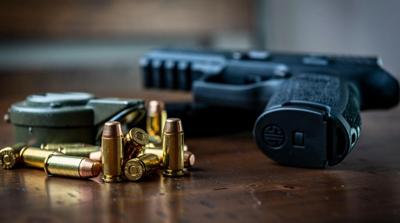


A handgun and ammunition sit on a wooden table.
PHILADELPHIA - An El Salvadorean citizen living in D.C. can be charged with illegal possession of a firearm under an ancient English principle allowing the disarming of people with loyalty to another government, a federal appeals court ruled, though it left unclear when, if ever, the phrase “the people” in the Second Amendment applies to resident aliens in the U.S.
The decision issued Sept. 1 by the Third Circuit Court of Appeals concerned Diego Edgardo Aleman-Lozano, who was pulled over in Pennsylvania for a traffic violation in 2021 and the state trooper noticed a rifle cartridge on the passenger seat. Aleman-Lozano had entered the U.S. illegally in 2017 but later obtained a nonimmigrant visa and work authorization as well as a Washington, D.C., motor vehicle license.
The trooper obtained a search warrant and found a pistol with a loaded 16-round magazine. The gun had no serial number and Aleman-Lozano said he bought it from an unidentified person in Maryland.
Aleman-Lozano was indicted for violating a federal law prohibiting most people in the U.S. under a nonimmigrant visa from possessing a firearm or ammunition. He challenged the indictment under the Second Amendment, which says “the right of the people to keep and bear Arms, shall not be infringed.”
The central question facing the Third Circuit was whether nonimmigrant visa holders are among “the people” in the Second Amendment. The Supreme Court has described “the people” as “citizens,” “law-abiding citizens,” “all Americans” and “all members of the political community.” The First and Fourth amendments in some cases apply “the people” to aliens regardless of their legal status.
The Third Circuit declined to decide the question but said the phrase “casts a wide net” and may include “at least some noncitizens.” But it doesn’t apply to Aleman-Lozano in this case, wrote Judge Patty Schwartz.
Applying the now-standard analysis to the Second Amendment, Judge Schwartz said there is ample evidence that it didn’t apply to non-citizens loyal to another government at the time the amendment was written. The English Bill of Rights also limited gun ownership to those loyal to the Crown – which included Protestants, not Catholics. (Some U.S. colonies also had laws disarming Catholics that “would be unlawful under the First Amendment today,” the court noted.)
“From English common law through the Revolutionary period around the time of ratification, there was a historical tradition of disarming those considered disloyal to the sovereign,” she wrote. Viewed through that lens, the federal law prohibiting noncitizens from possessing weapons can be applied against Aleman-Lozano, she concluded.
Judge Peter J. Phipps concurred in the judgment but criticized the majority for making “a needless assumption, the breadth of which is staggering,” that all nonimmigrant visa holders are part of “the people” with full Second Amendment rights. Under a two-step process established by the U.S. Supreme Court in its landmark N.Y. State Rifle & Pistol Assoc. v. Bruen decision in 2022, courts must first ask whether the Second Amendment even applies to a gun law. Only then can the court ask if enforcement was constitutional.
Aleman-Lozano is a foreign citizen outside the definition of “the People” in the Second Amendment and didn’t qualify for the narrow exceptions to the federal gun law, such as a licensed hunter vacationing in the U.S., Judge Phipps wrote. There was no need to proceed to the second step of the Bruen analysis because the Second Amendment simply doesn’t apply, he said.