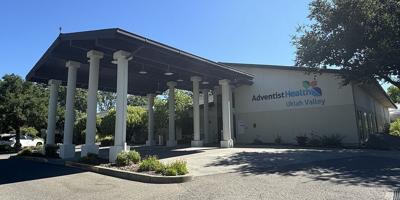


Adventist Health Ukiah Valley, California
PASADENA — Adventist Health will be allowed to resume its legal claims against some of America's biggest pharmaceutical makers, ostensibly on behalf of the federal government, for allegedly overcharging so-called safety net hospitals and other low-income health care providers, allegedly making Medicare and Medicaid pay hundreds of millions of dollars more than they should have.
On March 17, a three-judge panel of the U.S. Ninth Circuit Court of Appeals ruled a federal judge should not have tossed Adventist's lawsuit.
In the ruling, the appeals judges said the lower court was wrong to determine that Adventist had improperly attempted to ostensibly press fraud claims on behalf of the federal government as a way of sidestepping the law governing the federal 340B Drug Pricing Program that would otherwise prohibit them from suing the drug makers directly for the alleged overcharges.
Adventist Health System of West had filed suit in 2021 in Los Angeles federal court against a collection of pharmaceutical maker defendants, including Abbvie, Allergan, Astrazeneca, Novartis, Sandoz Group, Genzyme and Sanofi, and related companies.
Roseville-based Adventist Health West operates 27 hospitals, as well as hundreds of other clinics and other health care facilities, in California, Oregon, Washington and Hawaii.
The lawsuit did not target the drug makers directly on behalf of Adventist. Rather, Adventist brought the action as a so-called qui tam action under the federal False Claims Act. In such an action, a plaintiff, known as a "relator," files suit on behalf of the federal government, pressing claims of fraud against defendants. In the action, the plaintiff-relator seeks to recover money allegedly not paid to the government or allegedly paid out by the government as a result of alleged fraud.
Qui tam relator plaintiffs are then typically entitled to a cut of whatever sums may be ultimately recovered by the government through their lawsuit.
In this case, Adventist claimed the drug makers had overcharged by hundreds of millions of dollars for medications which were allegedly supposed to be sharply discounted under the U.S. Department of Health and Human Services' 340B Drug Discount Program.
The program was established and is governed by federal law, with the goal of ensuring hospitals and health care facilities serving low-income populations covered by Medicare and Medicaid maintain access to low cost medications.
The Adventist West system is considered a 340B "covered entity."
In Los Angeles federal district court, however, U.S. District Judge Dale S. Fischer tossed the legal action. In the March 2024 ruling, Fischer said the lawsuit should not be allowed to continue, because it essentially amounted to an attempt by Adventist to use the False Claims Act qui tam process as an end-run around court decisions which declared Section 340B doesn't include a so-called "right of private action," and thus prohibits health care providers from suing pharmaceutical companies directly for allegedly violating the 340B Program rules.
On appeal, however, the Ninth Circuit judges said Adventist's case should be revived.
The Ninth Circuit ruling was authored by Judge Roopali H. Desai, with judges Consuelo M. Callahan and Ana de Alba concurring.
In that ruling, Desai and her colleagues said they believed the lower court incorrectly determined that Section 340B's lack of a right of private action should thwart actions brought under the False Claims Act, if the FCA qui tam action concerns alleged 340B drug pricing violations.
They said both laws should be read to have full effect, with neither superseding the other.
"... Precluding Adventist’s FCA claims would also require us to find that Section 340B 'impliedly preempts the FCA,'" Desai wrote in the appellate opinion.
"... Congress enacted the FCA to 'enlist the aid of' private relators 'in combatting the rising problem of sophisticated and widespread fraud' resulting in financial loss to the government.
"It would contravene Congress’s intent to bar private relators like Adventist from bringing suit under the FCA simply because another statute, Section 340B, lacks a private right of action," Desai wrote.
Adventist is represented in the action by attorneys with the firms of Baron & Budd, of Washington, D.C.; Walden Macht Haran & Williams, of Philadelphia; and Powers Pyles Sutter & Verville, of Washington, D.C.
The pharamceutical companies are represented by attorneys with the firms of King & Spalding, of Atlanta, Los Angeles and Washington, D.C.; Arnold & Porter Kaye Scholer, of Los Angeles, New York and Washington, D.C.; Hogan Lovells US, of Los Angeles and Washington, D.C.; and Ropes and Gray, of Los Angeles, Boston and Chicago.