
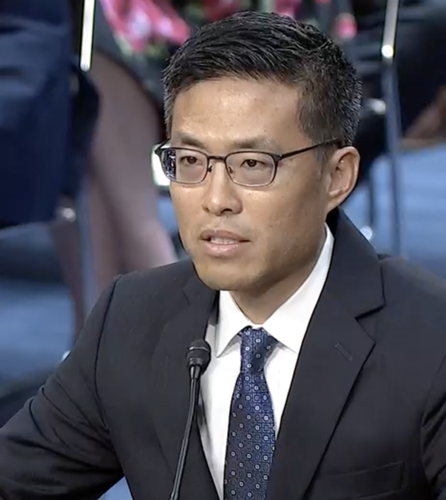


U.S. Ninth Circuit Court of Appeals Judge Eric Tung
PASADENA — A federal appeals court says a San Diego federal court judge was wrong to deny arbitration in wage claims against one of the largest travel nursing companies, by choosing to accept only the two of four arbitrator decisions that supported allowing the claims to proceed as a class action lawsuit in court.
On April 1, a three-judge panel of the U.S. Ninth Circuit Court of Appeals sided with San Diego-based Aya Healthcare Services in its defense against an attempted class action lawsuit.
The decision overturned the ruling from U.S. District Judge Cathy Ann Bencivengo. In the ruling, the appeals panel said Bencivengo violated the Federal Arbitration Act by setting aside two arbitrators' decisions in deciding employee arbitration agreements aren't valid and the claims of a group of nurses should be allowed to proceed as a class action lawsuit.
"... The district court picked the two arbitral awards invalidating the agreements—and not the two awards upholding the agreements—to preclude the arbitration of disputes with respect to 255 other employees who had separate arbitration agreements with the agency. In other words, because two arbitrators had already found the agreements to be invalid, the remaining hundreds of agreements were deemed invalid too, rendering separate arbitrations unnecessary," the appeals judges wrote.
"The district court’s approach was erroneous."
The decision comes as the latest step in a court fight that landed in San Diego federal court in 2022.
At that time, attorneys with the firms of Stueve Siegel Hanson, of Kansas City, Missouri; and Hartley LLP, of San Diego, filed the potential class action lawsuit against Aya on behalf of named plaintiffs Laura O'Dell, Holly Zimmerman, Lauren Miller and Hannah Bailey, as well as potentially hundreds of others.
According to court documents, the plaintiffs worked for Aya, one of the largest companies speciailizing in connecting traveling nurses with work opportunities at local hospitals.
According to court documents, the plaintiffs accused Aya of allegedly violating California state and federal wage and labor laws by allegedly illegally reducing their pay mid-contract.
In response to the lawsuit, Aya sought instead to force the plaintiffs to have their claims heard individually by arbitrators, rather than judges in court.
According to court documents, all Aya nurses and clinical support staff are required to sign an agreement as a condition of employment to resolve employment-related disputes through arbitration, rather than as a lawsuit in court.
Should the parties disagree over whether the arbitration provision can apply, that dispute, also, should be heard by arbitrators, court documents said.
Judge Roger Benitez, who was initially assigned to the case, granted that motion, and sent the four named plaintiffs' claims to arbitration, to determine if the cases could proceed in arbitration or as the class action sought by the plaintiffs.
The four arbitration hearings, however, resulted in split decisions: Two arbitrators backed the plaintiffs, while two others sided with Aya.
While those arbitration-related proceedings continued, 255 additional plaintiffs had joined the case. Aya argued all of those plaintiffs also needed to take their claims to arbitration.

U.S. District Judge Cathy Ann Bencivengo
However, Judge Bencivengo, who replaced Benitez on the case, denied Aya's request related to the hundreds of other cases and declared the arbitration agreements to be invalid.
In that decision, Bencivengo, acting on her own and without a motion from either party, declared that a legal doctrine, known as "non-mutual offensive collateral estoppel," meant the arbitration agreements could not be enforced and the claims could proceed as a class action.
However, in that ruling, Bencivengo chose only to rely on the two arbitrators' decisions that supported her conclusion, asserting the other two arbitrators' rulings could be thrown out because they "were not as 'reasoned' or 'thorough.'”
On appeal, the Ninth Circuit judges said it was Bencivengo's decision that should be tossed out.
The appellate decision was authored by Ninth Circuit Judge Eric Tung. Judges Richard C. Tallman and Lawrence VanDyke concurred in the ruling.
In the appellate ruling, Tung noted Bencivengo's ruling misapplies that doctrine and violates the Federal Arbitration Act and its stated intent to end "judicial hostility to arbitration."
Tung said Bencivengo's ruling amounts to another in a growing list of "new devices" deployed by plaintiffs' lawyers and judges seeking to sidestep the federal law.
"The point is this: nowhere in this scheme—from the beginning of arbitration to its end—did Congress contemplate that a non-mutual preclusion doctrine could be deployed to frustrate an arbitration that the parties had agreed to undertake in resolving their disputes," Tung wrote.
Further, the judges said, Bencivengo's ruling improperly sought to use the arbitrators' decisions as a kind of representative sample "akin to a bellwhether class action" to determine the viability of all other claims in the case, a process "to which the parties never agreed."
"... Under the district court’s logic, just one arbitration proceeding would be enough to preclude hundreds (or thousands) of other arbitration proceedings," Tung wrote. "That is no ordinary class action.
"That is a class action stripped of all its important protective features. And whereas bellwether actions are generally not binding unless the parties agree to that effect in advance, under the district court’s approach, the results of one arbitration proceeding would be binding on the rest. In sum, its approach would supplant arbitrations with binding bellwether class actions lacking the procedural safeguards of ordinary class actions.
"The FAA (Federal Arbitration Act) does not allow that."
Aya has been represented by attorneys from the firms of McDermott Will & Schulte, of Washington, D.C.; Gordon Rees Scully Mansukhani, of Irvine and Chicago; and Robinson Markevitch & Parker, of Los Gatos.
The U.S. Chamber of Commerce filed a brief in support of Aya.