
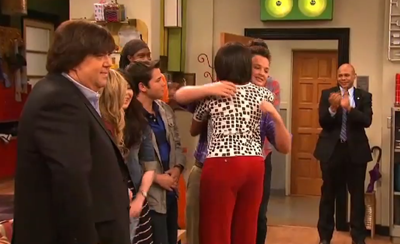



Nickelodeon TV producer Dan Schneider, left, on set with the cast of television show, “iCarly.”
LOS ANGELES — A state appeals panel has tossed a defamation suit from Nickelodeon executive Dan Schneider in connection with allegations that surfaced in a documentary about minors who worked on several television shows, which he said indirectly accused him of child sexual abuse.
Schneider sued Warner Brothers Discovery, Maxine Productions, Sony Productions and, as individuals, Mary Robertson and Emma Schwartz, for the writing, direction, production and editing of “Quiet on Set: The Dark Side of Kids TV,” a 2024 five-part series focused on the off-camera environments on some of Schneider’s shows. According to court records, those titles include “All That,” “The Amanda Show,” “Drake & Josh,” “iCarly” and others.
In his complaint, Schneider alleged “the voiceovers and graphics in ‘Quiet on Set’ and its trailer, juxtaposed or edited with the visual depictions, are purposefully and intentionally defamatory in that they falsely and repeatedly state or imply that Schneider is a child sexual abuser and committed crimes in this regard.”
The defendants tried to end the lawsuit by invoking California’s law that combats strategic lawsuits against public policy, but Los Angeles County Superior Court Judge Ashfaq Chowdhury denied that request. They challenged that ruling before the California Second District Appellate Court.
Los Angeles Superior Court Judge Melanie Ochoa, sitting by designation, wrote the panel’s opinion, filed Sept. 10; Justices Rashida Adams and Mark Hanasono concurred.
Before Judge Chowdhury, Schneider didn’t challenge the issue of anti-SLAPP protections but instead claims he was likely to succeed at trial, detailing specific moments from the trailer and series he found implicitly defamatory and asserting the evidence would show actual malice in defendants’ production choices.
To support that position, Schneider supplied a report from John Vaccaro, a partner at the public relations firm where Schneider is a client. That declaration, according to Ochoa, “included copies of public posts found on various online platforms, including comments posted on the YouTube.com comment section of the trailer” as well as comments from an “apology video” Schneider posted to his own Facebook page in response to the first four episodes.
Judge Chowdhury overruled the defendants’ evidentiary objections and ultimately found Schneider’s lawsuit wasn’t baseless or frivolous. The judge said Schneider argued “persuasively that defamation can be implied … and how the ordinary viewer understands the trailer and documentary to be defamatory.”
Ochoa said Chowdhury found — and Schneider didn’t challenge — that the footage is the type of speech the anti-SLAPP law protects. The panel agreed that fact is undisputed. However, Ochoa continued, “Schneider’s complaint does not allege that any specific factual statement regarding him in ‘Quiet on Set’ is false.” While noting California law recognizes the concept of implied defamation, the panel said the factual question on appeal is quite narrow.
“Defendants do not argue that characterization as a child sexual predator is not defamatory,” Ochoa wrote. “Nor do the parties dispute whether this characterization is ‘substantially true.’ Schneider denies engaging in such conduct and, while defendants stand by allegations of other forms of bad behavior made in ‘Quiet on Set,’ they do not advance the argument that child sexual abuse is a substantially true description of Schneider’s conduct. Additionally, Defendants do not argue that characterizing Schneider as someone who has sexually abused children is merely a matter of opinion and not a fact capable of being disproven. Thus, the only element of Schneider’s defamation by implication claim that is disputed by defendants is whether their work is reasonably subject to the meaning Schneider contends.”
Before addressing Schneider’s ability to show he might succeed at trial, the panel first noted its agreement with defendants that the social media posts included in Vaccaro’s declaration shouldn’t have been entered as evidence.
“These postings were made on various platforms, under individuals’ handles, some of which appear to be a first and last name, while others we must hope are pseudonyms, such as ‘MrAverageViewer,’ ‘kermittthefrog2311’ and “Cowbells,’ ” Ochoa wrote. “He seeks to introduce these statements as evidence that “viewers understood defendants’ statements or implications … to mean that Schneider in fact committed crimes of child sexual abuse.’ ”
What is relevant, the panel said, is how a judge or jury views the entire context of the litigation, not third-party posts. Ochoa also said the courts must look at the entirety of a piece like “Quiet on Set,” but noted the trailer was distributed about five weeks before the full five-part series, which was available on limited platforms compared to the more widely available preview.
“Moreover, the purpose of a trailer is to advertise a film and is intended to reach a broader audience than those who will ultimately elect to watch the film in its entirety,” Ochoa wrote. “Many of those who view the trailer may therefore have no interest in viewing the three-plus hour documentary, and the context provided by the entire work cannot be imputed to the viewers of the trailer.”
The panel then examined Schneider’s specific contentions about the trailer as well as all five episodes, explaining in certain circumstances where it disagreed with his framing.
“Schneider’s description of this segment does not exactly correspond with what is displayed in the episode,” Ochoa wrote, referencing six minutes in the second installment focused on a man named Jason Handy, who has been convicted of felony sex crimes with child victims. “Schneider is not mentioned at any time during this six-minute segment.”
Regarding the third episode, Ochoa wroteL “Schneider does not specifically identify any portion of this episode as allegedly defamatory; however, this episode provides additional relevant context for the allegedly defamatory elements. This episode focuses on the sexual abuse experienced by a single former child actor that had not been disclosed publicly, as well as the institutional response on set. The perpetrator of this abuse, Brian Peck, is specifically identified by name and shown in accompanying images. Schneider is mentioned at various points in this episode, including statements from the abuse survivor that he was ‘the only official at Nickelodeon who stood by (the victim) at this time.’ ”
Those and other examples pointed the panel to say it couldn’t “credit Schneider’s description as evidence that could prevail at trial” to defeat the ani-SLAPP motion.
“Schneider’s description does differ in ways that directly affect the totality of the circumstances analysis," the judges wrote in the appellate decision. "For instance, while Schneider contends that, by the end of the trailer ‘only Schneider’s name and likeness (were) offered,’ this is not an accurate statement of what the trailer shows. Rather, by one minute and 13 seconds into the trailer, it displays a photo of three men, with the voiceover: ‘These are three predators who worked at Nickelodeon, all in a short amount of time.’ And, contrary to Schneider’s description, Peck’s name is displayed onscreen, highlighted on what appears to be a legal document, as the abusive conduct is described. Schneider, on the contrary, is not mentioned at all in the trailer after it segues into a discussion of child abuse.”
After determining the trailer alone doesn’t “reasonably permit the implication Schneider sexually abused children,” the panel said the full documentary also wouldn’t lead a reasonable viewer to consider Schneider a child sexual predator.
“The limited question for this court is not whether the defendants’ work states or implies that Schneider was a bad boss, created a toxic workplace, produced age-inappropriate scripts, or even engaged in inappropriate sexual conduct with adult employees; it is whether the documentary is reasonably subject to the interpretation that Schneider sexually abused children,” Ochoa wrote. “The documentary clearly distinguishes between the lamentable conduct that its participants attribute to Schneider — gender discrimination, harassment, toxic workplace behavior and inappropriate sexual innuendo — and the child sexual abuse explicitly attributed to three named individuals, two of whom are discussed at length.”
The panel reversed the superior court ruling and remanded the complaint with an order to grant the motion to strike the complaint. It also said the defendants are entitled to the legal costs of their appeal.
The defendants are represented by attorneys from the firms of Greenberg Traurig, Foley Hoag and Gibson Dunn & Crutcher.
Schneider is represented by attorneys from the firms of Moser Legal and Sullivan & Worcester.
The Reporters Committee for Freedom of the Press and the International Documentary Association filed support briefs for WB.
