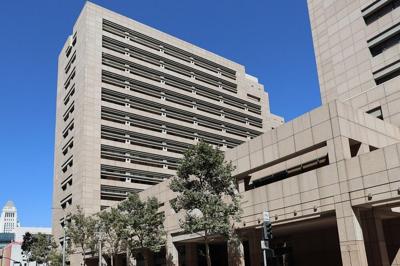


Ronald Reagan State Building, home of the California Second District Court of Appeal, Los Angeles
LOS ANGELES —A state appeals panel has said Kaiser Foundation Health Plan isn’t entitled to a new trial and agreed a jury correctly awarded $66 million to a hospital that alleged it was underpaid for providing emergency services to plan members.
The root issue is more than 4,000 emergency care claims Pomona Valley Hospital Medical Center processed for Kaiser plan members from October 2017 through March 2020. The start date coincides with Kaiser’s decision to terminate a 2004 contract it had with the hospital in favor of paying what it determined to be the reasonable value of services rendered. For the period in question, Kaiser reimbursed the hospital about $39.8 million while the hospital had billed $136.6 million
The hospital sought reimbursement through a Los Angeles County Superior Court lawsuit in November 2017. A jury ultimately ruled in its favor following a January 2023 trial, but Judge Lynette Winston later granted Kaiser’s motion for a new trial, finding the 2004 contract shouldn’t have been allowed as evidence. Winston entered a conditional order allowing the hospital to accept about $8 million in lieu of a new trial.
After the hospital accepted that deal, Kaiser took the issue to the California Second District Appellate Court on four main arguments: that the new trial was appropriate but offering reduced damages was improper because the admission of the contract as evidence affected liability as well as damages; that the trial should’ve include evidence about the hospital’s overall operating costs; that the hospital’s expert testimony was improper; and that the prejudgment interest rate should be 7%, not 10%.
The hospital then cross-appealed, but with only one contention: the 2004 contract was properly included in the original trial and therefore Judge Winston should’ve denied the motion for a new trial.
Justice Elwood Lui wrote the panel’s opinion, filed Feb. 27 and certified for publication on March 12; Justices Anne Richardson and Arthur Gilbert concurred. Gilbert, who retired from the appellate court in early 2026, was assigned to the panel.
According to court records, the 2004 contract stipulated Kaiser would reimburse Pomona Valley Hospital 86% of charges billed to Kaiser plan members. It further barred the hospital from attempting to collect the remaining 14% directly from patients. Kaiser gave the required notice it was terminating the contract, and Lui said during the trial a company representative testified “Kaiser’s intent was to try to renegotiate the contract but that the parties could not come to an agreement on rates. In the months following the termination notice, and without a new contract in place, Kaiser informed Pomona Valley Hospital that it would reimburse 29% of billed charges for emergency services claims.”
During the trial, hospital expert Chris Fritz said the fair market value of the services was 77.5% of the billed charges, not quite $106 million. Lui said Fritz reached that percentage considering six negotiated emergency services rates, which included the 2004 contract, rates Kaiser paid to other hospitals and rates Pomona collected from other large commercial health plans.
But Fritz, Lui wrote, “did not use the actual rate paid under the in-network contracts because he considered the rate to be artificially low for calculating reasonable value in this case. This was due to the large health plans’ role in ‘steerage’ of patients to non-emergency elective services at the hospital. According to Fritz, steerage increases non-emergency patient volume and benefits the hospital financially and logistically.”
Kaiser plan members would generally use Kaiser hospitals except for emergency needs, so Pomona Valley doesn’t benefit from referring emergency patients to non-emergency services. So Fritz used a multiplier in order to make such claims “more comparable to the out-of-network claims that are at issue in this dispute.”
Kaiser expert Mark Gustafson said the $39.8 million already exceeded fair market value because, Lui wrote, “contracted commercial insurers would have reimbursed an average of 26.3% of the total billed charges at issue, while Kaiser itself reimbursed approximately 29%.” Gustafson further said the 2004 contract involved amounts increasing at faster rates than general hospital services and claimed Pomona Valley charges more than about 80% of nearby hospitals.
The jury determined the hospital correctly showed the fair market value for the claims was about $105.8 million, and since Kaiser had already paid almost $39.8 million it awarded the difference of more than $66 million.
Regarding the propriety of the 2004 contract, Lui said Kaiser argued before the trial that the contract itself contained language clarifying both it and the hospital agreed the payment rate “was not relevant and not admissible as evidence of reasonable value, and that the contract was not probative of reasonable value due to changes in the law since the time of its execution, including that balance billing had since been outlawed.”
But the appellate panel agreed with the logic under which that pretrial motion failed and further said Judge Winston “improperly disregarded the procedural context in which the motion in limine was decided, as well as later events relevant to the determination.” Lui noted Kaiser’s appeal doesn’t challenge the relevance of the contract and the 86% reimbursement rate, only that it contains a section precluding its use as evidence.
In conditionally granting a new trial, Lui continued, Winston didn’t “give due consideration” to another Kaiser pretrial motion to “preclude evidence of its ‘reimbursement methodology’ ” as a matter of normal business in favor of the type of calculations required in a reimbursement claim in a civil court proceeding. That position, Lui said, functionally “supports the trial court’s initial order denying the first motion” and so now, with the trial ended, “Kaiser cannot fault the trial court for effectively adopting its position.”
The panel said Kaiser took other positions at trial and before requesting a new trial affirming the distinction between the two approaches to valuation, such as requested jury instructions. It further said that although Kaiser failed to show the denial of its initial motion was erroneous, “the trial court’s initial interpretation of the contractual clause was superior.”
Lui said the contested provisions “is hardly a model of clarity” and noted Kaiser had no evidence supporting its claim that it agreed to the 86% reimbursement rate understanding it was a high figure and concerned about it being used in subsequent litigation. He said “an equally viable conjecture is that the parties agreed to this poorly drafted provision with little if any consideration of its ultimate effect,” and later wrote “it is not this court’s role to guess what limited circumstances the parties may have had in mind when agreeing to the exclusionary language.”
Because the panel found the “best interpretation” of the challenged provision is that it doesn’t apply to the type of valuation calculation required in the hospital’s claim, the contract was correctly allowed as evidence and Judge Winston was wrong to use its inclusion as grounds for ordering a new trial.
The panel also found trial court rulings regarding what evidence the jury could hear about the hospital’s costs did not compel reversal of the verdict. They determined if there was any error Kaiser failed to show the probability of a better outcome, and also that its challenge to Fritz’s testimony was rightly denied, especially since Kaiser “availed itself” of the opportunity to cross-examine Fritz, challenging his methodology and having its own expert, Gustafson, say Fritz’s math “doesn’t pass the smell test.”
Finally, the panel agreed with Kaiser that pretrial interest awarded to the hospital should’ve been figured at 7% instead of 10%. The higher rate would’ve been proper had the hospital’s litigation asserted breach of contract, Lui explained, and the panel said the cases it cited to argue for the 10% figure weren’t convincing.
The panel reversed the April 2024 order conditionally granting a new trial, vacated a May 2024 amended judgement and remanded the case to the trial court with instructions to enter a judgment that is consistent with the jury’s verdict and the initial January 2024 judgment with the exception of the 7% interest figure.
The hospital, which is entitled to recover the costs of its appeal, was represented by King & Spalding.
Kaiser was represented by the firms of Reed Smith and Kellogg, Hansen, Todd, Figel & Frederick.