
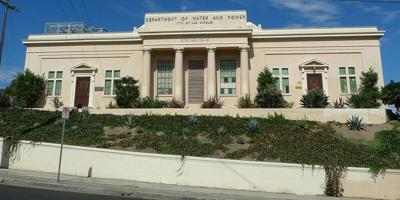



L.A. Department of Water and Power Pumping Station No. 2
LOS ANGELES - A state appeals panel has agreed California’s constitution doesn’t prevent the Los Angeles Department of Water and Power from implementing tiered rates based on usage, but also said the city can’t make its water customers fund a special subsidy for low-income accounts.
The underlying issue dates to March 2016 when the LA City Council passed a new water rate ordinance. In August 2018, Stephen and Melinda Dreher initiated a class claim with the city, and in March 2019 filed a complaint in state court for damages and challenging the rates on behalf of themselves and other customers. In addition to the low income subsidy, the Drehers claimed the tiered rate structure exceeded “the proportional cost of the service attributable” to each customer’s land parcel.
Los Angeles County Superior Court Judge Mary Strobel ordered the city to stop including the subsidy charge — which generated $25.9 million in its first year — but said the Drehers weren’t entitled to refunds on charges they paid before the ruling because they didn’t pay under protest. Strobel also ruled the tiered rates otherwise complied with state law.
The Drehers challenged that ruling before the California Second District Appellate Court. Justice Michelle Kim wrote the panel’s opinion, filed Dec. 8; Justices Gregory Weingart and Rashida Adams concurred.
On appeal, the Drehers insisted the state law mandating formal protest of certain payments in order to preserve the potential for a refund applies only to sanitation and sewage, including water standby fees, but isn’t applicable to water delivery charges. The panel agreed no published decision counters the Drehers’ position, but also said there aren’t any cases where a plaintiff sued a city or county, challenging delivery charges in this specific manner.
The relevant “payment under protest requirement applies to ‘fees, rates, tolls, rentals or other charges … fixed pursuant to this article,’ ” Kim wrote, adding the law makes it clear those “include ‘fees, tolls, rates, rentals or other charges for services and facilities furnished by’ the entity ‘in connection with its water, sanitation, storm drainage or sewerage system,’ that are enacted by an ordinance or resolution ‘approved by a two-thirds vote of the members of the legislative body’ of the entity.”
The panel further said it didn’t find, nor did the Drehers describe, any “inherent incongruity between water service on the one hand, and sanitation and sewerage systems on the other.” It also reasoned that the Drehers did receive relief because their water bills decreased after Judge Strobel ordered the city to stop charging the low income subsidy.
Regarding the tiered water rates, the panel said the Drehers — who challenged only the rates charged to single-dwelling unit residential customers — failed to show Strobel’s ruling to be erroneous. It noted the legal obligation for a government entity to do more than balance service costs against revenue but, quoting state law, must “correlate its tiered prices with the actual cost of providing water at those tiered levels.”
In order to implement the 2016 rates, the city determined current costs, and those projected over five years, to obtain water from four supply sources — recycled water, Metropolitan Water District supply, groundwater and water from the Los Angeles Aqueduct — then designed a four-tier rate structure that factored conservation goals and established usage thresholds. Tier one accounted for basic indoor needs; the middle tiers accounted for outdoor use factoring lot size, season and temperature zone; and the fourth tier applied to all additional usage. In fiscal 2013, only 8.7% of single-family residential customers reached Tier 4.
“The Drehers contend the manner in which the city set the water budgets for each tier and allocated the water supply costs (using the (water supply cost adjustment)) and the (peak pumping and storage) costs among the tiers resulted in water charges that were not cost proportional,” Kim wrote. “We conclude the Drehers’ arguments have no merit.”
In broad strokes, the panel noted the Drehers’ functionally suggested the city was obligated to make sure the least expensive water was used for the lowest tiers by tracing flow from each of the four sources directly to each customer parcel. Not only would such a standard “be virtually impossible to meet,” Kim wrote, but the state constitution doesn’t require that degree of specificity, only that customers be charged proportionally.
“Because the volume of each source of supply varies, and no one source can meet the demand of all customers, parcels would be charged a higher or lower rate for the same volume of usage based on which source of supply happens to be available when they turn on their tap,” Kim wrote. “For example, assuming the city could dispatch the sources of supply from least to most expensive, the lowest cost supply would likely be quickly depleted by the highest and most inefficient users. Meanwhile, the most efficient users may turn on their tap to find that only more expensive sources of supply are available.”
So long as a city determines the actual cost of providing service within each water tier, the panel continued, the system is constitutional. A government can do so by deciding how an appropriate HCF allocation per tier, and it can set those breakpoints to encourage conservation.
“The Drehers make arguments based on the false premise that tiered water rates must be perfect to be constitutional,” Kim wrote. “They propose hypothetical scenarios about how individual parcels may use water. For example, they assert that some parcels may use all their water for indoor use and none for irrigation. In setting water budgets, however, there is no requirement that the city consider how each individual parcel serviced by LADWP uses water.”
The panel further examined the city’s rate methodology in great detail, notably pointing out a dynamic formula through which the city assesses likely demand as well as supply from the four sources and adjusting the factor every six months. It also said Judge Strobel properly evaluated the peak pumping and storage calculations.
The plaintiffs are represented by attorneys from the firms of Berdin & Weil and the Law Office of Paul G. Kerkorian.
The city is represented by attorneys from the firm of Colantuono, Highsmith & Whatley.