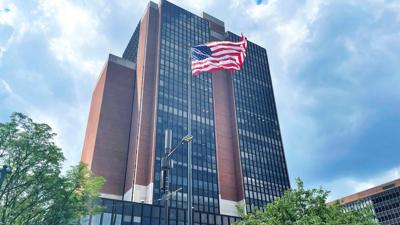



James A. Byrne U.S. Courthouse in Philadelphia
PHILADELPHIA – The Biden-era detention of two immigrants will cost the federal government about $34,000 for the months the men spent in a detention center without bond hearings.
Though courts are now dealing with President Donald Trump’s detention practices and challenges made by prisoners held without bond, some issues predate his inauguration. Adewumi Abioye spent 16 months in a center before a court ordered a bond hearing and Adolph Michelin waited a year for his.
When they prevailed in court, they asked that the federal government pay their attorneys fees because it had no reason to delay their chances at being released on bond for that long. Under the Equal Access to Justice Act, they argued their detainment proceedings had become a civil matter.
Going back to English law, Judge Thomas Ambro wrote that “personal liberty” is a civil right secured by civil action.
“After we overthrew the English crown, we retained this framework from English common law,” he wrote.
“Much has changed over the centuries. Not this.”
Abioye entered America from Nigeria on a tourist visa in 2018 but pled guilty to conspiracy to commit wire fraud two years later. When he completed his sentence in May 2022, Immigrations and Customs Enforcement took him to immigration detention at Moshannon Valley Processing Center in Pennsylvania.
An immigration judge ordered him back to Nigeria. An appeals board affirmed. He appealed to the Fourth Circuit to keep from being removed and by October 2023, he had spent 16 months at Moshannon Valley without a bond hearing.
He went to court to challenge and won in federal district court. That November he was released on a $5,000 bond and moved for the court to punish the feds by paying his lawyer fees.
Michelin had a similar experience. After coming to America from Jamaica, he was arrested by ICE in January 2022. He petitioned for his immigration case to be reopened but received no response.
He spent a year in detention until going to court to seek a bond hearing. He was released on a $10,000 bond.
Judges awarded Abioye $18,224.58 and Michelin $15,841.60, which were affirmed by the Third Circuit. The EAJA says a prevailing party is owed fees and expenses against the United States unless the government was “substantially justified” in its actions.
The feds argued their cases were habeas actions, which aren’t “wholly civil.” They are instead “hybrid” actions in a category of their own, they claimed.
“The ‘hybrid’ theory raises a question: A hybrid of what and what,” Judge Ambro wrote.
“The Government avoids saying in its brief, because the answer exposes this argument as a dead end. To the extent habeas actions are hybrids, they are hybrids of civil actions and criminal ones.”
Other federal appeals courts have split on the issue, but the Third Circuit found the Tenth’s reasoning most persuasive. That immigrant also spent more than a year in detention during the Biden administration and was awarded $18,553.92.