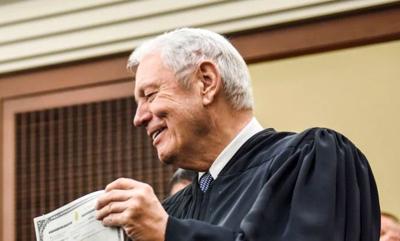



U.S. District Judge Joseph R. Goodwin
CHARLESTON – A federal judge has granted a petition to release a Venezuelan national being detained following a traffic stop on the West Virginia Turnpike.
In a January 28 opinion, U.S. District Judge Joseph A. Goodwin ruled Antony Segundo Larrazabal-Gonzalez immediately be released from custody following a hearing Monday.
“In our society, freedom is the constitutional default,” Goodwin wrote in his 10-page opinion. “When the government confines a person in a jail and, when called upon, cannot articulate the facts or authority justifying that confinement, the detention violates the Fifth Amendment.
“Habeas corpus exists precisely for this moment. … Petitioner is ordered released immediately from civil immigration custody.”
Larrazabal-Gonzalez filed a civil complaint January 22 against South Central Regional Jail superintendent Christopher Mason, acting Philadelphia Field Office Director of the U.S. Immigration and Customs Enforcement Michael T. Rose, acting U.S. Ice Director Todd D. Lyons, acting director of U.S. ICE, Secretary of Homeland Security Kristi Noem and U.S. Attorney General Pam Bondi.
He was stopped January 13, arrested and detained by ICE officers while traveling on Interstate 77. He has been detained at South Central since then. He was traveling with two others who also were arrested and detained. One is Damary Alejandra Rodriguez Flores, and she also has a petition pending before Goodwin.
Larrazabal-Gonzalez was seeking immediate release from immigration detention or an order directing respondents to provide him with a custody hearing before a neutral decisionmaker with authority to assess the necessity of detention and to order release on appropriate conditions.
Larrazabal-Gonzalez is a citizen and national of Venezuela and a noncitizen resident of the United States. He came to America in 2023 and lives in Atlanta. He already has been in immigration proceedings, attending many court dates and is scheduled to appear in Atlanta in October.
He says his confinement is “civil and administrative in nature” and that it is not based on any criminal conviction or charge. He also says his detainment violates his Fifth Amendment Due Process Rights, the Immigration and Nationality Act, the Administrative Procedures Act, the Equal Protection Clause of the Fifth Amendment and the Suspension Clause.
The federal respondents said the petitioner has failed to exhaust his administrative remedies and lacks standing to bring his Administrative Procedures Act claim. They argue his detention is mandatory and that he has received sufficient due process. Mason says he is a nominal figure in the case.
To start Monday’s hearing, Goodwin said the sole purpose was to determine whether Larrazabal-Gonzalez’ arrest and detention was constitutional because that is “the singular inquiry when a petition for writ of habeas corpus challenges an unlawful detention.”
Goodwin also said the burden of proof rested with the government to justify custody.
“The government, however, did not meet that burden,” he wrote in his opinion. “The government presented no witnesses. It offered no affidavits. It introduced no testimony. The government put no one on the stand: not an arresting officer or an immigration officer or a custodian or a decisionmaker.
“It offered no warrant, of any kind, nor did it offer evidence that any warrant was sought or obtained. And despite the court’s inquiry, the government could produce no evidence that the Petitioner presented circumstances of exigency, flight or necessity.
“In fact, the government could not show that the Petitioner had even been evaluated under that criteria or any other criteria.”
Goodwin says the government couldn’t answer who ordered the stop, why the vehicle was stopped, what legal authority was invoked, what facts were known at the time, what statements were made, what notice was given, what process was available and when any hearing would occur.
“The government repeatedly answered: ‘I don’t know,’” Goodwin wrote. “Instead, the government relied on documents attached to its brief, including two forms from events that took place in 2023. But when asked if the government would offer those documents as evidence, the government declined to do so. The court ruled that the attachments to the briefs were not evidence.”
He writes that an immigration officer checked boxes on a form indicting unlawful presence, but the form doesn’t document any statement by the petitioner, does not identify officers who obtained any information, does not describe the circumstances of the stop and does not establish that any neutral decisionmaker reviewed or approved detention.
“Without more, the government falls far short of proving its justification for detaining petitioner, nor can the government overcome petitioner’s habeas challenge of an unlawful detention,” Goodwin wrote. “When the government confines a person, it must be prepared — when called upon — to show who seized him, why, how, and under what authority. A statute does not execute itself.
“Detention is not self-justifying. Courts do not infer constitutionality from silence. Courts do not presume lawfulness when no evidence is offered to support it. Here, the government presented no evidence. This was not a technical failure. It was a complete one.”
During Monday’s hearing, Goodwin says the government conceded that any person in the United States is entitled to due process.
“In short, it is unconstitutional for the government to detain a person without explanation, without a hearing, without notice, or without any means of challenging that detention,” Goodwin wrote. “Here, that is exactly what the government did.
“After federal officers arrested the petitioner, he was held in a state jail. Nine days passed before petitioner could obtain counsel and counsel could file his habeas petition. At the time of the petition’s filing, federal authorities had not scheduled a hearing for the petitioner, nor had the petitioner received notice of a hearing to determine whether removal proceedings would begin.”
Goodwin said that the same as holding someone on a criminal charge without arraignment or bail hearing.
“The Constitution does not tolerate such delay simply because the detained person is subject to immigration law,” Goodwin wrote. “In fact, the petitioner’s immigration status does not burden the relevant constitutional protections.
“Despite what some may have been led to believe, immigrants illegally in this country enjoy protections guaranteed by the Fifth Amendment.”
In his opinion, Goodwin takes the opportunity to comment on current events in the country.
“This case does not arise in isolation,” Goodwin wrote. “The court is aware that similar seizures and detentions are occurring increasingly across the country.
“Individuals are stopped during ordinary civilian activity, taken into custody for civil immigration purposes, and confined in local jails without prompt hearings, without individualized findings, and often far from counsel, family, or community. That broader context matters, especially when assessing constitutional risk.”
He said the court does not supervise immigration enforcement.
“It does not adjudicate removability,” Goodwin wrote. “It does not weigh policy choices committed to the political branches. This court does, however, maintain a narrow, unavoidable duty to ensure that custody itself is lawful.
“It is not the vigilance of detainees or the speed of their lawyers that determines what is and what is not constitutional. Nor does the United States Constitution require habeas petitions to activate its protections. Liberty is not a prize for procedural persistence. It is the baseline.”
That, Goodwin writes, is why the court’s job to “scrutinize custody is more acute than ever, as liberty is administratively restrained.”
“Every day it happens — outside the criminal process, in facilities designed for punishment, and lacking the ordinary safeguards that must accompany arrest and prosecution,” he wrote. “And while judicial restraint is often the right answer in a system of checks and balances, it does not mean that courts should subscribe to judicial passivity.
“Instead, courts must draw and hold clear lines in every case. Here that line is a simple proposition: the government may not confine a person in a jail without promptly justifying that confinement before a neutral decisionmaker in a manner the person can meaningfully access.”
After Monday’s hearing, the government asked for more time to present evidence or affidavits. Goodwin denied that request.
“Habeas corpus does not permit detention to continue while the government justifies its actions after the fact,” he wrote. “Because the government failed to meet its burden to justify custody, continued detention cannot stand. There is no factual record to remand. There is no process to await. The Constitution requires release.”
Goodwin also ruled the government is prohibited from re-arresting and detaining Larrazabal-Gonzalez unless there is “significant change in circumstances” to justify it. He also wrote that he won’t grant a certificate of appealability unless there is a “substantial showing of the denial of a constitutional right.”
Larrazabal-Gonzalez was represented by Jonathan Sidney of Climate Defense Project in Forest Hill and by Leslie Marie Nash of Mountain State Justice. The federal respondents were represented by Christopher Arthur of the U.S. Attorney’s Office for Southern West Virginia.
U.S. District Court for the Southern District of West Virginia case number 2:26-cv-00049