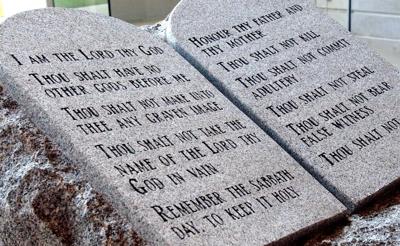


WASHINGTON — More than two dozen Texas families are asking the U.S. Supreme Court to hear their challenge to a state law that requires public schools to post a Protestant version of the Ten Commandments in every classroom.
The request, which was filed August 17, urges the court to protect students’ and parents’ religious freedom by blocking Texas Senate Bill 10, ensuring that families, and not politicians, have the right to decide what role religion plays in their lives.
“As a rabbi and parent, forcing a Christian version of the Ten Commandments on children in every classroom is particularly upsetting,” said Joshua Fixler, a plaintiff in the case. “I am not only worried about my own kids, but I’m deeply concerned about all the children in my congregation.
“These displays put children in the position of having to defend themselves and their families’ religious beliefs against a government mandate that makes them feel different and separate from their classmates.”
The American Civil Liberties Union of Texas is representing the families, which include Christian, Jewish, Hindu, Baha'i, and Unitarian Universalist, attend 22 school districts across the state.
The petition seeks review of lower court rulings in two separate but similar cases: Nathan v. Alamo Heights Independent School District and Cribbs Ringer v. Comal Independent School District.
Under S.B. 10, Texas public schools must permanently display a state-mandated version of the Ten Commandments, drawn from the Protestant King James Bible, in a “conspicuous” place in each classroom, from kindergarten through 12th grade.
The families challenging S.B. 10 object to the law because the displays will pressure children to conform to the state’s favored religious beliefs and interfere with parents’ right to guide their children’s religious instruction.
“The U.S. Supreme Court has rejected this kind of government-imposed religion before, and it should do so again,” said Chloe Kempf, staff attorney for ACLU of Texas. “Having these posters in Texas classrooms puts students at risk of bullying, stigmatization, and religious coercion. Our nation’s bedrock principle of separating church and state means that families and faith communities — not politicians — get to decide what role religion plays in children’s lives.
“Texas students deserve public schools that welcome them for who they are, respect their religious or nonreligious backgrounds, and give them the high-quality education they need to build their futures.”