

U.S. Supreme Court
WASHINGTON - The states of Maryland and South Carolina will have to litigate their lawsuits against 3M over chemicals called PFAS in federal court rather than their preferred state venues.
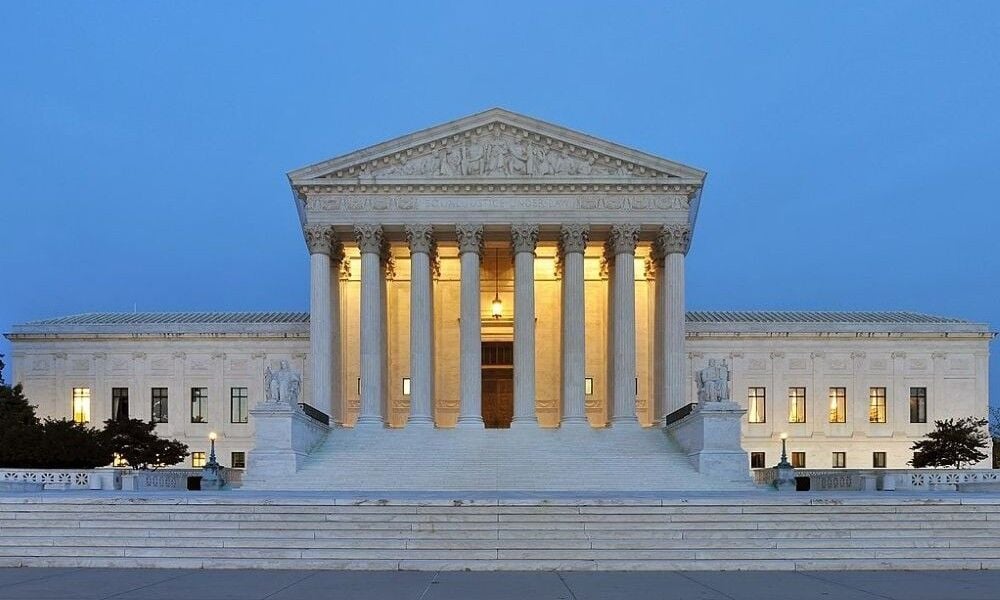
That’s the message from the U.S. Supreme Court’s March 2 denial of a request to review an appellate court ruling holding the federal officer statute puts the states’ cases in federal court. Among the uses for PFAS is firefighting foam, which 3M has argued was manufactured pursuant to federal government specs for use on military bases.
States have imposed their own maximum contaminant levels for PFAS, which are alleged to cause illness - though some dispute that conclusion as premature because of a lack of research. States have also hired private lawyers to sue on contingency fees, and defendants like 3M and DuPont say their cases belong in federal court instead of on the states’ home turfs.
The Supreme Court leaving the Fourth Circuit decision in place will have impacts elsewhere, as states fight to stay out of a federal multidistrict litigation proceeding in South Carolina.
In 2023, Maryland and South Carolina separately sued 3M in their respective state courts over alleged environmental contamination relating to 3M’s manufacture and sale of per- and polyfluoroalkyl substances, which are part of the PFAS group.
These are two in a line of cases filed by several States, public water authorities and private plaintiffs to hold 3M responsible for alleged PFAS contamination. The States claimed that, for decades, 3M sold PFAS for use in a variety of consumer products, causing “widespread contamination,” even though it was aware of the chemicals’ risks to human health and the environment.
In separate cases alleging similar facts and theories of liability, both states sued 3M for alleged environmental harm from the manufacture and sale of aqueous film-forming foam, or AFFF, which 3M produced for the U.S. military under federal contracts.
The states specifically disclaimed any right to recovery for alleged AFFF contamination in their PFAS complaints.
According to 3M, because AFFF lawsuits involved federal contracts, a clear basis for removal to federal court under the federal officer statute, the states intentionally filed their PFAS claims separately, and specifically disclaimed AFFF liability in the PFAS complaints, as part of a strategy to keep the PFAS cases in state court.
3M removed the PFAS and AFFF lawsuits to federal court, and, in response, the states moved to remand the PFAS claims – and not the AFFF lawsuits – back to their respective state courts.
For its part, removing these cases to federal court was part of an overall strategy by 3M to consolidate all PFAS and AFFF cases into the federal MDL and avail itself of the “federal government-contractor defense,” which “immunizes government contractors from state tort liability when they produce equipment for the U.S. military pursuant to ‘reasonably precise specifications’ issued by the government,” the company stated in its brief opposing review.
The district courts in both cases granted the states’ motions, reasoning that remand is appropriate “because both States’ complaints unambiguously disclaim recovery for injuries caused by AFFF and instead focus entirely on 3M’s manufacture and sale of PFAS-containing consumer products.”
The Fourth Circuit reversed, refusing to allow the states to effectively bifurcate their complaints between the PFAS and AFFF claims.
As explained by 3M, the Fourth Circuit recognized that the federal officer removal statute was intended to flip the customary presumption against federal removal, even in cases involving state-law claims, when federal officers or their contractors are involved, and provides an exception to the general view that plaintiffs are the masters of their complaints.
The Fourth Circuit concluded, according to 3M, that “3M had ‘plausibly alleged that its charged [PFAS] conduct was related to its federal [AFFF] work’ notwithstanding the States’ disclaimers” and that “courts must ‘credit [the] Defendants’ theory of the case when determining whether’ there is … a connection or association between the charged conduct and acts taken under federal direction.”
The states claimed in their petition for Supreme Court review that the Court of Appeals’ decision conflicted with rulings by the First, Ninth and 11th circuits.
3M described that assertion as “flat wrong” in its brief.
While the Supreme Court’s denial of certiorari gave no indication of how the individual justices voted, the fact that it did not take up the case indicates that no more than three were in favor of review.
Justice Samuel Alito did not participate in the consideration or decision to deny review.