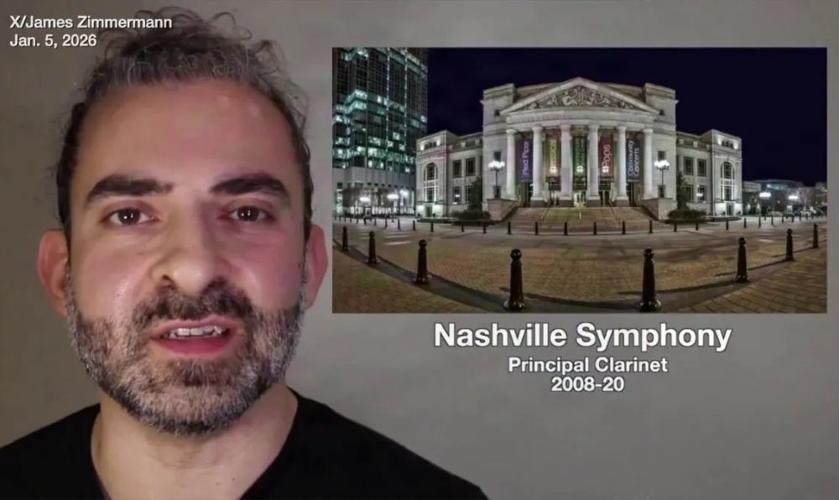




KNOXVILLE, Tennessee – A renowned clarinet player says he was snubbed for a position with the Knoxville Symphony Orchestra for “an obvious DEI hire who’s still in college.”
James Zimmermann filed his complaint last month in the Knox County Circuit Court against the Knoxville Symphony Society.
According to the complaint, the orchestra erred with its “wrongful and discriminatory refusal to hire him as principal clarinet despite defendant’s determination that he was the best performer in a blind audition for which the defendant had personally induced him to spend scores of hours preparing.”
The complaint also toots Zimmermann’s horn by showing his qualifications, saying he is “an extraordinarily talented professional musician with extensive training and experience playing the clarinet.”
In June, the Knoxville Symphony posted a notice for auditions for its Principal Clarinet to be held September 15-16. The auditions were screened, meaning the applicants play behind a screen so hiring decisions “could be made purely based on the skill of the performer and quality of the music produced rather than idiosyncratic or potentially discriminatory grounds.”
The notice said the position was full-time for a 35-week season, and the salary was $47,476 plus benefits.
The complaint also says Edward Pulgar, the orchestra’s principal second violin, messaged Zimmerman urging him to audition.
After he applied, Zimmerman says the audition repertoire materials included a solo rendition of “Mozart, Clarinet Concerto, K.622, First movement exposition” as well as 18 other pieces by 16 different composers.
“From July 30 through September 14, Zimmermann devoted approximately three to four hours almost every day rehearsing the pieces included in the repertoire,” the complaint states. “The only reason Zimmermann rehearsed the pieces in the repertoire was because he had been extended the opportunity for a screened or ‘blind’ audition. …
“The screened audition process is the universal standard of American symphonies. Deviation from this process is virtually unheard of. Nearly every member of every reputable orchestra is hired through screened auditions. Screened auditions are standard, well-understood procedures.”
Zimmermann says he spent a total of nearly 100 hours practicing the repertoire pieces. And, as a result, he says he excelled at the screened audition.
“Based on Zimmermann’s masterful performance, Tucker (Mark Tucker, the orchestra’s personnel manager) texted Zimmermann only a few minutes after his audition concluded to declare, ‘You advanced to the semifinal and will play tomorrow morning,’” the complaint states.
Zimmermann again excelled in the semifinal round and the final round, according to the complaint.
“Tucker notified Zimmermann that he had won and that the orchestra would ‘get (Zimmermann) on the payroll’ within two weeks,” the complaint states. “Tucker promised to give Zimmermann a telephone call to follow up the next day.”
But Tucker didn’t call as promised.

Ford
“Instead, on the morning of Thursday, September 18, Rachel Ford, the Chief Executive Officer of the orchestra called Zimmermann to inform him that, even though he had been the top performer in the screened auditions and had prevailed in the final round, the orchestra would not hire him,” the complaint states. “She indicated that, based on information which the orchestra could have accessed at any point in the month-and-a-half prior to his screened audition, the orchestra had determined he had not been adequately committed to Diversity, Equity, and Inclusion anti-racist principles at a previous job several years ago with the Nashville Symphony.”
Zimmermann says he was “canceled” after 12 years with the Nashville Symphony for resisting DEI policies within the orchestra.
“I’m suing because these orchestras can't keep throwing out their best players to make room for diversity hires and putting race and politics above merit and skill,” Zimmerman told Fox News. “All this does is lower the quality of the music, alienate audiences and turn the arts into politics.”
Ford also emailed Zimmermann, putting the reasoning in print.
“Based on a number of items which have come to the attention of the Knoxville Symphony Orchestra regarding your employment with the Nashville Symphony, I regret to inform you that the KSO has decided not to move forward with offering you a contract of employment,” Ford’s email states, according to the complaint, which also says Ford refused to “participate in any ongoing communications related to this matter.”
Zimmermann says he doesn’t think the orchestra had ever previously declined to hire someone who had been recognized as the top performing in the screened audition process.
“Indeed, it is virtually unheard of for any American orchestra to complete a screened audition process and refuse to hire the person chosen as the best performer, unless he were legally ineligible to be hired,” the complaint states. “The orchestra instead offered the position of Principal Clarinet which Mr. Zimmermann had earned to a person of Asian descent who had not performed as well as Mr. Zimmermann during the screened auditions.”
Zimmermann accuses the orchestra of promissory estoppel as well as racial discrimination in violation of the Tennessee Human Rights Act.
“Had Zimmermann not been a white male, particularly a white male who had previously expressed opposition to DEI initiatives, the orchestra would have proceeded with hiring him consistent with the result of its screened auditions,” the complaint states. “Had Zimmermann been a member of a racial minority group, the orchestra would have proceeded with hiring him, consistent with the result of its screened audition, regardless of statements it believes he made several years ago concerning race-conscious diversity, equity and inclusion initiatives in other orchestras.
“The orchestra failed to hire Zimmermann because of his race, creed, color, religion or national origin.”
He seeks reliance damages in excess of $25,000 to compensate him for his time spent rehearsing for the audition as well as compensatory damages in excess of $47,476, which was a year’s salary plus benefits. He also seeks attorney fees, court costs and other relief.
According the complaint, Zimmermann has played the clarinet since 1991, professionally since 1997. He received a bachelor’s degree in music performance, summa cum laude, from the University of Southern California in 2004 and a master’s degree in music performance from the University of Minnesota in 2007.
From 2008 through 2020, he was the Principal Clarinet of the Nashville Symphony, and he was elected by the orchestra’s members to the 2011-2013 term on the Nashville Symphony’s Board of Directors. They later elected him in 2018 to the Musicians Negotiating Committee for contract negotiations.
In addition, he was an acting associate professor of clarinet at Vanderbilt University’s Blair School of Music and taught at several other universities. He has performed as a guest with the Detroit and Boston symphonies, and he has been hired as a session musician for hundreds of commercial recordings that includes video games such as “Call of Duty” and “Madden” as well as for films such as HBO’s “A Christmas Story Christmas” and “Matchbox and Hershey.”
His recorded performances have been used in theme parks around the world such as Sea World, Disney Tokyo, and Walt Disney World, and also at President Barack Obama’s second presidential inauguration in January 2013. He performed at Carnegie Hall in October as Principal Clarinet of the Hollywood Film Music Orchestra.
Zimmermann said he sees more support for his actions now than he did in 2020.
“Six years ago, when the Nashville Symphony was being overtaken by DEI, I sounded the alarm, but it fell on deaf ears,” he told Fox News. “My colleagues thought I was conspiratorial or downright crazy. It’s different now though.
“There are still detractors out there, but they’re vastly outnumbered by people wanting to push back against the insanity of DEI. A blind audition is the most meritocratic system imaginable, and it’s clear that people see Knoxville’s refusal to hire me as an attack on meritocracy. You don’t have to be a symphony aficionado to understand how outrageous this is.”
Zimmermann is being represented by Paul J. Krog of Bulso PLC in Brentwood, Tennessee, and by Dan Backer of Chalmers Adams Backer & Kaufman in Washington, D.C.
Knox Circuit Court case number C-25-341125