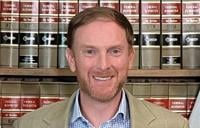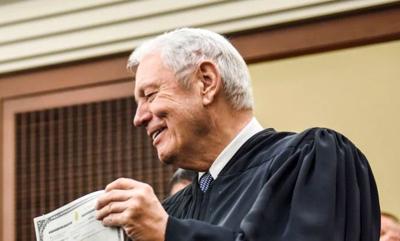



U.S. District Judge Joseph R. Goodwin
CHARLESTON – A federal judge has ruled Immigration and Customs Enforcement’s practice of conducting arrests with masked, unidentifiable agents violates the Fourth Amendment’s prohibition on unreasonable seizures.
In a February 19 opinion, U.S. District Judge Joseph E. Goodwin ordered the immediate release of petitioner Anderson Jesus Urquilla-Ramos, who was “arrested abruptly and without warning by a group of masked men purporting to be” ICE officers.
“Antiseptic judicial rhetoric cannot do justice to what is happening,” Goodwin wrote to begin his 34-page ruling. “Across the interior of the United States, agents of the federal government — masked, anonymous, armed with military weapons, operating from unmarked vehicles, acting without warrants of any kind — are seizing persons for civil immigration violations and imprisoning them without any semblance of due process.
“The systematic character of this practice and its deliberate elimination of every structural feature that distinguishes constitutional authority from raw force place it beyond the reach of ordinary legal description. It is an assault on the constitutional order. It is what the Fourth Amendment was written to prevent. It is what the Due Process Clause of the Fifth Amendment forbids.”
Goodwin has issues similar rulings in recent weeks, as have other federal judges in the district and across the country.
Urquilla-Ramos, a 21-year-old national of El Salvador, said he hadn’t broken any traffic laws, but an officer pulled him over because of a plastic cover on the license plate of the vehicle. He was detained at South Central Regional Jail in Charleston, but he never was cited or charged for a traffic violation.
“I will not pretend, through careful procedural language, that what is at issue here is a technical question of statutory interpretation,” Goodwin wrote. “The overarching issue is whether the federal government may deploy anonymous agents to seize persons on American streets and highways for civil violations, without warrants, without identification, and without any process before or after.
“The Constitution does not permit that. … In our constitutional republic, governmental force derives its authority from the Constitution. But that authority is not unlimited. The Government’s power is legitimate only because it is derived from the people and exercised through law by identifiable public officers answerable to the public and to the courts. The structure of the Constitution guarantees visibility.”
In his petition, Urquilla-Ramos says the group of masked men got out of an unmarked black Ford Explorer “without even a license plate” and arrested him. He said the stop, arrest and detention violated multiple constitutional, statutory and regulatory protections, including the Fourth and Fifth Amendments, the Immigration and Nationality Act and the Administrative Procedure Act.
At Thursday’s hearing, the government did not dispute the allegations in the petition.
Goodwin agreed Urquilla-Ramos’ rights under both the Fourth and Fifth Amendments were violated.
“Petitioner was arrested by unidentifiable, masked officers acting without a warrant, without articulable justification for concealing their identities, and with no mechanism by which he could identify those seizing him or meaningfully test the legality of their asserted authority,” he wrote. “In the absence of a warrant, individualized justification, or any means of contemporaneous attribution of the seizure to particular officers, the deployment of masked and anonymous agents to execute a civil arrest strips the seizure of the accountability the Fourth Amendment presupposes and renders it unreasonable. …
“The government’s mandatory detention of him is unlawful under the Fifth Amendment’s Due Process Clause and applicable statutory provisions.”
Goodwin wrote that the use of masked agents to affect a civil immigration detention under these circumstances is unreasonable and unconstitutional.
“In reaching this conclusion, I consider the court’s responsibility to interpret the Constitution, the philosophical foundation of our system of self-governance, the historical context of immigration enforcement, the historical context of the Fourth Amendment, the personal security the Amendment guarantees, the meaning of a “reasonable” search and seizure, and the government’s asserted interests in permitting masked law enforcement,” he wrote, adding the court has a responsibility to the Constitution.
“Our legal culture has developed a strange timidity about constitutional interpretation,” Goodwin wrote. “We often act as if constitutional meaning emerges only from the Supreme Court, as if district courts merely wait for appellate instruction before interpreting constitutional text.
“That approach inverts the Constitution. In arguments everywhere, lawyers reach for perfect case analogies and factual alignment as if the Constitution itself were somehow inaccessible. But the Constitution is not a compilation of case holdings. It is a text with meaning that existed before any court construed it, and it continues to bind government conduct whether or not a prior case has addressed the specific facts at hand.
“To be sure, precedent matters profoundly. When the Supreme Court or the Fourth Circuit has resolved a question, this court follows that resolution. When prior cases illuminate related questions, the court learns from them carefully. Precedent provides predictability, constrains arbitrary interpretation, reflects accumulated judgment, and promotes equal treatment. But it cannot replace the Constitution. When precedent directly resolves the question before me, that ends the inquiry. When prior cases provide clear guidance, I follow it.
“But when existing cases address different facts, different contexts, and different questions, the Constitution still applies. And the court must determine what it means through disciplined interpretation, not serial citation. This is especially true when the government employs practices so recent that doctrine has not yet addressed them. The absence of a case holding that warrantless, non-exigent, anonymous civil seizures in the interior of the United States violate the Fourth Amendment does not mean the Constitution permits them. It means the practice is new enough, and brazen enough, that no court has yet been required to state the obvious. This court is now required to say it.”
Goodwin says anonymous police stops must remain a rare exception and “must not be premised on anonymity for the mere sake of officer protection.”
“If that were so, all officers across America might take to the streets in masks, but that would run contrary to the transparency and accountability our democracy demands,” he wrote. “In a system of checks and balances, the policy of officer anonymity violates the Constitution by evading accountability and judicial review.”
Goodwin says today’s ICE’s operational practices “raise new constitutional concerns.”
“While undercover operations in organized crime or anti-terrorism units may justify limited identity concealment, routine immigration enforcement lacks such extraordinary circumstances,” he wrote. “When the public cannot readily determine who is acting under government authority, it is difficult to regard the actions as legitimate exercises of law enforcement power.
“The use of masks and other tactics that obscure official identity carries historical and semiotic weight. Authoritarian regimes have used masked security forces to intimidate and control populations. In this nation’s history, the Ku Klux Klan relied on masks to terrorize victims while concealing accountability.
“With this background in mind, the ICE tactics of anonymous enforcement in this case contravene the history, purpose and modern interpretation of the Fourth Amendment.”
Goodwin says there is no doubt Urquilla-Ramos enjoys Fourth Amendment rights. He entered the country as an unaccompanied minor and was placed under the care of the United States Department of Health and Human Services, through its Office of Refugee Resettlement. He was released from custody into the United States, where he maintains a pending asylum application, lawful work authorization, and a valid driver’s license. He has lived her for the past four years.
“Noncitizens may hesitate to assert their rights out of fear of government retaliation,” Goodwin wrote. “In practice, undocumented immigrants may endure unreasonable searches and seizures rather than risk asserting Fourth Amendment protections that may or may not apply.
In this way, the Fourth Amendment, intended by the Founders as a shield for individual liberty, is turned into a sword.”
Goodwin says the actions by masked ICE agents doesn’t just corrode the protections envisioned by the Founders. Instead, he says those protections have been “eviscerated.”
“The Founders recognized that freedom is imperiled not only when government actions lack legal justification, but also when those actions are carried out by agents whose authority is unchecked and whose actions cannot be traced. In this light, a warrantless, anonymous civil seizure like the one at issue here is merely a general warrant in modern dress.
“Masking and anonymization of officers, therefore, are fundamentally inconsistent with the historical understanding of the Fourth Amendment.”
He says allowing officers to conceal their identity effectively collapses the system.
“Officers are thereby emboldened to exercise their power in an arbitrary and oppressive manner,” Goodwin wrote. “And public trust is decimated.”
He said there is a practical danger to the practice as well, including documented cases of people posing as ICE agents to accost immigrants and even commit sexual assault.
“These incidents have generated widespread fear within immigrant communities, affecting routine activities such as sending children to school, grocery shopping and attending recreational events,” Goodwin noted. “Validating law enforcement conduct that invites impersonation and undermines public trust would contaminate Fourth Amendment principles.
“As we have seen, when officers are faceless and nameless, others can exploit that anonymity for personal gain or criminal acts. This approach poses a serious public safety risk, endangers personal security, and increases the danger of law enforcement work — because the public cannot distinguish officials from imposters.
“Individuals understandably refuse to cooperate when they cannot tell the difference between a government agent and a criminal actor. This is precisely the kind of insecurity the Framers sought to prevent when they enshrined personal security in the Fourth Amendment.”
Goodwin also says there are times when anonymity is necessary, such as an undercover officer infiltrating a criminal organization. But he says those cases are temporary and subject to later scrutiny.
“Accountability is deferred in those cases, not abandoned,” he wrote. “That is the critical distinction. What justifies concealment in genuine exigencies is that it is exceptional.
“Stops without identification must remain rare exceptions, not routine practice. …
“What is happening here bears no resemblance to those recognized exceptions. This is not an undercover operation. No specific danger has been identified that required these agents to be masked for this arrest. This is a deliberate choice to conduct routine civil immigration enforcement through masked anonymous agents operating without warrants across the interior of the United States.
“When concealment becomes policy rather than exception, the government has not invoked an exigency. It has abolished the rule that exigency was meant to qualify.”
The government’s justification for ICE officer masking is safety, but Goodwin finds that claim insufficient.
“A mask does not stop a bullet,” he wrote. “It does not deflect a blow. It provides no physical protection that the tactical equipment these officers already carry does not provide. A mask does one thing: it hides the face of the officer wearing it.
“On a public highway, in a civil arrest of a person suspected of no crime, the only purpose served by hiding an officer’s face is to prevent his identification. And preventing identification serves only to eliminate accountability. A law enforcement practice whose sole operational effect is the elimination of accountability is not a safety measure. It is a constitutional deficiency wearing the name of one.”
Goodwin says every public official who exercises power assumes some personal exposure as the price of legitimate authority.
“Judges sentence,” he wrote. “Prosecutors accuse. Officers seize. None is entitled to anonymity as a default condition of exercising state force. The officer who arrests a person stands in no different constitutional position than the judge who sentences him or the prosecutor who sought the conviction. All exercise delegated authority.
“All do so under their own names and in their own persons, because accountability is not a burden imposed on public officials as a matter of grace. It is the structural condition of their authority. Remove it and what remains is not law enforcement. It is force without a face, which is another name for the thing the Fourth Amendment was written to prevent.”
When someone cannot identify the agents who seized him, Goodwin says the seizure is “functionally unanswerable.”
“That is not a procedural gap,” he wrote. “It is the elimination of constitutional accountability itself. Masking during arrests is therefore not a neutral safety measure; it is a deliberate choice that transforms the nature of the seizure from lawful authority into anonymous coercion.”
He also says Urquilla-Ramos was not given due process.
“He was seized without warrant, given no notice of the basis for his detention and transported to a regional jail without any opportunity to be heard before a neutral decisionmaker,” Goodwin wrote. “What the government offered instead was a fait accompli: seizure, transport, imprisonment and the suggestion that review could be sought of a deprivation already complete, through mechanisms controlled by the detaining authority. That is not due process. It is the absence of it. …
“Treating the immigration process as ‘a game of detention roulette’ is inconsistent with the constitutional guarantee of due process.”
In closing, Goodwin says an “anonymous government is no government at all.”
“It cannot be held accountable,” he wrote. “A masked agent freely uses force without justifying his actions, and the public cannot name him to challenge his conduct.
“A regime of secret policing has no place in our society. Here, the government’s power is derived by the people, and the people must be able to identify the government when it acts to infringe on their liberty. Masks obscure government action and deprive the public of its Fourth Amendment protections.”
Urquilla-Ramos was represented by Omar Baloch of Raleigh, N.C., and by William Shane Wilson of Wilson Legal Group in Charleston. The federal respondents – President Donald Trump, Philadelphia ICE Field Office Director Brian McShane, U.S. ICE Acting Director Todd Lyons, Department of Homeland Security Secretary Kristi Noem and U.S. Attorney General Pam Bondi – were represented by Christopher R. Arthur and Matthew C. Lindsay of the U.S. Attorney’s Office in Charleston, and SCRJ Superintendent Christopher Mason was represented by Anthony D. Eates II and Holly J. Wilson of the West Virginia Attorney General’s office.
U.S. District Court for the Southern District of West Virginia case number 2:26-cv-00066