
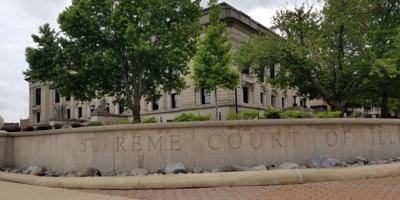



Illinois Supreme Court, Springfield, Ill.
SPRINGFIELD — The Illinois Supreme Court has again turned away another challenge to Illinois' gun owner licensing regime, this time declaring a man who had his FOID card suspended after he was charged with a crime, but then had it reinstated when the charges were dropped, can't sue the state for violating his Second Amendment rights.
The state high court delivered the ruling on May 21, overturning the ruling of a judge in Randolph County that the state's treatment of plaintiff Malik Bright was sufficient to declare at least a portion of the state's firearms owner permitting law unconstitutional.
Randolph County is located in far southwestern Illinois, across the Mississippi River from Missouri.
The case had landed in court in Randolph County in 2023, as Bright accused Illinois State Police of wrongly suspending his Firearms Owner Identification (FOID) card, and then took too long in reinstating it after he had been cleared of criminal charges, violating his rights.
According to court documents, Bright was arrested by police officers in February 2023 on charges of aggravated unlawful use of a weapon.
Bright claimed he had been pulled over by the officers that day, and had declared he had an unloaded Glock .45 pistol in a locked case in the vehicle. However, he said officers still arrested him and seized the gun.
Following his arrest, the Illinois State Police moved swiftly to suspend Bright's FOID card, under a state law that allowed for such suspensions for people who have been charged with felonies.
On April 20, 2023, the Cook County State's Attorney's office dismissed the charges against Bright, prompting Bright to apply quickly for his FOID card to be reinstated. State Police approved that request on May 31, 2023.
After the charges were dropped and before the State Police reinstated Bright's FOID, Bright filed suit against the State Police, nominally through Jeffrey Yenchko, chief of the State Police's Firearms Services Bureau.
The lawsuit marked a series of legal challenges brought against Illinois' gun owner permit system in recent years.
Across the country, most U.S. states have substantially loosened gun ownership rules, particularly in the wake of U.S. Supreme Court decisions explicitly declaring Americans have a constitutional right under the Second Amendment to own and carry firearms for self defense, hunting and other lawful purposes.
Currently, 29 states have recognized a constitutional right to carry firearms and do not require any gun-related permits.
Illinois, however, has defended its FOID law, making the state one of just two U.S. states that still require residents to obtain government permits before purchasing, owning or carrying any kind of firearm or ammunition.
To date, Illinois' FOID gun owner licensing regime has withstood numerous court challenges, for various reasons. To this point, the Illinois Supreme Court and other state appeals courts have refused to rule on the merits of the question of whether the state law violates the Second Amendment.
Rather, the lawsuits have typically devolved into disputes over the details particular to each plaintiff, allowing Illinois state courts and the Illinois Supreme Court to find various ways of disposing of the legal challenges without ruling on the constitutionality of the FOID requirements themselves.
In Bright's case, the state again asked to dismiss Bright's claims, asserting his case, like others before him, was moot, because the state had given him his FOID card back after he had filed suit.
A Randolph County judge, however, refused to abide by that reasoning, saying so-called "mootness exceptions" should apply because the provisions of the state law allowing police to suspend someone's gun ownership rights after they are charged, but not convicted of crimes, violates their constitutional rights.
The State Police appealed, taking the case directly to the Illinois Supreme Court.
There, the high court once again refused to consider the constitutionality of the FOID law, instead finding the Randolph County judge had overreached in refusing to let the state pull the plug on the challenge to the FOID regime.
In the decision authored by Illinois Supreme Court Chief Justice P. Scott Neville, the justices agreed the reinstatement of Bright's card after he filed suit should moot his case and remove the ability of judges to rule on his claim.
They said the lawsuit only applies to Bright, himself, and since he got his FOID back, the lawsuit "does not present a question of a public nature" sufficient to strike down an Illinois state law as unconstitutional.
Further, the justices said, they doubted Bright's claim that without a court ruling in his favor, he could again suffer the same alleged violation of his rights in the future.
"His claim that he may be charged with another felony offense and have his FOID card suspended at some time in the future is purely speculative," Neville wrote. "In short, he has not established a realistic expectation that he will personally be subject to the same action again."
The Illinois FOID statute, however, continues to face legal challenges. Two days before the Illinois Supreme Court ruled in Bright's case, three Chicago residents joined with the constitutional legal advocacy group, the New Civil Liberties Alliance, to challenge the FOID law directly federal court.
None of those residents had FOID cards suspended. Rather, they alleged directly that Illinois' permit requirements directly violate their rights under the Second Amendment.
That lawsuit remains pending, and the state has not yet responded to it in court.