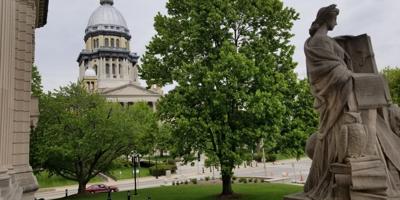


Illinois Capitol, seen from steps of Illinois Supreme Court, Springfield
CHICAGO — A new lawsuit is taking aim once again at attempting to topple Illinois' gun owner licensing law, asserting the state's requirements that gun owners obtain a state-issued Firearms Owner Identification Card in order to legally own and carry guns and ammunition violates the Second Amendment.
The lawsuit was filed May 19 in Chicago federal court by attorneys from the Washington, D.C.-based constitutional legal advocacy organization the New Civil Liberties Alliance (NCLA).
The lawsuit was filed on behalf of named plaintiffs Christopher Laurent, Kim Dalton and Justin Tucker, all identified in the complaint as Chicago residents. In a press release Laurent is further identified as a Navy veteran; Dalton, as a chef and restaurateur; and Tucker as a "liberty advocate."
In the lawsuit, all of the plaintiffs and the NCLA assert the state's FOID law tramples their constitutional rights to keep and bear arms under the Second Amendment — which the plaintiffs argue is a "fundamental right" — by forcing people to first secure approval from the state to purchase and own a gun.
They further assert the FOID law and licensing requirement amounts to violations of Illinoisans' rights to due process under the Constitution's Fourteenth Amendment.
“If you have a right to do something, that means you don’t need to ask the government’s permission," said attorney Jacob Hubert, of the NLCA, who is among those representing the plaintiffs in the FOID legal challenge, in a statement included in the press release announcing the lawsuit.
"And if the government has a lawful reason to take away your rights, it has to prove its case in court. That’s how it’s supposed to work in America — but that’s not how it works now in Illinois. The court should explain to Illinois officials that they can’t force people to get a license to exercise a constitutional right — and they can’t treat people as guilty until they prove themselves innocent.”
NCLA President and Chief Legal Officer Mark Chenoweth added: “This case is not about invalidating all licensing related to guns. But requiring people to get permission from the government in advance even to obtain a gun for hunting or for self-defense in the home is outrageous. The point of having Constitutional rights is that we do not have to get the government’s permission to exercise them.”
The lawsuit is the latest in the past few years filed to challenge Illinois' FOID gun permitting regime.
In recent years, most U.S. states have substantially loosened gun ownership rules, particularly in the wake of U.S. Supreme Court decisions explicitly declaring Americans have a constitutional right under the Second Amendment to own and carry firearms for self defense, hunting and other lawful purposes.
Currently, 29 states have recognized a constitutional right to carry firearms and do not require any gun-related permits. Among Illinois' neighboring states, these include Indiana, Iowa, Missouri and Kentucky. Other states who operate udner so-called "constitutional carry" licensing gun ownership laws include Florida, Texas, Ohio, Arizona and Georgia, as well as nearly all southern states, the Mountain West states of Montana, Wyoming, Idaho and Utah, and the New England states of New Hampshire and Vermont.
The state of Wisconsin, like the states of California, does not require a permit to own or purchase a firearm. However, they do require gun owners to obtain a permit to carry the weapon outside the home.
Illinois and Massachusetts, however, stand as the only states that still require residents to obtain government permits before purchasing, owning or carrying any kind of firearm or ammunition.
To date, Illinois' FOID gun owner licensing regime has withstood numerous court challenges, for various reasons. However, to this point, plaintiffs have not been successful in constitutionally squaring up the FOID law and rules in court. Rather, the lawsuits have typically devolved into disputes over the details particular to each plaintiff, allowing Illinois state courts and the Illinois Supreme Court to find various ways of disposing of the legal challenges without ruling on the constitutionality of the FOID requirements themselves.
For instance, in 2022, the Illinois Supreme Court overturned a ruling from a judge in White County, who had ruled the FOID law unconstitutional. In that case, the Supreme Court ruled 4-3, with dissents from all of the three Republicans on the court at the time, that the plaintiff in the case never proved she needed a FOID to possess a gun in her own home.
The Illinois Supreme Court has also rejected challenges to the FOID law because plaintiffs, whose FOID cards were revoked when they were charged with a crime ultimately got their FOID cards when they were never convicted.
However, in 2025, a divided three-justice panel from the Illinois Fourth District Appellate Court narrowly ruled the FOID law constitutional, because they said the law doesn't forbid Illinoisans from owning any guns, only requiring them to obtain a FOID card before owning them.
And other legal challenges remain pending, including cases before the Illinois Supreme Court over the treatment of nonviolent felons under the Illinois FOID regime.
However, in their new case in federal court, the NCLA and Chicago plaintiffs are attempting to bypass the Democratic supermajority Illinois Supreme Court altogether, and challenge the state's gun permit system solely on federal constitutional grounds.
In the lawsuit, plaintiffs Laurent and Dalton say they want to purchase firearms for self defense "but have not done so because they do not have FOID cards, refuse to submit to the state's unconstitutional procedure, and are unwilling to subject themselves to criminal prosecution by violating the law."
Their co-plaintiff, Tucker, says he has a FOID card, but he does not wish to be forced to "keep it in his possession whenever he possesses a firearm or ammunition as the law requires" and he does not wish to be forced to renew the permit in order to "retain his Second Amendment rights."
The NCLA said the lawsuit is needed to overturn Illinois' alleged unconstitutional gun owner permitting system, which they said "flips the presumption of liberty, placing the burden of proof on citizens to get government permission to exercise their freedom."
The state of Illinois has not yet responded to the lawsuit in court.
According to a court docket, the case has been assigned to U.S. District Judge LaShonda A. Hunt, an appointee of former President Joe Biden.