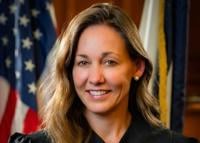


Kanawha Circuit Judge Maryclaire Akers
CHARLESTON – A conservative legal group has urged the state Judicial Hearing Board to reject sanctions against Kanawha Circuit Judge Maryclaire Akers, arguing that disciplining her over public comments about the state’s child welfare system would violate the First Amendment and chill speech by judges statewide.
In an amicus brief, the American Center for Law and Justice told the JHB it is interested in how the West Virginia Code of Judicial Conduct interacts with judges’ free speech rights.
Earlier this month, Akers asked the state Supreme Court to step in and force dismissal of judicial ethics charges stemming from a 2025 radio interview about West Virginia’s troubled foster care system.
As her May 8 petition notes, the state Judicial Hearing Board ruling already has said it found no clear and convincing evidence of misconduct. Akers asks the justices to issue a writ of mandamus directing the state Judicial Hearing Board to dismiss all charges after Special Judicial Disciplinary Counsel Rachael Fletcher Cipoletti conceded the burden of proof can’t be met and recommended the case be dropped.
Once disciplinary prosecutors say the evidence fails to satisfy the “clear and convincing” standard and the respondent judge agrees, Akers argues the board has a legal duty to grant dismissal, much like a trial court must grant a prosecutor’s good‑faith motion to dismiss criminal charges.
The case arises from Akers’ handling of emergency concerns about children in Department of Human Services custody being housed in hotels and a Kanawha County 4‑H camp, including a 12‑year‑old boy who attempted suicide while in a hotel. After a February 28, 2025, public administrative hearing, Akers entered an agreed order establishing an “improvement period” and appointing Supreme Court Division of Children’s Services director Cindy Largent‑Hill as a monitor to help DoHS reduce and ultimately eliminate the use of unlicensed facilities.
On March 3, 2025, Akers appeared on MetroNews’ “Talkline” statewide radio program to explain the hearing, the agreed order and the monitoring process. In that interview, she emphasized she did not “want to be negative towards anybody involved in the process,” said her “polar star” was the child’s best interest, described how the monitoring would work and repeatedly declined to discuss specific future decisions or broader political blame.
The ACLJ is a national organization “dedicated to the defense of constitutional liberties secured by law.” The group has appeared in several U.S. Supreme Court cases involving free speech and religion.
At the heart of its 17‑page amicus brief is the argument that any application of a key rule of the Code of Judicial Conduct to Akers’ comments must be constrained by controlling U.S. Supreme Court precedent, particularly Gentile v. State Bar of Nevada. Rule 2.10(A) restricts judges from making certain public statements about pending matters, but ACLJ says that rule cannot be enforced in a way that infringes constitutionally protected speech.
The group stresses that judges, while obligated to act “in a manner that promotes the public confidence in the independence, integrity and impartiality of the judiciary,” “do not shed all constitutional rights upon assuming the bench.”
According to the ACLJ, the JHB “walks a narrow path” between enforcing ethics rules and violating the First Amendment, and any admonishment of Akers could “unconstitutionally chill the speech of all West Virginia judges” and “deprive the public of information on the legal system which is of great public interest.”
The ACLJ brief leans heavily on the Supreme Court’s 1991 Gentile decision, which upheld a “substantial likelihood of material prejudice” standard for disciplining lawyers’ public comments about pending cases as a constitutionally acceptable balance between free speech and fair trial rights. The ACLJ says Gentile is the “definitive statement” on professional speech restrictions and should govern how West Virginia applies its judicial conduct rules.
Professional speech restrictions, the group argues, are content-based regulations that must be narrowly tailored to serve compelling state interests and cannot rest on “speculative concerns about ‘public perceptions’ and conclusory assertions about judicial neutrality.” Instead, discipline is permissible only when speech creates a concrete, substantial likelihood of materially prejudicing legal proceedings.
The ACLJ says the JHB has “entirely failed” to apply that framework in Akers’ case, and warns that vague, standardless enforcement risks becoming a “trap for the unwary” that violates due process and invites viewpoint discrimination.
The ACLJ brief characterizes Akers’ speech as “carefully circumscribed comments about systemic problems in West Virginia’s child welfare system.” The group says those remarks were confined to information already in the public record, disclosed no confidential material and did not express bias or comment on the merits of specific cases or parties.
The comments were made in the context of a one‑year monitoring period focused on policy implementation in the child welfare system, according to the brief. The ACLJ says there was “no realistic threat” that Akers’ statements would affect any proceeding, including a 12‑year‑old’s foster placement or a Department of Health and Human Services improvement period referenced in the filing.
“Such speech lies at the First Amendment’s constitutional core,” the ACLJ writes, calling it expression about “governmental accountability on matters of paramount public concern.” The brief argues that judges, like lawyers, are uniquely positioned to inform the public about how legal institutions function and that their informed criticism of systemic failures is “precisely” the kind of discourse the First Amendment is designed to protect.
The ACLJ describes the state’s abuse and neglect docket as an area of especially intense public concern, and it notes the public has a legitimate interest in the operation of courts and says interest is “arguably even more compelling” when it comes to how the state treats “its most vulnerable, abused and neglected children.”
To bolster its position, ACLJ points to the 1994 WVSC decision in In re Hey, which dismissed a complaint against a circuit judge over public comments about a judicial disciplinary hearing on First Amendment grounds.
In that case, the court warned that punishing judges for discussing the fairness of disciplinary proceedings could “disserve” the integrity and independence of the judiciary and chill critical discussion by those most knowledgeable about the process.
The ACLJ says Akers’ situation presents “even less” grounds for discipline, because she did not criticize particular hearings but “highlighted her concerns with the abuse/neglect system as a whole.”
The brief also cites scholarship by former Michigan Supreme Court Chief Justice Bridget Mary McCormack, who has argued that ethical rules leave open a “vast educative function” for judges and impose an obligation to help make the legal system as fair and effective as possible.
The ACLJ tells the JHB that reading Rule 2.10(A) to bar Akers’ comments would effectively bar judges from speaking publicly about systemic issues whenever any related matter is pending in their courts.
That approach, the group says, would prevent judges from giving educational talks, participating in conferences or providing commentary on governmental performance and would punish “a ‘substantial’ amount of protected free speech” in violation of overbreadth doctrine.
Instead, ACLJ urges the JHB to interpret Rule 2.10(A) narrowly, focusing on speech that poses a substantial likelihood of material prejudice while allowing robust judicial participation in discussions about court administration and child welfare policy.
The brief concludes by asking the tribunal to “decline to sanction Judge Akers’s speech,” arguing that silencing judges on systemic problems “impedes the democratic processes necessary for effective reform.”
The brief is signed by ACLJ attorneys Jordan Sekulow and Donn Parsons, along with Charleston lawyers Roberta F. Green and former state Supreme Court Justice John McCuskey of Shuman McCuskey Slicer PLLC.
West Virginia Supreme Court of Appeals case number 26-259 (West Virginia Judicial Investigation Commission complaint 25-2025 and West Virginia Supreme Court of Appeals case number 25-483)