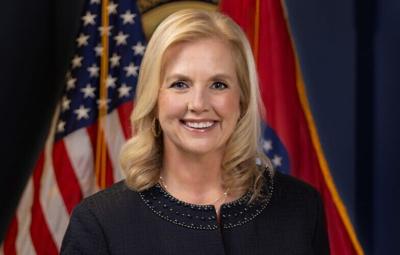



Missouri Attorney General Catherine Hanaway
JEFFERSON CITY — Missouri Attorney General Catherine Hanaway has issued cease-and-desist letters to six prediction market operators accused of offering unlicensed sports wagering to Missouri residents through sports “event contracts.”
The letters, dated Sept. 16 and 17, were sent to Polymarket, Kalshi, Crypto.com, Novig, Underdog and Robinhood, with the Attorney General’s Office warning that the companies must either comply with Missouri’s sports wagering requirements or stop offering the platforms to people in the state.
Hanaway said the companies are subject to Missouri’s sports wagering laws despite characterizing their products as “event contracts” or “swaps.”
“Missourians voted for a safe, well-regulated sports wagering market that supports public education and addresses problem gambling,” Hanaway said in the statement. “Companies cannot repackage sports bets as ‘event contracts’ to avoid Missouri law.”
She said companies offering sports wagering in Missouri must be licensed by the Missouri Gaming Commission, pay required taxes and fees, and ensure that people under 21 cannot place wagers.
The cease-and-desist letters identify the operators as online sports wagering platforms and state that they have been offering sports wagering to people located in Missouri without submitting to regulation by the Missouri Gaming Commission.
The letters give the companies the choice of ceasing the activity or obtaining the required license and complying with the state’s other requirements. The letters also warn that continued violations could result in enforcement action by the state.
Missouri voters approved Amendment 2 in 2024 to legalize and regulate sports wagering in the state.
Under the voter-approved framework, sports wagering is overseen by the Missouri Gaming Commission and became available Dec. 1, 2025.
The system allows wagering through licensed mobile and online platforms as well as in person at authorized locations. Sports betting gross receipts are subject to a 10% tax, with the framework providing for revenue to support public education and a fund addressing problems associated with compulsive gambling.
The Attorney General’s letters state that online sports wagering operators are required to obtain a Missouri Gaming Commission license.
The letters also point to a 10% wagering tax on adjusted gross revenue from in-state sports wagering and licensing fees that can reach $500,000 for an initial license and for a renewal every five years.
According to the letters, those taxes and fees are appropriated to Missouri institutions of elementary, secondary and higher education and to a Compulsive Gaming Prevention Fund.
The letters also raise age-verification requirements. Missouri law prohibits sports wagering by anyone under 21 and requires online sports wagering platforms to actively prevent people younger than 21 from placing wagers. The Attorney General’s Office says several of the companies’ own terms or websites allow people who are 18 or older to participate.
The letter to Crypto.com says its U.S. Exchange Terms and Conditions allow people who are at least 18 years old to place wagers.
The letter to Kalshi says its Member Agreement permits people who have reached the age of majority in their state of residence, which the letter identifies as 18 in Missouri, to place wagers. Polymarket’s letter similarly points to its U.S. Rulebook, which permits people at least 18 years old and who have reached the age of majority in their state or country of residence to place wagers.
Robinhood’s letter says its Customer Agreement permits people who are at least 18 and of legal age under the laws of their jurisdiction to place wagers. The Underdog letter states that its website reflects that people in Missouri who are at least 18 can place wagers through its platform.
Novig’s letter does not include the same under-21 allegation, but says the company is offering sports wagering in Missouri without a Missouri Gaming Commission license and has failed to pay the required state taxes and fees. The letter states that, according to Novig’s website, the company was offering sports wagering to Missouri residents.
A central issue in all six letters is whether sports “event contracts” are subject to state gambling laws.
The Attorney General’s Office says the companies have claimed that their products are “event contracts,” or “swaps,” governed by the federal Commodity Exchange Act and subject exclusively to regulation by the Commodity Futures Trading Commission.
Missouri disputes that interpretation. The letters state that Missouri shares the view of the majority of federal courts that online sports wagering platforms are subject to state gambling laws because the Commodity Exchange Act does not preempt state law in this area and because sports betting event contracts do not qualify as “swaps” under the act.
The letters cite several federal court cases in support of that position, including decisions involving Kalshi from the U.S. Court of Appeals for the Ninth Circuit on Aug. 28, 2026, the Sixth Circuit on April 24, 2026, and federal district courts in Iowa, Connecticut, Utah, New York and Maryland.
The Novig letter also cites a 2025 federal court case involving the North American Derivatives Exchange and Nevada.
The state is giving the companies 30 days from the dates of their respective letters to confirm that they have complied with Missouri law or stopped offering sports wagering to people in Missouri.
The letters state that if the companies do not comply, Missouri will pursue legal action.
Hanaway said Missouri remains open to possible legislative reforms in the future, but the immediate options available to the companies are to bring their operations into compliance with Missouri law or stop offering their online sports wagering platforms to people in the state.