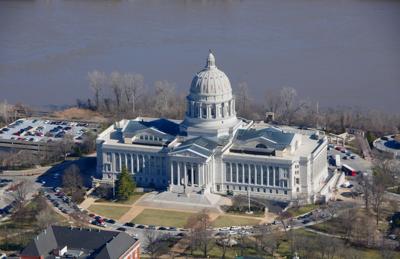


JEFFERSON CITY — The Missouri Supreme Court unanimously ruled that Gov. Mike Kehoe acted within his constitutional authority when he called an extraordinary session of the Missouri General Assembly in August 2025, affirming a lower court judgment and rejecting a challenge brought by the Missouri State Conference of the National Association for the Advancement of Colored People (NAACP) and two individual plaintiffs.
In an opinion issued May 27, the court held that Article IV, Section 9 of the Missouri Constitution grants the governor discretion to determine when an extraordinary occasion exists and to convene the General Assembly accordingly.
The court affirmed the judgment of the Cole Circuit Court, which had found the governor possessed the constitutional authority to call the session.
The lawsuit stemmed from Kehoe’s proclamation convening the Second Extraordinary Session of the 103rd Missouri General Assembly in August 2025.
In the proclamation, the governor cited the need for legislative action on two matters: establishing new congressional districts and altering Missouri’s initiative petition process.
He stated that the General Assembly had adjourned its regular session without adopting new congressional district boundaries and expressed concerns that the state’s existing congressional map could be vulnerable to legal challenges under the Voting Rights Act and the 14th Amendment.
He also cited the approaching 2026 election cycle and concerns regarding the initiative petition process.
Following the governor’s call, lawmakers convened and passed House Bill 1, which adopted a new congressional district map, and House Joint Resolution 3, which proposed a constitutional amendment related to the initiative petition process.
The NAACP filed suit on Sept. 3, 2025, the day the extraordinary session was scheduled to begin.
The organization sought a declaration that the governor’s proclamation failed to identify an “extraordinary occasion” as required by the Missouri Constitution and requested court orders preventing the session from proceeding.
After the General Assembly met and enacted legislation before the circuit court ruled on the requested injunctions, the plaintiffs amended their pleadings and sought to block implementation of the measures passed during the session.
The circuit court denied requests for temporary restraining and preliminary injunctions and later ruled in favor of the state following a bench trial.
On appeal, the NAACP argued that Article IV, Section 9 requires an extraordinary occasion to exist before the governor may exercise his authority to convene lawmakers.
The plaintiffs contended that the term “extraordinary occasion” should be interpreted to mean an unusual set of circumstances and argued that the reasons cited in the governor’s proclamation did not meet that standard because many of the issues identified already existed during the regular legislative session.
Writing for the court, Judge Mary R. Russell rejected that interpretation, concluding that the constitutional provision’s language repeatedly grants the governor authority to act based on what he “deems necessary.”
The opinion noted that the provision authorizes the governor to provide information to lawmakers and recommend legislation at times he considers necessary, and that the same language applies when calling an extraordinary session.
The court stated that identical wording within the same constitutional provision should be presumed to carry the same meaning.
The court further held that the ordinary meaning of “extraordinary,” both at the time the provision was adopted and today, refers to something outside the regular course or pattern.
In the context of legislative sessions, the court said the term means a session held outside the General Assembly’s ordinary legislative session rather than requiring a unique or urgent event.
According to the opinion, nothing in the constitutional text limits the governor’s discretion or establishes criteria for determining whether a situation is sufficiently unusual to justify convening lawmakers.
The justices stated that adopting the NAACP’s interpretation would require reading additional restrictions into the Constitution that are not present in the text.
The court noted that constitutional provisions must be interpreted according to their plain language and that courts should not add words or limitations that do not exist.
Because the court concluded that Kehoe acted pursuant to his constitutional authority, it declined to address the circuit court’s alternative finding that the dispute presented a political question more appropriately resolved by the executive branch than by the courts.
The court ultimately held that Article IV, Section 9 affords the governor discretion to determine when an extraordinary occasion has arisen and to call an extraordinary session of the General Assembly.
It concluded that Kehoe’s decision to convene the Second Extraordinary Session of the 103rd Missouri General Assembly fell within that constitutional authority and affirmed the circuit court’s judgment.
All seven judges concurred in the decision.
Supreme Court of Missouri case number: SC101541