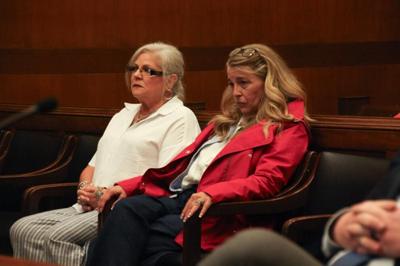


Kimberly Maynard (left) and Jan Hite King listen to a hearing in their case April 25, 2025.
CHARLESTON – The West Virginia Supreme Court has reinstated election‑related misdemeanor charges against two former Cabell County Commission candidates.
In the April 7 opinion, the Justices granted a writ of prohibition blocking a circuit judge’s order that had thrown out the indictment against Jan Hite King and Kimberly Maynard as time‑barred.
The signed opinion, written by Chief Justice Haley Bunn, said the lower court “clearly erred” when it applied the one-year general statute of limitations for misdemeanors instead of the Election Code’s specific five-year deadline.
King and Maynard ran for Cabell County Commission in 2022. They signed Certificates of Announcement on Feb. 3, 2022, swearing they lived in Magisterial District 1. An investigation by the Secretary of State’s Office concluded King actually lived in District 2 and Maynard in District 3. The Secretary of State’s office referred the matter for prosecution, and a Cabell County grand jury indicted them last April on misdemeanor counts of false swearing and aiding and abetting false swearing under the Election Code, along with a misdemeanor conspiracy count under the general criminal code.
Wayne Circuit Judge James Young, sitting in Cabell County for the case, dismissed the entire indictment after finding the one‑year statute of limitations for misdemeanors had run before the 2025 indictment was returned.
The state conceded the conspiracy count was untimely but argued the election‑specific charges were governed by code that gives prosecutors five years to indict “any crime or offense” under the Election Code. Young concluded the Election Code limitation was vague as to misdemeanors.
But the Supreme Court rejected that reasoning, saying code unambiguously applies to both felony and misdemeanor violations of the Election Code and, as the more specific statute, must prevail over the general misdemeanor limitations provision.
In the 18-page opinion, the 4-1 majority criticizes Young rush to judgment.
“The circuit court jumped to conclusions, resigning itself to repeal of West Virginia Code … by implication without first attempting to harmonize the two statutes as required by the precedent on which it relied,” Bunn wrote. “The language of West Virginia Code … makes no attempt to distinguish felonies from misdemeanors and invites no confusion as to its application to election-specific misdemeanor offenses, providing a five-year statute of limitations for ‘any crime or offense under any provision of this chapter.’
“Accordingly, we find clear error in the circuit court’s application of the general, one-year statute of limitations found in West Virginia Code … to dismiss election offenses that are subject to a five-year statute of limitations.”
By granting the writ of prohibition, the court prevented enforcement of Young’s May 2025 dismissal order and sent the case back with the Election Code counts reinstated. The decision means prosecutors may move forward on the false‑swearing and related charges, which fall within the five‑year window from the alleged conduct in February 2022.
The ruling also signals that future prosecutions for Election Code violations in West Virginia can be brought up to five years after the alleged offense, potentially expanding the reach of election‑fraud enforcement statewide.
In his dissent, Justice Charles Trump says the writ of prohibition should have been denied because Young’ ruling was not “clearly erroneous as a matter of law,” even if the majority ultimately disagreed with it.
Trump believes Young reasonably applied the one‑year misdemeanor statute of limitations and says any error was not the kind of “substantial, clear‑cut” legal error needed to justify extraordinary relief.
Because the majority had to engage in substantive statutory‑construction work to choose between two arguably conflicting limitations statutes, Trump says that “belies” the idea that the circuit court plainly violated clear law.
But Trump does say there is tension between the five-year and one-year statutes of limitation when applied to misdemeanor election offenses, calling it a genuine conflict the circuit court had to resolve.
If lawmakers truly intended election misdemeanor prosecutions to have a five‑year limit despite the general one‑year rule, Trump says they “need only have included” express supersession language – which they did not. He says courts should not supply that.
In addition to this case, King and Maynard filed civil lawsuits in Cabell County in 2023 that later were removed to federal court claiming their constitutional rights were violated and saying the residence statute is discriminatory. The combined case was dismissed in federal court in 2024. Cabell County paid more than $38,000 in legal fees fighting the suits.
West Virginia Supreme Court of Appeals case number 25-371