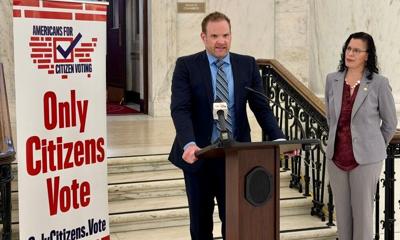


Jack Tomczak with Americans for Citizen Voting speaks during a September 15 press conference at the West Virginia Capitol while state Sen. Patricia Rucker (R-Jefferson) listens.
CHARLESTON – An amendment on this fall’s ballot would ensure that only United States citizens can vote in West Virginia elections.
Senate Joint Resolution passed on the final day of this year’s legislative session. It will appear as Amendment 1 and will be called the Citizenship Requirement to Vote in West Virginia Elections Amendment.
"This amendment provides that in all elections held in West Virginia only citizens of the United States who are citizens of this state are qualified to vote,” the ballot will read.
If passed, the amendment will modify Section 1, Article IV of the state Constitution to prohibit persons not United States citizens from voting in any election held within the state.
On September 15, state Senator Patricia Rucker (R-Jefferson) conducted a press conference at the state Capitol to explain the importance of the amendment.
“West Virginia already has in code that only citizens can vote in elections, but that is not enough,” Rucker said during Tuesday’s press conference. “That’s law, and law can change, as we know. But the language in our Constitution is not clear.”
West Virginia Code §3-2-2 requires U.S. citizenship for voting. However, the state Constitution (art. 4, sec. 1) only expressly requires voters to be “citizens of the state” and not specifically U.S. citizens. “Citizen” is defined by state Constitution art. 2, sec. 3, which includes but is not limited to a person who is “residing in this state.”
Thus, a non-U.S. citizen who resides in West Virginia is currently a state “citizen” under the West Virginia Constitution. There is no requirement to be a U.S. citizen in the West Virginia Constitution to be a state citizen.
The proposed amendment does not change state citizenship requirements, but it does expressly require U.S. citizenship as a prerequisite for voter registration, aligning the state Constitution with current state election law.
“This proposed amendment will ensure that no future Legislature can just simply change things,” Rucker, who is the assistant majority leader, said. “It also gives us greater authority to enforce the law we currently have in place.”
Rucker, who is a naturalized citizen originally from Venezuela, said citizenship and the right to vote are important issues to her.
“Every year, we welcome new naturalized citizens in our state,” she said. “Individuals like myself, who went through the proper and legal process to become a United States citizen. Just like I did, those new citizens were in both of allegiance to our country and the Constitution.
“It has never been more important to me that we ensure that that oath and that allegiance matters, and it’s necessary in order to be able to vote and determine who is going to be guiding our state in the future.”
A leader of a national advocacy group that supports citizen-only voting initiatives across the country is optimistic the amendment will be approved by voters.
“Since 2018, 15 states have amended their state constitution to make it to only U.S. citizens are allowed to vote in the United States and federal elections,” said Jack Tomzcak, vice president of outreach for Americans for Citizen Voting. “And in every state, it has passed with overwhelming support, and we anticipate that again here in West Virginia.”
In recent years, several states have passed constitutional amendments to ensure non-citizens don’t vote in state elections. West Virginia, for example, has an amendment on the ballot in this fall’s election.
In recent years, ACV has worked to have similar measures adopted in states. Texas voters approved a similar measure in November. And in 2024, eight states (Idaho, Iowa, Kentucky, Missouri, North Carolina, Oklahoma, South Carolina and Wisconsin) passed laws to keep non-citizens from voting.
Including Texas, 21 states now have laws ensuring only American citizens can vote in those states, and several other states are actively considering such legislation.
Legislatures in Arkansas, Kansas and South Dakota also have placed amendments on the 2026 ballot.
Rucker said she has met people on the campaign trail who were not U.S. citizens who were registered to vote and thought they could do so.
“It was, in their case, inadvertent,” she said. “They just didn't understand. Some of them had … automatically checked the boxes at the DMV without understanding that. The box says, you must be a citizen. …
“But I do know that it is an issue. Folks do not necessarily understand that in order to vote in West Virginia, you must be a citizen.”
Tomczak said the amendment doesn’t make non-citizen voting, which already is against the law, “more illegal.”
“This amendment just makes it so a city can’t legalize a non-citizen,” he said. “There are four states plus the District of Colombia where non-citizen voting has been legalized on municipal or school board members. Those states are California, Illinois, Vermont and Maryland. Those four states have constitutions that are similar to West Virginia. …
“This (amendment) prevents cities from letting non-citizens vote legally rather than preventing unintentional voting. There is wiggle room on this now, and the amendment will clarify it so that it leaves no window.”
Rucker said becoming a U.S. citizen through naturalization gives her a unique perspective on the issue.
“I did it the right way, which meant that I turned over my passport and my visa to immigration,” she said. “And then, at that point, I was unable to travel, unable to seek new employment … you are essentially locking yourself in, waiting for INS to decide. It’s a huge sacrifice. I was very fortunate that I had a job and also my husband found a job and could support me.
“But you do it because you desperately want to give back to this country, and you feel that it is important. My loyalty is with the United States America, and that means getting to go to that ballot box and getting to make my choice. The thought that people could do that without going through that process, not only makes what I did senseless, but you’d have folks making decisions on who’s representing you that have no skin in the game at all.
“I feel that the responsibility of citizenship is super, super important, and should be something you really commit yourself to.”