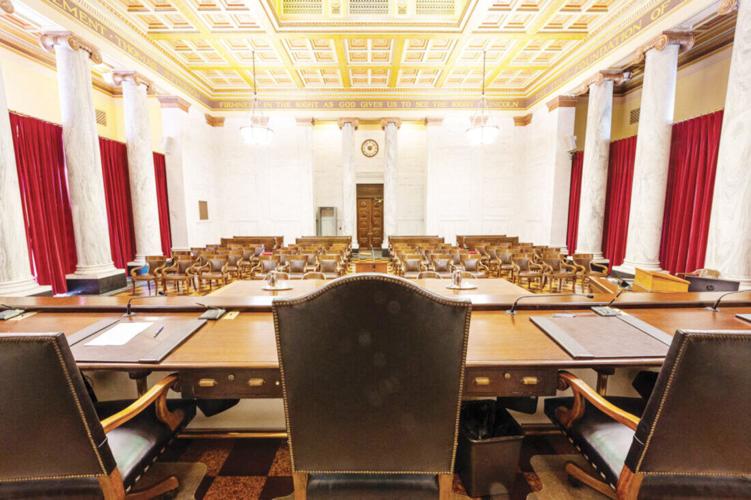




CHARLESTON – The state Supreme Court has suspended the law license of an Elkins attorney and former state delegate for one year for failing to properly communicate with his clients.
In a March 27 opinion, the Justices also ordered Phillip S. Isner to refund $2,500 to one client and pay the costs associated with his proceedings to the state Lawyer Disciplinary Board.
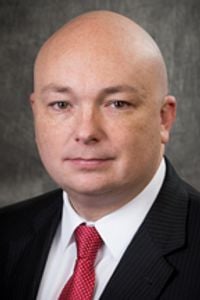
Isner
The LDB’s Hearing Panel Subcommittee had found Isner committed 25 violations of the West Virginia Rules of Professional Conduct arising from a seven-count statement of charges issued in July 2024. The HPS alleged Isner failed to properly communicate with his clients, diligently and competently expedite litigation consistent with their interests, timely prepare orders as required by tribunal rules, and perfect an appeal.

Bunn
The HPS essentially recommended the punishment handed down in the Supreme Court opinion, but Isner object to the HPS’s recommendation, sending it to the justices. In the opinion written by Chief Justice Haley Bunn, the court said Isner committed 24 violations.
Isner was admitted to the State Bar in 2003, and he says his practice currently consists of 80% abuse and neglect litigation with the rest being criminal defense.
He previously was admonished in 2017 and 2020, and the LDB’s Investigative Panel issued a three-count statement of charges against him in 2022 alleging violations of most of the same rules in these charges. The court ordered two years of supervised practice then effective August 2023.
IN February 2024, the court also found Isner in contempt of the disciplinary order requiring him to pay the costs of earlier proceedings, provide proof of compliance with enhanced continuing legal education and submit monthly supervision reports to the Office of Disciplinary Counsel. Isner purged himself of this contempt and resumed his supervised practice
The charges in the seven complaints related to this newest discipline accuse Isner of a lack of diligence and competence as well as failure to communicate and expedite litigation.
“In general, the complainants allege that they retained Mr. Isner to do work which he did not timely or competently perform, that he did not communicate with them, that he failed to appear for appointments, and was otherwise unreachable to discuss their cases,” Bunn wrote. “Three complain of his failure to return property or money at end of his representation. Apart from certain of the violations alleged in Counts 2 and 6, Mr. Isner admitted the majority of the alleged rule violations in either his answer to the Statement of Charges or by conceding them in the proposed findings he submitted following the evidentiary hearing before the HPS. …
“In many of those admissions, however, Mr. Isner characterized the violations as merely ‘technical violations.’”
The opinion says Isner challenges the HPS’s findings, claiming the ODC failed to present clear and convincing evidence that he violated duties and that the HPS’s recommended suspension exceeds sanctions imposed for comparable misconduct.
“As Mr. Isner correctly observes, our rules require ODC to prove allegations of misconduct by clear and convincing evidence,” Bunn wrote. “However, the record reflects that Mr. Isner failed to file discovery in accordance with the scheduling order issued by the HPS. As a result, the HPS granted ODC’s motion to exclude all witnesses, exhibits, or mitigating evidence offered by Mr. Isner at his evidentiary hearing — a motion Mr. Isner did not oppose.
“While he was permitted to testify on his own behalf and cross-examine the complainants, Mr. Isner was not permitted to offer additional witnesses or introduce evidence to contradict the complainants’ testimony.
“Although Mr. Isner attacks the adequacy of ODC’s evidence, this self-inflicted evidentiary prohibition leaves him ill-equipped to rebut ODC’s evidence or corroborate his denials of misconduct.”
Bunn says the court has often reminded that the HPS “is in a better position than this court to resolve the factual disputes which may arise in a case” because it “hears the testimony of the witnesses firsthand and, being much closer to the pulse of the hearing, is much better situated to resolve such issues as credibility.”
“Due to his own neglect, Mr. Isner was foreclosed from offering any evidence to contradict the complainants’ thematically consistent testimony about his refusal to return phone calls, provide timely information, attend scheduled meetings, or timely perform promised work — even across years of representation in various matters,” Bunn wrote. “Contrary to Mr. Isner’s arguments, it was his own testimony that lacked corroboration while the complainants’ testimony was corroborated across the various counts.
“Client after client shared virtually identical complaints about Mr. Isner’s refusal to return phone calls, keep them informed about their cases, and timely and properly perform promised work, most of which Mr. Isner admitted in either his answer or proposed findings.”
In his opposition to the HPS’s recommended one-year suspension, Bunn says Isner claimed his misconduct was not “knowing,” as found by the HPS, but merely negligent. He further argues that his misconduct caused little to no harm on the whole, and that a one-year suspension exceeds the discipline rendered in similar cases.
“More generally, Mr. Isner insists these violations are the residue of the ‘practice management shortcomings, isolated delays and communication lapses’ that the discipline arising from his 2022 charges — and particularly his supervised practice — has already addressed,” she wrote. “He contends that a one-year suspension will derail the significant progress and improvements he has made since his supervised practice began in August 2023.”
The court rejected Isner’s characterization of his misconduct as simple negligence.
“His disciplinary history and the numerous complaints in this matter reflect an unrelenting refusal to communicate with his clients and diligently perform work, even after receiving multiple ethics complaints for this behavior for which he was required to answer before disciplinary authorities and this court,” Bunn wrote. “This same type of misconduct dates back as far as 2017 and, contrary to Mr. Isner’s assertions, did not abruptly cease after he began his supervised practice.”
The court and HPS agreed Isner was remorseful and generally cooperative in the underlying proceedings.
But “his sustained pattern of misconduct for nearly a decade, along with his disciplinary history, necessitate suspension,” Bunn wrote. “We commend Mr. Isner for his interest in continuing his practice management improvements, however, our prior supervised practice requirement did not grant him immunity from discipline for complaints not yet adjudicated.
“Even if Mr. Isner had comprehensively addressed the practice management shortcomings to which he attributes the underlying complaints, lawyer discipline is not merely corrective.”
Isner is a native of Elkins and a 2003 graduate of the West Virginia University College of Law. He served in the House of Delegates from 2016 to 2018 as a Democrat. He unsuccessfully ran for the same seat in 2020.
West Virginia Supreme Court of Appeals case number 24-376 (Lawyer Disciplinary Proceeding case numbers 22-02-471, 22-02-484, 23-02-163, 23-02-262, 23-02-362, 24-02-047 and 24-02-050)