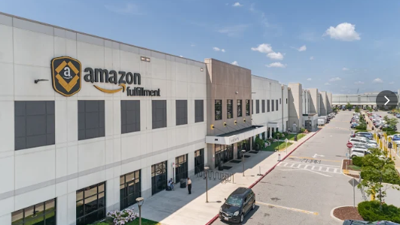



Amazon fulfillment center
CHICAGO — Amazon is asking federal judges to slap a hold on money transfers judges have ordered the online retail marketplace giant to make, as Amazon seeks more time to investigate potential lawsuit settlement abuse in apparently routine trademark infringement suits, which Amazon asserts may be the result of "potential collusion" to secure court orders to unlock sellers' money Amazon had frozen for different reasons.
Since August, Amazon has filed motions in a mounting number of so-called Schedule A trademark infringement cases in which Amazon is not a party. The motions request a stay of orders previously entered by federal judges, directing Amazon to transfer money from sellers who are accuse of selling goods that violate trademark protections to outside companies claiming to hold the infringed intellectual property.
In the motions, Amazon says it has grown increasingly suspicious of many of these settlements and is asking judges for more time to investigate the lawsuits and resulting settlements before the money is paid out and disappears.
"Amazon recently identified a number of concerning patterns in some Schedule A cases that suggest that certain plaintiffs and defendants in Schedule A cases may be colluding with one another to obtain transfer orders in order to extricate funds from an Amazon marketplace account that had already been frozen by Amazon for independent enforcement reasons unrelated to the claims asserted in the Schedule A case that gave rise to the transfer order," Amazon wrote in a Sept. 30 filing in one of the cases.
"In other words, Amazon has reason to believe that some Amazon merchants, or entities or individuals acting on their behalf, are using Schedule A litigation and the transfer orders that result therefrom to cause funds to be paid to themselves in order to circumvent other enforcement actions that have already caused those same funds in the defendants’ merchant accounts to be frozen."
The so-called Schedule A lawsuits have become a widespread mechanism for companies to pursue compensation and redress against individuals and other companies they accuse of using online marketplaces to sell counterfeit merchandise that allegedly featured their trademarks.
The lawsuits have notably been used by professional and college sports teams and leagues, including the NFL, Major League Baseball and NBA; luxury and designer brands, including Rolex, Gucci and Dior; entertainment companies, including Disney, Warner Bros. and Lucasfilm; gaming companies, like Nintendo; and an array of consumer and beauty brands, among others.
Many of the lawsuits appear to target companies and individuals based in China or other Asian countries.
The cases have descended by the thousands into federal court, with most lodged in the Northern District of Illinois courts in Chicago.
When Schedule A defendants settle or otherwise are ordered to pay, the funds are often paid under so-called turnover orders, in which Amazon and other online marketplace operators are directed by the court to take the funds out of the sellers' accounts and transfer it to the Schedule A plaintiffs.
However, in the new filings, Amazon says it has grown increasingly suspicious of some of these settlements.
The first such motion to stay was lodged in litigation between a company identified as NextClimb Investments LLC and a series of online Amazon sellers.
In that case, Amazon noted NextClimb and the defendants agreed to settlements which include suspiciously precise amounts. Amazon noted the settlement amounts correspond "to the cent" to amounts Amazon on which Amazon had placed "internal restraint."
They noted, for instance, that NextClimb had agreed to accept $14,780 from one Amazon seller and exactly $7,953.26 from another.
"Where purported settlement amounts precisely match the entirety of a seller’s restrained balance, carried out to the cent, it raises a substantial question whether the 'settlements' were negotiated based on the merits of the underlying dispute or were instead determined by the amount of funds available in each account," Amazon wrote in the motion in the NextClimb case.
Further, Amazon noted NextClimb claims to hold trademark rights to "HVAC vent covers." But the alleged trademark claims involved sellers offering "DIY Christmas Ornament Kits" and "platform boots and knee-high boots."
"Amazon’s review to date has not identified sales or listings by these sellers involving HVAC vent covers or other products bearing the asserted NEXTCLIMB mark," Amazon wrote. "That apparent disconnect raises a substantial question as to the factual basis for naming those sellers as defendants and for the resulting settlements."
In the NextClimb motion, Amazon asserts its investigation involves NextClimb, and NextClimb's lawyer, identified as Shaoyi Che, of the firm of YoungZeal LLP, of Frisco, Texas.
However, Amazon said the "full scope of potentially affected matters remains under investigation." The company said its initial review of "just four NextClimb cases" involves "more than $4.67 million from 435 seller accounts to plaintiff's counsel."
Amazon said its initial investigation has also "identified potentially similar activity in cases involving other plaintiffs and at least four other plaintiff-side law firms." The filing does not identify those other firms or plaintiffs.
However, Northern District of Illinois court records indicate Amazon has filed similar motions to stay in more than two dozen cases.
Attorneys representing plaintiffs in those cases include: Dongying Su, of Hyacinth Law, of Evanstonl; Qin Zhuang, of Haworth, New Jersey; Faye Yifei Deng, of YK Law LLP, of Los Angeles; Wengang He, of Custos Law APC, of Chicago; Di Li, of Di Li Law, of City of Industry, California; Yifeng Hao, of Alioth Law PC, of Sacramento, Washington; and Ziyuan Zhang, of J. Zhang and Associates, of Flushing, New York.
The initial filing in the NextClimb motion was redacted and kept largely under wraps in court until early October. In the meantime, however, Amazon lodged motions to stay in many of the other Schedule A cases, all requesting the same relief based on the same allegations and alleged need for further investigation.
While the motion to stay in the NextClimb case remains pending, judges in many of the other Schedule A cases in which Amazon has filed motions to stay have granted the motions in recent days.
In some of those orders, a federal judge has specifically linked the duration of the stay to the outcome of the NextClimb motion.
Amazon is represented in the matters by attorneys from the firm of Kilpatrick Townsend & Stockton, of Chicago.