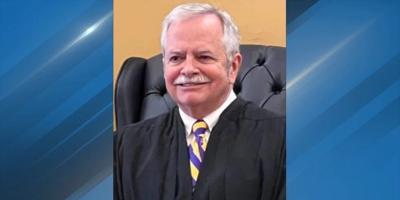



Judge Tim Sweeney
CHARLESTON – West Virginia Supreme Court justices questioned whether a circuit judge’s efforts to force action on child welfare staffing shortages crossed ethical boundaries, weighing arguments he improperly used his office against his attorney’s contention that he acted to protect children.
The court heard arguments October 14 in the disciplinary case against Third Circuit Judge Timothy Sweeney, who is challenging ethics charges stemming from a February 2025 order, interviews with news organizations and Facebook posts promoting fundraisers and law enforcement activities.
Judicial Disciplinary Counsel Teresa Tarr asked the justices to find violations on all charges, including those the Judicial Hearing Board declined to sustain, and publicly admonish Sweeney. His attorney, J.H. Mahaney, urged the court to dismiss the charges, arguing that the judge’s intervention improved services for vulnerable children and that any procedural mistakes should not become disciplinary offenses.
“Sometimes when judges have to make difficult decisions on the bench, the ends do justify the means,” Mahaney told the court. “Sometimes when it comes to the welfare and safety of children, the ends are what really matters.”
Tarr argued that accepting Sweeney’s explanations – that his Facebook posts were informational and his media interviews justified by their results – would undermine the rules governing judges.
“If the court were to adopt either one of those, that would basically nullify the Code of Judicial Conduct,” she said.
The justices took the case under advisement without announcing a decision.
The dispute grew out of a February 3, 2025, review hearing in an abuse and neglect case involving a child who had not received a previously ordered treatment placement. According to Sweeney’s response brief, Child Protective Services employees testified that severe staffing shortages prevented them from meeting children’s needs. One worker described handling about 100 families when best practice called for about 10.
Sweeney subsequently issued an administrative order assigning then-Department of Human Services Secretary Alex Mayer and other senior agency officials to temporary CPS duties. He directed them to appear February 20, 2025, to receive assignments, under threat of contempt.
He also spoke with news organizations about the shortages, arguing that someone needed to stand up for children. The Judicial Investigation Commission publicly admonished him in June 2025. His objection led to formal disciplinary proceedings.
At Wednesday’s oral arguments, Mahaney said a worker had pleaded for help getting officials in Charleston to respond.
“Maybe they’ll listen to you,” Mahaney said, recounting the worker’s appeal to Sweeney. “Help me.”
Mahaney argued that Sweeney’s response produced results: Mayer met with the judge, and staffing increased before the scheduled February 20 appearance.
“Children, their safety was being improved,” Mahaney said. “The caseworkers were improved. That has to count for something.”
But Chief Justice Haley Bunn questioned what limits would remain if judges could use public pressure to address systemic problems outside their branch of government.
“If there is no discipline in this situation, what’s to stop any judicial officer from seeing a systemic problem … and using his or her position to step outside the role of the judiciary’s branch?” Bunn asked.
Mahaney said the distinction was good faith, citing the hearing board’s finding that Sweeney acted to help children. If the court concluded that his procedures were improper, he argued, it could correct the legal error without imposing discipline.
“If you go too far, it is a legally correctable matter, not an ethics matter,” he said.
Tarr argued that Sweeney denied agency officials notice and an opportunity to be heard before assigning them duties. She also contended that he disclosed information arising from a confidential abuse and neglect proceeding without the findings necessary to authorize its release.
A justice asked whether the department could have challenged the order through a petition for a writ.
Tarr responded that the burden should not fall on parties to challenge improper judicial conduct. She said Sweeney used news coverage to pressure the department and effectively placed himself in the position of a party.
“He went to the news media and talked to the news media to strong-arm them into doing what he wanted,” Tarr said.
Mahaney countered that the department never objected to the order, despite knowing how to seek judicial relief. He also disputed that Sweeney’s interviews improperly addressed a pending case, saying the judge discussed systemic staffing failures rather than the merits of a particular proceeding.
Justice H.L. “Kirk” Kirkpatrick acknowledged Sweeney’s frustration but questioned that distinction.
“It’s uncontroverted that he was speaking about pending cases,” Kirkpatrick said. “Isn’t that correct?”
“I don’t believe that’s true,” Mahaney responded. “He talked about systemic problems, not a pending case, and that is a very different thing.”
Tarr maintained that both the underlying child welfare proceeding and the administrative matter remained pending when Sweeney spoke publicly. In rebuttal, she also argued that staffing decisions belonged to the executive branch, not the judiciary.
The court also examined charges involving Sweeney’s Facebook activity, including shared law enforcement job announcements, fundraising notices, human-trafficking stories and public-safety messages. His profile photograph showed him wearing a judicial robe in a courtroom.
Tarr argued that fundraising posts amounted to prohibited solicitations. They included an ice cream social benefiting a volunteer fire department and benefits for a sheriff’s deputy who was ill.
Bunn questioned whether sharing such notices was comparable to the direct solicitations involved in earlier disciplinary cases Tarr cited.
“It’s not as direct, but it’s still direct because people post things for a reason,” Tarr said. “They post things because they want a response.”
Tarr also argued that posts about criminal matters, along with Sweeney’s reactions to comments, conveyed a pro-prosecution and pro-law-enforcement outlook inconsistent with judicial impartiality.
Mahaney said the Facebook allegations arose only after disciplinary investigators began examining the child welfare matter.
“Nobody ever complained about the Facebook charges,” he said. “No one ever said, ‘Hey, I feel aggrieved by that.’”
He challenged the hearing board’s conclusion that posts could collectively create an appearance of partiality even when individual posts were not themselves violations – an approach described in Sweeney’s brief as an “aggregation” theory.
Bunn questioned why the rules’ concern with judicial integrity and conduct would prevent the board from considering the posts together.
Mahaney said disciplinary counsel still had to prove violations by clear and convincing evidence. He said the posts served community purposes, did not personally benefit Sweeney and caused no harm.
Tarr disputed the claim Sweeney received no benefit. She said he testified that he wanted the public to know he supported the deputy, portraying himself favorably even if he received nothing tangible.
Mahaney closed by arguing that Sweeney should not face punishment for trying to address conditions that endangered children.
“Judge Sweeney doesn’t want applause,” he said. “He did this to try to be helpful. And that has to count for something.”