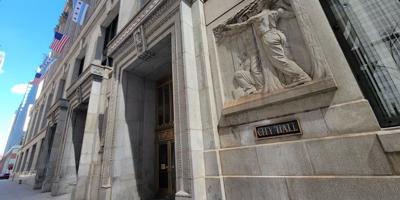


Chicago City Hall
CHICAGO — Even as Chicago's civilian police oversight board has cleared nearly every misconduct claim against the police officers involved in the death of Dexter Reed, a Chicago man killed after he opened fire on police during a West Side traffic stop, lawyers for the city have also asked a judge to dismiss Reed's family's lawsuit seeking to make the city pay for Reed's death.
In late January, the city filed a motion to dismiss the lawsuit filed by Reed's mother, Nicole Banks, in which she seeks a payout potentially worth millions of dollars over her son's headline-grabbing death amid a shootout with Chicago Police.
In the motion to dismiss, the city asserts Reed's relatives have no basis to bring a lawsuit over the incident, in which investigators agree he fired his gun first, prompting police to return fire.
In the filing, the city argues the traffic stop was lawful, and was not part of any ongoing pattern of "objectively unreasonable traffic stops conducted without reasonable articulable suspicion." Nor can Reed's family identify any "current pattern and practice of excessive force" that could justify Reed's decision to not comply with officers' demands during the stop and then pull a gun and fire at officers.
The dismissal motion came about a month after the court ordered the case to be reinstated in December 2025. And that reinstatement came, in turn, about eight months after indignant Chicago aldermen on the City Council rejected an attempt by the administration of Mayor Brandon Johnson to push through a $1.25 million deal to pay Banks and end the legal action quickly.
At the time, some aldermen against the settlement have described the deal as "absurd" and "an absolute embarrassment," with opponents noting allowing such a payout to Reed's family would signal to police and criminals alike that the city doesn't value its police officers and any violent encounter with police - even if they are the fault of the criminal - could lead to a large and quick payday for criminals and their families.
Banks had filed suit in 2024, quickly after Reed's death and before Chicago's Civilian Office of Police Accountability (COPA) had even begun its investigation into the incident in earnest.
Banks is represented by attorneys Andrew M. Stroth, of Action Injury Law Group; Steven A. Hart and Bradley Kupiec, of Hart McLaughlin & Eldridge; and Sheila A. Bedi and Kara C. Crutcher, of the Community Justice and Civil Rights Clinic, of the Northwestern Pritzker School of Law, all of Chicago.
Reed died in a traffic stop on March 21, 2024.
According to published accounts, a Chicago Police tactical unit pulled Reed's vehicle over in a portion of Chicago's Humboldt Park neighborhood known by police and the public alike for extensive problems with gang activity and gun violence.
According to accounts and video evidence, police ordered Reed to lower his window. Reed initially complied. However, video of the incident showed he rolled his car window back up while talking with police, despite repeated command from officers to keep his window down. In response to officers' commands, Reed repeatedly said, "OK, I'm trying," but continued to roll his window up.
Reed then reportedly opened fire on officers from within the vehicle, striking one officer in the hand. Officers then returned fire from multiple directions, killing Reed. According to reports, an emptied ammunition magazine was found inside Reed's vehicle.
Almost immediately after the incident, the former head of COPA, Andrea Kersten, and Mayor Johnson moved quickly to fault police for Reed's death, despite knowing evidence indicated Reed disobeyed officers' commands and fired first.
Reed's family's lawsuit rested heavily on statements Kersten made in a letter to Chicago's police superintendent about Reed's death. In that letter, Kersten said her initial review of video of the incident raised concerns over the officers' justification for the traffic stop and officers' actions up to and including their decision to collectively fire at and kill Reed that day after Reed opened fire on them from inside his vehicle.
Following the shooting, Kersten also repeatedly made statements questioning officers and their tactics in various media interviews, despite her responsibility to ultimately lead the investigation into the incident.
Kersten's handling of the Reed investigation appeared to play a significant role in her ultimate ouster from the top spot at COPA in February 2025. While she resigned, it was widely acknowledged she resigned under pressure from the mayor's office.
COPA's investigation into the shooting wrapped in February 2026, with investigators almost entirely clearing officers involved in Reed's death of misconduct. The COPA report remains closed, as it has been forwarded to Chicago Police Superintendent Larry Snelling for review and further action.
It is not known how the results of that investigation may factor into proceedings over Reed's family's lawsuit.
However, in a published about the completion of the COPA report by Block Club Chicago, Reed's family's lawyers said they were “disappointed by this decision by the Civilian Office of Police Accountability and would like to see the full investigative report.”
In their lawsuit, Reed's family have attempted to claim police were the actual aggressors.
The lawsuit asserted officers, who were members of a special Chicago Police Department tactical unit operating in plain clothes in an unmarked vehicle in the high crime Humboldt Park neighborhood, pulled Reed over for no reason, and then "approaching him aggressively ... brandished their weapons in a threatening manner, screamed curse words at (Reed), and attempted to unlawfully enter his vehicle."
The lawsuit did not concede that Reed fired first, even though Kersten has repeatedly stated she believes that is what the evidence indicates.
Rather, the lawsuit claimed officers "used wildly disproportionate force against (Reed) - repeatedly shooting at him even when he clearly presented no threat."
The lawsuit further claimed that Reed suffered from post-traumatic stress disorder, caused, in part, by living in a high crime neighborhood subject to "hyper policing" and other alleged abuses by Chicago Police officers.
The lawsuit claimed, without evidence, that Reed's PTSD caused him to react poorly to officers' commands, for instance, rolling his car window back up when commanded to roll down the other windows, while repeatedly stating "Okay, okay I'm trying" in response to officers' further commands.
The lawsuit asserted police officers should have known "when stopping people in a neighborhood historically and culturally known for its heightened levels of police harassment and violent traffic stops, there is a strong likelihood that the individual lives with PTSD symptoms such as hypervigilance."
The lawsuit accused officers of violating federal law and Reed's Fourth Amendment rights, and of excessive force.
The lawsuit further leveled accusations of racism against the officers and Chicago Police in general, claiming the traffic stop was "unlawful" and is part of a "longstanding practice" by CPD of allegedly using legal "pretexts" to pull over black drivers on Chicago's south and west sides, particularly in high crime neighborhoods.
They asserted the officers only stopped Reed "because he was a young, Black man driving a vehicle on the westside of Chicago."
In seeking to dismiss the lawsuit, however, the city asserts Reed's family can't produce evidence or legal precedent to back their demands for payment from the city in a case in which their deceased relative fired at police.
The city asserts officers were legally justified under U.S. Supreme Court precedent to stop Reed, who was observed driving without a seat belt and operating a vehicle with illegally tinted front windows.
And they said the evidence indicates Reed appeared to refuse to comply with officers' instructions, including to roll down his rear windows, and instead did the opposite, rolling up his front drivers' side window, disobeying officers' clear command to keep the window down.
Reed also refused officers' instructions to unlock his doors.
The city notes it was only at that point that officers drew their weapons, out of concern Reed might be about to take action against them.
"Reed was not treated as a threat until he failed to comply with the Officers’ direct commands to roll down his windows and unlock his doors," the city asserts.
"... Faced with this situation, a 'reasonable officer' in light of the totality of these circumstances would assess Reed’s actions as a threat to the safety of the officers conducting the traffic stop and any civilians in the area, and react to this threat by drawing his or her weapon, and taking a defensive stance to preserve the safety of the officers and civilians.
"... Their actions were objectively reasonable and did not violate Reed’s rights...," the city asserts.
Reed then fired his weapon, prompting officers to return fire, the city says.
Further, the city argues the claims that the city should pay because Reed was acting under a fear of excessive force because of a pattern of such alleged misconduct by police officers doesn't square with evidence showing the city has reformed its policing operations, and sharply decreased complaints of excessive force during encounters with police.
"This data supports that the City is not maintaining a custom or practice of excessive force, but is diligently working to reform and improve its services," the city argues.
Plaintiffs have not yet responded to the city's motion. And the judge has not yet ruled in the matter.