
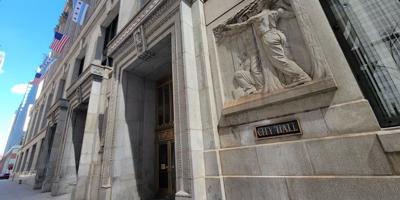


Chicago City Hall
CHICAGO — A federal judge won’t let a marketing firm sue Chicago for pulling the plug on an illuminated skyscraper presentation planned to coincide with NBA All-Star Game festivities near the United Center in 2020.
U.S. District Judge Steven Seeger filed an opinion Sept. 30 granting summary judgment to the city in the lawsuit it faced from National Experiential. According to court records, the dispute involves the firm’s deal with Nike to laser-project footage of Michael Jordan’s 1988 Slam Dunk Contest victory on the Prudential Building and the word "United" on the Aon Center with Jordan’s iconic Jumpman logo in place of the letter "I."
Seeger explained National had a contract with the Chicago Department of Cultural Affairs and Special Events and got licenses to put its projection equipment in a city park. The company said it obtained assurances from MB Real Estate Services, which manages Millennium Park, that it didn’t need additional permits.
However, Seeger explained, “A local ordinance banned temporary illuminated signs and dynamic displays for commercial speech. Unfortunately for National Experiential, the Nike projection was a double whammy: it was illuminated and dynamic. So, the city pulled the plug on the project.”
The city also rejected the company’s position the video was “art with no commercial message,” a determination National found material after the Prudential building was lit in red to allude to the Bulls while several floors of Blue Cross building windows were illuminated to read “NBA All-Star 2020.”
It claimed Chicago Sports Commission Executive Director Kara Bachman slyly spiked the Nike art in favor of the Prudential building hue.
After two rounds of dismissal motions, Seeger said, National’s claims against the Commission, Bachman and MB Real Estate Services fell off with only its First Amendment claims against Chicago remaining: that the ordinance violates rights as written and as the city applied it to the situation, as well as an excessive discretion allegation. Both parties moved for summary judgment.
Seeger’s opinion included renderings from National’s 35-second video detailing its display plans. He also said National’s contract with MBRE warned the company “it might need a permit, if local ordinances required one. And the agreement put the burden squarely on the shoulders of National Experiential to get a permit, if a permit was necessary at all.”
The judge also described the “bureaucratic frenzy” that ensued two days before the display was to go live when Zoning Administrator Patrick Murphey — upon hearing of the project for the first time — determined it conflicted with city ordinance. Murphey also rejected the “art with no commercial message” argument less than an hour before the scheduled start time.
National argued the city ordinance doesn’t serve a compelling government interest to restrict commercial speech more stringently than artistic or other expression. Seeger said there is “some intuitive appeal” to that position, but then explained the importance of the 1980 U.S. Supreme Court opinion Central Hudson Gas & Electric v. Public Service Commission which, he said, “articulated a more forgiving, intermediate scrutiny standard for commercial regulations. In the decades that followed, the Supreme Court has poured cement around the notion that commercial speech receives less protection than other forms of speech.”
Seeger noted a 2015 Supreme Court ruling, Reed v. Town of Gilbert, as National argued that ruling came down against “different levels of protection to different categories of speech. But Central Hudson authorizes the government to do just that. It gives the government greater latitude to regulate commercial speech than other forms of expression,” a precedent no court has determined is undone by the Reed ruling.
After determining the correct standard, Seeger then explained why Chicago’s ordinance meets that benchmark. He said the city’s reasons for the ban include traffic safety and aesthetics, noting those reasons qualify as “significant government interests” before agreeing the regulation itself directly advances those interests.
“The city wants to avoid distractions for drivers, and wants to keep Chicago the most beautiful city in America,” Seeger wrote. “The city was well within its rights to conclude that banning illuminated signs and dynamic displays containing commercial messages would promote those goals. Not everyone wants Chicago to look like Times Square.”
As to whether the ordinance is “more extensive than necessary,” Seeger said the question returns to whether a distinction between commercial and noncommercial displays is justified.
“An artistic display can distract drivers just as much as commercial speech,” Seeger wrote. “Imagine an oversized illuminated display of Mona Lisa walking hand-in-hand through a meadow with Michelangelo himself, with a jealous David watching longingly in the background. It might cause drivers to look up, give a look, and not see the helmetless twenty-something bro-dude pedaling super slowly on a Divvy bike. There is nothing about commercial speech that is inherently more distracting to drivers than artistic speech. Everyone loves looking at Michael Jordan perform his magic on the basketball court. But plenty of people enjoy gazing at artwork, too. It’s hard to take your eyes off both of them.”
However, Seeger said, the city reasonably concluded “art is prettier than ads,” meaning the ordinance serves its interest of “preserving an attractive visual environment.” But he also examined how the broad ordinance language creates confusion around speech that is neither commercial nor artistic, such as a political or religious message, like something acknowledging a national political convention or saying “Welcome Home, Pope.” Still, because neither party raised that concern, Seeger didn’t make an official ruling.
“The contours of National Experiential’s as-applied challenge are hazy,” Seeger continued, saying it seemed the argument is one of selective enforcement based on CSC’s Prudential and Aon displays. But to prevail, he said, National would have to show “the city called off the Nike projection because of its viewpoint,” while the record shows Murphey sincerely believed the Jordan campaign violated the ordinance.
“The parties spill a lot of ink arguing about whether the Jumpman logo contains a commercial message,” Seeger wrote. “That question seems like a slam dunk. But it’s also beside the point” because the only question is if the city applied its ordinance without violating constitutional protections, and “after discovery, National Experiential doesn’t have enough evidence to support” claims the city favored the Bulls and NBA over Nike.
As for the CSC display, he continued, it did so “without getting the blessing of the city itself,” which means National can’t show the city chose one entity over another, and said even if it did, turning the Prudential Building red might’ve been acceptable because colored lights aren’t a “sign” and don’t explicitly convey a commercial message. It was Valentine’s Day, Seeger noted, so red lights could’ve had multiple meanings.
Seeger rejected National’s comparison to the "Art on the MART" digital modern art displays that illuminate the Merchandise Mart building from April through December, explaining the widely-recognized Jumpman logo is inherently commercial.
Finally, Seeger rejected the excessive discretion claim, which originally rested on allegations the city zoning administrator has too much power in the ability to approve or reject temporary signs. But Seeger said the company attempted a “bait and switch” by arguing in its summary judgment motion against the exemption for noncommercial art.
“The court declines to consider the new legal theory,” Seeger wrote. “National Experiential cannot take a shot after the buzzer sounds and expect the court to count it. The time for amendment has long passed. This litigation has been ongoing since 2021. National Experiential had ample opportunity to bring this claim before now.”
Further, he said, the argument is meritless because the code adequately defines what constitutes a “commercial message” and Murphey applied those criteria.
