

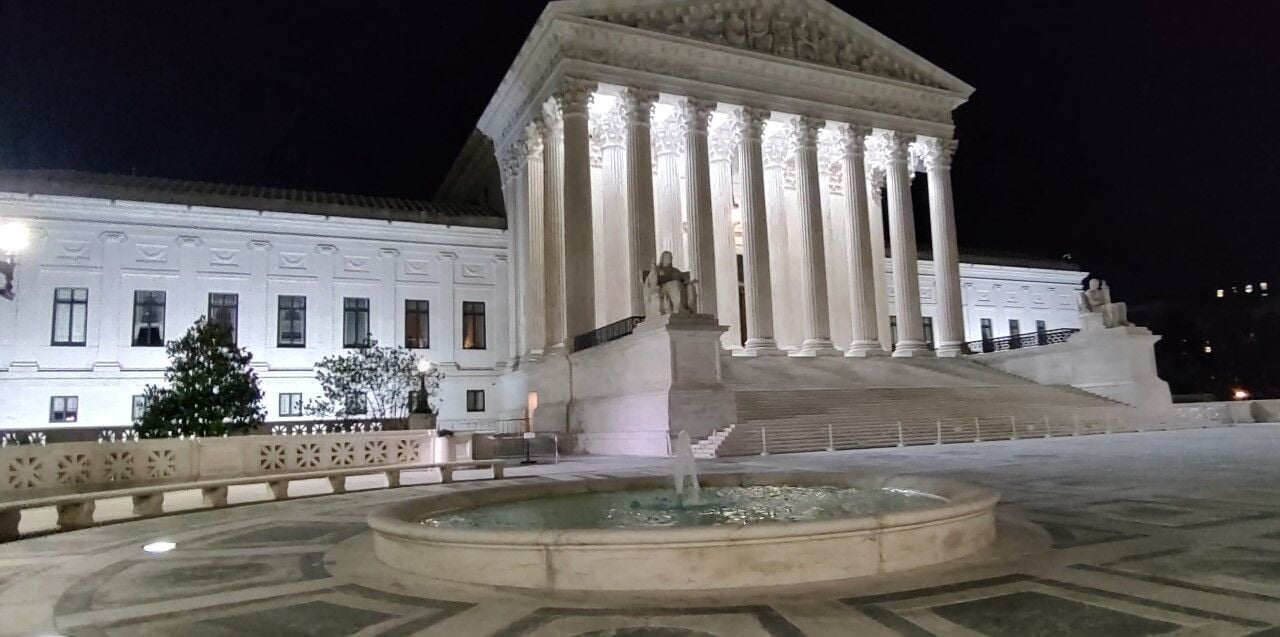
U.S. Supreme Court
WASHINGTON, D.C. — Less than a month before the Supreme Court is scheduled to take up the legal challenge against Cook County's so-called "assault weapons" ban, lawyers for the county are asking the high court to pull the plug on the case, saying the case should now end because one of the petitioners challenging the gun ban abruptly indicated he is stepping away from the matter.
On Nov. 5, Cook County State's Attorney Eileen O'Neill Burke filed a motion before the U.S. Supreme Court, asking justices to declare the case against the county's gun ban ordinance "moot."
In that motion, they assert the as-yet unexplained decision by petitioner Cutberto Viramontes to ask the court for permission to be dismissed from the case means the challenge no longer has any viable plaintiffs to move it forward in court.
The county asserts the remaining individual co-petitioner in the case, identified as Christopher Khaya, shouldn't be allowed to continue in the case because, while he seeks to own a gun that is banned by Cook County's ordinance, it is not an AR-15. Burke asserts that should end the case because the Supreme Court only agreed to hear the case on the question of whether the Constitution guarantees Americans "the right to possess AR-15 platform and similar semiautomatic rifles."
"The Court did not grant review on petitioners’ broader argument that Cook County’s ordinance 'is facially invalid under the Second Amendment,'" Burke wrote. "Accordingly, Khaya has no 'personal stake ' in the question," and thus, shouldn't be allowed to continue the case for a lack of standing.
Attorneys for Viramontes filed the motion to dismiss Viramontes on Oct. 29. The motion offers no reason for Viramontes to withdraw.
The motion further states the dismissal "does not apply to any other petitioner," and asserts "this case remains pending as to all other petitioners."
The Supreme Court hasn't yet ruled on either motion. The high court is scheduled to hear oral arguments in the dispute over the constitutionality of Cook County's gun ban, as well as Connecticut's similar statewide ban,on Dec. 2.
The arguments and resulting decision carry with them high constitutional stakes for gun owners and others throughout the U.S. Should the high court declare the Cook County and Connecticut gun bans unconstitutional, it would likely similarly write the end of similar "assault weapons" bans in 10 states, including Illinois' state gun ban law.
The Illinois law is not yet directly before the Supreme Court, even though it has also been the subject of years of court challenges since it was enacted in 2023.
Democratic state lawmakers and Gov. JB Pritzker passed the law in direct response to the massacre at the 2022 Fourth of July parade in suburban Highland Park. The attack was carried out by a lone gunman wielding a semiautomatic rifle manufactured by Smith & Wesson, which the state has included on a list of so-called "assault weapons" Illinois Democrats believe should be banned in the state.
Second Amendment rights supporters, however, say the Illinois state law and similar gun bans are blatant violations of the Second Amendment, particularly as interpreted by the U.S. Supreme Court in two decisions, New York State Rifle & Pistol Association v Bruen and the earlier landmark Second Amendment decision, District of Columbia v Heller.
The Cook County "assault weapons" ordinance predates the Illinois law and in some ways served as the model for the constitutionally questionable law. The county first banned certain semiautomatic weapons in 1993. But the ordinance was strengthened and lengthened in the years since to ban a longer list of firearms and so-called "large capacity magazines."
The ordinance has also been the subject of long-running legal challenges.
To this point, courts in Illinois, in particular, mostly have sided with the state and Cook County.
For the most part, judges, including at the U.S. Seventh Circuit Court of Appeals and other appeals courts, have ruled that the banned weapons are not "arms" protected by the Second Amendment, because the courts say states and other governments have the authority to ban weapons they believe are overly dangerous or too closely related to military-style weaponry.
That view was reinforced by a 2-1 decision at the Seventh Circuit, shortly after the Supreme Court agreed to take up the challenges to the Cook County ordinance and Connecticut state law in one proceeding.
At the high court, challengers have asserted the Cook County and Connecticut bans must fall because they unconstitutionally prohibit Americans living in those places from owning weapons that are in common use and are not both "dangerous and unusual."
They note the firearms banned under the county ordinance and similar state laws are among the most commonly owned guns in America.
In response, Cook County and Connecticut have argued the Supreme Court should all but ignore ownership figures, asserting only that it is enough for lawmakers to decide the guns are too dangerous to continue to allow private ownership.
Cook County argued that its bans don't unfairly trample the constitutional rights of people living in the county or other locations that have enacted similar gun bans. Rather, they said, overturning the gun bans would instead restrict the rights of people living in heavily populated places like Cook County to decide which weapons should be permitted in their communities.
Anyone who still wishes to own such weapons, they said, are free to leave.
In the Cook County and Connecticut cases, the individual petitioners have been joined by the Second Amendment rights activist and legal advocacy groups, the Second Amendment Foundation (SAF) and Firearms Policy Coalition.
While they are also considered petitioners, Cook County asserted in its motion that Viramontes' decision to withdraw from the case should also disqualify their standing to continue the case, as well, as such organizations can only typically achieve standing in constitutional legal disputes derivatively from their individual members.
No petitioners have yet responded at the Supreme Court to Cook County's motion.
However, in a statement issued on Nov. 5, the SAF said: “There is every reason that this case should continue, both on behalf of the remaining individual plaintiff (Khaya), as well as on behalf of SAF’s members.
“This issue will be addressed by the Supreme Court.”