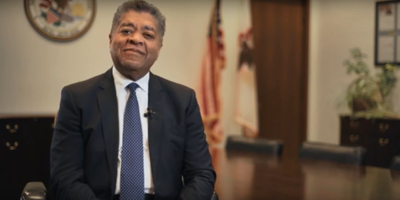



Former Cook County Chief Judge Tim Evans
CHICAGO — Cook County's recently replaced longtime chief judge, who helped to spearhead some of Illinois' controversial criminal justice reforms and oversaw Cook County's troubled electronic monitoring program, has landed in a new role on a prominent state appeals court.
On Aug. 6, the Illinois Supreme Court announced justices had appointed former Cook County Chief Judge Timothy Evans to serve on the Illinois First District Appellate Court in Chicago.
According to the announcement, Evans has been appointed to fill out the remainder of the term of former First District Appellate Justice Terrence J. Lavin, who retired in March. Evans' term on the appellate court is scheduled to begin Aug. 17 and expire on Dec. 4, 2028.
The First District court hears appeals from cases in the Cook County Circuit Court.
In the announcement, the Illinois Supreme Court pointed to Evans' 34-year career as a Cook County judge, including 24 years as chief judge overseeing the state's largest county court system.
The state high court said Evans' "experience leading hundreds of judges means he understands the importance of excellent judicial service and makes him a valuable addition to the appellate court."
Evans' appointment to the state appellate court comes a little less than a year since his fellow Cook County judges voted in September 2025 to replace him from the office he had held since 2001.
In voting 144-109 for challenger and current Cook County Chief Judge Charles Beach, no judges publicly discussed their reasons for ousting Evans.
Evans, however, has in recent years gained public notoriety both for his stalwart support for controversial criminal justice reforms in Illinois, including the outlawing of cash bail, and for his office's handling of electronic monitoring for accused criminals awaiting trial.
Evans for years has been among the strongest defenders of Illinois' criminal justice reforms established under the legislation known as the so-called SAFE-T Act.
The reform package was enacted in 2022 by Illinois Democrats, as left-wing lawmakers seized on anti-police sentiment stirred up by Black Lives Matter protests and riots of 2020 to push through sprawling reforms of virtually every aspect of Illinois' criminal justice system.
The so-called Pre-Trial Fairness Act, prohibiting cash bail, was passed as a follow-up revision of the larger so-called SAFE-T Act criminal justice reform law. The abolition of cash bail took effect in 2023, after the Democrat-dominated Illinois Supreme Court rejected a challenge to the constitutionality of the law.
For years, Evans regularly touted the supposed effectiveness of the new laws at both strengthening civil rights for those accused of crimes and allegedly reducing crime.
Evans notably pushed back against statements and data produced by others involved in the criminal justice system, including the former Cook County Circuit Court clerk, who have claimed provisions under the so-called Pretrial Fairness Act that eliminated cash bail has resulted in more and more criminal defendants skipping court dates and effectively thumbing their nose at the courts.
In place of jailing many criminal defendants, Evans and other Democrats supported releasing many accused criminals, including those accused of violent crimes, on electronic monitoring.
The defense of the system continued even after published reports have documented hundreds of crimes committed by those supposedly being monitored electronically, and after some particularly heinous acts of violence committed in Chicago by those on electronic monitoring generated headlines throughout the country.
Evans further came into conflict at the end of this time as chief judge with Cook County Sheriff Tom Dart over the judge's continued support of electronic monitoring, as the sheriff bluntly criticized the county's judges under Evans' supervision for continuing to release violent criminals on electronic monitoring, enabling them to continue to commit crimes.
After public furor became too great —and particularly after a career criminal identified as Lawrence Reed set a 26-year-old woman on fire while riding a Chicago Transit Authority train in November 2025 — Evans conceded the program required review.
That review was conducted under Beach, when the new chief judge took office in December 2025.
It is not known how those concerns related to electronic monitoring and Evans' continued defense of the criminal justice reforms affected his removal.
Rather, in campaigning to replace Evans, Beach built his platform on "rebuilding the court system's reputation."
Beach indicated this would include being more transparent about how judges are assigned and how judges are investigated and disciplined for alleged misconduct.
In his final years as chief judge, Evans presided over several high-profile judicial scandals.
Among others:
- In 2024, longtime Cook County Judge Kathy Flanagan was referred to the state board for investigation into claims she allegedly ordered an attorney handcuffed to a chair following a tiff between the judge and the lawyer in her courtroom.
Flanagan reportedly asserted the investigation was unfair and would lead to instances in which attorneys who may disagree with a judge's ruling, "have a hissy fit," and launch investigations to destroy that judge's career.
- In 2017 the Illinois Courts Commission ordered former Cook County Judge Valerie Turner to retire from the bench, after she revealed under oath she had been diagnosed with Alzheimer's disease amid an investigation into allegations she improperly allowed a law clerk who was also running for judge to preside over cases while wearing Turner's judicial robe.
Before Turner's removal, Evans was challenged by other judges to provide a more full accounting of the matter. Evans reportedly refused, asserting he was barred by rules from commenting further.
That issue was among those that prompted Cook County Judge Thomas Allen to mount a strong but ultimately unsuccessful effort to unseat Evans as chief judge at the time.
- And in 2024, the Cook County courts referred longtime Cook County Judge E. Kenneth Wright to the JIB for investigation into claims he had improperly claimed a property tax break for a property outside Cook County, when his primary residence was supposed to be within the county's limits.
In all, Evans served as chief judge in Cook County for eight three-year terms. The former Chicago alderman was the first black judge to hold the office.
He is also a noted political ally of Cook County Board President and local Democratic Party leader Toni Preckwinkle.
In her role at the top of the Cook County Democratic Party, Preckwinkle leads the committee tasked with blessing judicial candidates with the party's official endorsement, which generally makes it far more likely that a candidate will win election.
In announcing Evans' appointment, the Illinois Supreme Court highlighted Evans' work to implement "a number of reforms and initiatives while serving as Chief Judge."
The highlighted initiatives included Evans' work overseeing "the opening of the state’s first Restorative Justice Community Courts in the North Lawndale, Avondale, and Englewood neighborhoods of Chicago and the first Restorative Justice Community Court in the suburbs in Sauk Valley."
They further noted Evans' work guiding "the Cook County courts during the COVID-19 pandemic and the resumption of jury trials with public health precautions."