
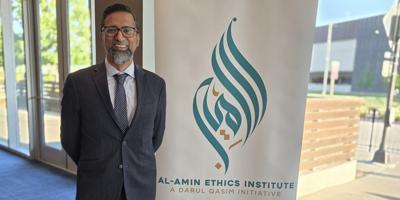



Dr. Umar Shakur
CHICAGO — A group of Muslim doctors have joined their names to the growing list of medical professionals, health care organizations and others seeking to strike down Illinois' state law creating a legal path for certain patients to take their lives through medically assisted suicide.
On Sept. 16, attorneys from the religious freedom advocacy group the Becket Fund for Religious Liberty filed another lawsuit challenging Illinois' new so-called medical assistance in dying (MAiD) law, seeking again to strike down the law they say enshrines a "regime of death" and attempts to conscript religious health care practitioners against their will, in violation of their First Amendment rights.
After bringing a lawsuit on behalf of Chicago's Roman Catholic Cardinal and a group of nuns who run elder care and health care facilities in Illinois, the new action lands on behalf of four Muslim physicians.
Named plaintiffs in the new action include: Akbar M. Ali, a internal medicine doctor in Evanston; Omar S. Hussain, a pulmonologist, of Libertyville; Umar M. Shakur, a cardiologist, of Chicago; and Asim K. Bahar, a cardiologist who practices in both Ottawa and Peru.
As with the lawsuits lodged on behalf of the Catholic Christian entities, the new lawsuit asserts the Illinois law would also force Muslim practitioners to violate their religious beliefs by allegedly forcing them to discuss medically assisted suicide with their patients.
"Muslims are forbidden from prescribing life-ending drugs, directing patients to obtain them, or helping facilitate a patient’s suicide in any way," the Becket Fund said in a statement announcing the lawsuit. "Islam teaches that life is a blessing from Allah and rejects the view that people suffering from illnesses — even terminal illness — are less valuable. Instead, Muslims believe lives of the gravely ill retain beauty, value, and goodness.
"Because suicide is prohibited, facilitating or assisting in it is also forbidden. Rather than aiding in a terminally-ill patient’s death, Muslims have a responsibility to provide them with care and comfort. In this tradition, compassion is accompaniment, not suicide."
The Muslim doctors' lawsuit is the fourth action now pending to challenge the Illinois law known as the End of Life Options Act (EOLOA.)
Prior lawsuits were brought by disability rights advocates and by Catholic and other Christian health care providers and organizations.
The disability rights advocates have claimed the Illinois EOLOA law violates their rights under federal law by allegedly creating a "duty to die" for those with paralysis and other disabilities, by allegedly forcing them to be subjected to pressure from doctors and health insurers to consider suicide as a cost- and labor-saving measure.
The Catholic and other Christian challengers, including Springfield's Roman Catholic Bishop Thomas Paprocki and Chicago Cardinal Blase Cupich, assert the law violates their First Amendment rights by forcing "healthcare providers, against their conscience, to participate in assisted suicide by compelling them to inform patients of the ‘benefits’ of suicide and their ‘right’ to kill themselves, and also help them qualify for lethal drugs, or pass them along to someone willing to help them obtain those drugs."
To this point, a federal judge has granted orders blocking the state from enforcing the EOLOA law against the Christian doctors, hospitals and other providers involved in the cases while the challenges play out.
That, however, however, will also need to wait until a federal appeals court in Chicago resolves related legal questions concerning the authority of the state to force Christian doctors and other medical professionals, as well as hospitals run by religious organizations, such as Catholic hospitals, to refer patients for abortions.
It is not known when the the U.S. Seventh Circuit Court of Appeals may rule in that case, known as Schroeder v Treto.
The EOLOA law generally took effect on Sept. 12.
Supporters of the law, including Illinois Gov. JB Pritzker, have said the law is needed to provide people with terminal illnesses with "the option to seek medication to peacefully end their lives on their own terms in consultation with physicians."
When he signed the bill into law, Pritzker said the law would enable "patients faced with debilitating terminal illnesses to make a decision, in consultation with a doctor, that helps them avoid unnecessary pain and suffering at the end of their lives."
The state has noted in court that the law only opens medical assisted suicide options to those with terminal diagnoses of no more than six months to live. Further, they asserted, the law doesn't allow anyone other than the patient to decide whether to move forward with the assisted suicide. And, the state asserted, the law requires that the patient undergoing the assisted suicide must be capable of administering the lethal drugs themselves.
However, the religious challengers all assert those limits won't prevent the law from violating the First Amendment religious freedom and conscience rights of religious doctors, health care and elder care providers, as well as patients, who object to taking any part in assisted suicide.
The Muslim doctors in the new lawsuit say the same, noting the law puts them and "other Muslims providing health care in Illinois to a stark choice: either abandon their religious beliefs that human life is sacred or face significant fines and penalties."
In the lawsuit, the doctors further note their concerns that research shows an increase in suicide attempts in areas and at times when suicide is a topic of public discussion.
Echoing the complaint lodged by their Catholic counterparts, the Muslim doctors said: "The many Illinois nurse practitioners, doctors, mental health professionals, pharmacists, hospitals, and care homes with religious or moral objections to participating in assisted suicide have nowhere to go, because Illinois’ purported 'optout' still requires religious physicians like Plaintiffs to directly participate in and materially assist the same medicalized suicides to which they object.
"The Muslim patients who do not want to be offered the chance to kill themselves at their lowest moment will be left out in the cold."
As with the Catholic and other Christian challengers, the Muslim doctors similarly seek court orders blocking the state from compelling them from participating in medical assisted suicide, and ultimately striking down the law.
Illinois has not yet responded to the Muslim doctors' lawsuit and the court has not yet ruled on that request. The prior temporary restraining orders were issued without objection from the state of Illinois.
The Muslim doctors are represented by attorneys Mark L. Rienzi, Laura Wolk Slavis, Adele A. Kleim, Benjamin A. Fleshman and Siena A. Marcelle, of the Becket Fund for Religious Liberty, of Washington, D.C.
