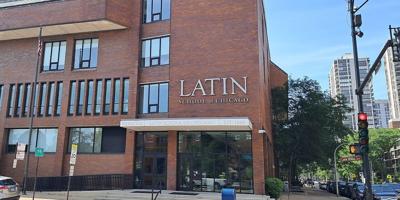



Latin School of Chicago
CHICAGO — A state appeals panel will not allow the parents of a boy who died by suicide — which the parents attribute to bullying at Chicago’s prestigious Latin School — to sue the school and officials for their roles in the circumstances.
Robert and Rose Bronstein’s son, Nate, died in January 2022. That April the couple sued Latin School and a collection of current and former administrators and counselors, among others, seeking $100 million in damages based on accusations the school failed to intervene in extensive cyberbullying at the hands of classmates through text message and Snapchat, and said school officials didn’t do enough to address concerns raised while their son was still alive. They have pursued separate litigation regarding their access to his academic records.
In October 2024, Cook County Judge Scott D. McKenna dismissed large portions of the couple’s third amended complaint, prompting Robert Bronstein’s challenge to the Illinois First District Appellate Court.
Justice Bertina Lampkin wrote the panel’s opinion, filed Sept. 30; Justices Clare Quish and Mary Rochford concurred.
Bronstein challenged McKenna’s dismissal of the claims for wrongful death, violation of Illinois’ bullying prevention law, intentional infliction of emotional distress and breach of fiduciary duty, as well as a claim of direct liability that the child’s estate asserted against the school.
Regarding the Bullying Prevention Act, Bronstein said McKenna wrongly determined the law doesn’t allow for private litigation.
The law, Lampkin wrote, “contains no explicit statement about the circumstances in which civil liability may or may not attach.” While a 15-year-old student “is indisputably a member of the class for whose benefit” legislators crafted the law, she continued, “a private right of action is not consistent” with the law’s underlying purpose.
The panel further explained the BPA was not by nature “remedial, but instead erects a regulatory framework for schools to follow to establish compliant anti-bullying policies, report data on bullying allegations and receive grant money for anti-bullying programming.” While the law imposes obligations for what schools must submit to the State Board of Education, it doesn’t place any onus “with respect to parents or children.”
There is a passage in the law specifying one section “shall not be interpreted to prevent a victim from seeking redress under any other available civil or criminal law,” meaning private litigation under that one statute isn’t the only way to seek a remedy for bullying victims.
Bronstein further said McKenna should have let him plead a common law negligence claim based on the BPA’s requirements, but the panel said there is no record of a proposal to amend the complaint in that fashion or a suggestion of why such an amendment should be allowed.
As to the direct liability claim against the school, the panel again found the complaint lacking in its attempts to establish the school took it upon itself to take a protective role and then failed in that task.
“No factual allegations establish how Latin School’s actions or failings caused Nathan’s injuries, left him worse off, or increased the risk of harm to him,” Lampkin wrote. “On that basis, plaintiffs cannot state a claim for the breach of a duty that was voluntarily undertaken by Latin School as an institution.”
Bronstein’s fiduciary claim relied on the theory the school assumed that duty when counselors met with the child to address mental health and bullying, then committed a breach by failing to stop or investigate the bullying or to inform the Bronsteins. The panel agreed with Judge McKenna that this claim was duplicative of the insufficient duty allegations foundational to the estate’s negligence claim.
The panel also said Bronstein failed to overcome the general rule that the “voluntary act of suicide is an independent, intervening act which is unforeseeable as a matter of law,” saying the complaint doesn’t adequately allege the school should’ve expected the outcome when it failed to notify the parents of the bullying or to properly investigate and punish other students.
According to court records, school counselors had discussed suicidal ideation with Nathan based on incidents “long before the bullying” traced to December 2021 and that he specifically asked administrators to not mention bullying incidents to his parents.
“Holding Nathan’s death to be a foreseeable result of what was largely alleged inaction would be an impossibly onerous standard,” Lampkin wrote, expressing the panel’s agreement with Judge McKenna. “Particularly when Nathan had not been a student at Latin School for 28 days, during which time he was on vacation and in his parents’ continuous control.”
With respect to emotional distress, Lampkin continued, “there is a noticeable absence of allegations which link any of defendant Latin School’s actions or inactions to Nathan’s mental state or eventual suicide.”
Finally, the panel considered the Bronsteins' arguments they should be allowed another chance to amend their complaint. It reviewed the litigation timeline, covering “16 months and multiple iterations of a massive and voluminous complaint” before McKenna’s dismissal, in which he reasoned there were no factual gaps to be filled that might change his mind on which claims to stifle.
“The complaint before us is thorough and comprehensive,” Lampkin wrote. “It documents in tremendous detail the numerous interactions plaintiffs had with defendants both before and after Nathan’s death, defendants’ conduct, Nathan’s struggles and plaintiffs’ considerable efforts to get Nathan the help he needed. As an illustrative example, we have discussed the insufficiency of the complaint as to the element of causation throughout this opinion. Thus far, plaintiffs have not identified any statements Nathan made to his family or school staff or outside mental health professionals, or any other fact, that tied his emotional distress or decision to end his own life to the actions or inactions of defendants. After four versions of their complaint, we can only conclude that such facts do not exist.”
Judge McKenna’s ruling is affirmed.
The Bronsteins are represented by attorneys from the firms of Actuate Law and Burke Warren MacKay & Serritella, both of Chicago.
The school is represented by the firm of Stamos & Trucco, of Chicago, and on appeal by the Law Offices of Michael T. Reagan, of Ottawa.