
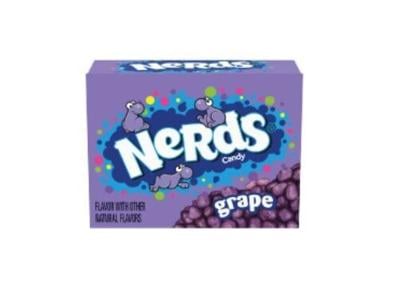


Nerds
CHICAGO – Candy class actions are coming after Florida’s version of MAHA claimed several popular products like Nerds contain unsafe levels of arsenic.
One large box of Nerds contains an amount of arsenic that should be spread out over a year, a study released in January by the “Healthy Florida First” initiative says. Plaintiff lawyers jumped on the chance to sue Ferrara Candy Feb. 4 in Chicago federal court.
The research looked at arsenic levels in popular candies like Jolly Ranchers, Twizzlers and Skittles. Armed with these results, plaintiff Christina Anstett’s lawsuit says snackers wouldn’t have bought Ferrara’s Laffy Taffy, Nerds and Sweet Tarts or would have paid less had they known about the levels of arsenic in them.
“When Plaintiff Anstett… purchased the products, which were produced in the same facilities as the other products at issue, she believed that she was purchasing safe candy consistent with Defendant’s implied promise that their products were safe for consumption,” the suit says.
“However, this was not the case.”
Healthy Florida First is led by Gov. Ron DeSantis’ wife Casey and has taken on products like infant formula and bread. The program uses millions of dollars to test for contaminants and is supported by Robert F. Kennedy, Jr., head of the federal Department of Health and Human Services.
Plaintiff lawyers have been similarly inspired by Kennedy, who enjoyed a long career as one of them before his appointment to his federal post. He’s used it to question the safety of Tylenol, talc and other common consumer products under a call to “Make America Healthy Again.”
Healthy Florida First aligns with that goal, and one byproduct is litigation. Wisner Baum, which employs Kennedy’s son, is already seeking candy clients for a class action.
The D.C. firm Schonbrun Seplow Harris Hoffman & Zeldes apparently beat Wisner Baum to it. Those lawyers are hoping to certify a nationwide class of consumers and a Florida subclass to seek statutory damages under that state’s Deceptive and Unfair Trade Practices Act.
They also mention ultra-processed foods, another one of Kennedy’s causes that is also the subject of multiple lawsuits. Some of those were brought by Morgan & Morgan, where Kennedy used to work.
“Today, the goal of food producers who make ultra-processed food is not necessarily to make a healthy product – but to pump out as much addictive food as possible to enhance their bottom line,” the suit says.
Children are getting a year’s supply of arsenic in just 16 gummy bears, four pieces of Laffy Taffy and 96 Nerds, the Florida testing says. Arsenic is naturally occurring and found in many foods, and the FDA has not specified what is considered a uniform safe level in them.
One candy trade group took exception to Florida’s testing methods, saying they will only cause confusion for consumers and regulators. The FDA’s Closer to Zero initiative is already working on reducing arsenic in food, the National Confectioners Association said.
“Florida has chosen sound bites over science – ignoring this science-based program in favor of publishing unsourced materials that amount to little more than a scare tactic,” NCA said.
“Food safety and product quality remain our highest priorities, and we remain dedicated to being transparent and socially responsible – and we follow the science.”
Among the group’s gripes are that Florida’s methodology relies on screening benchmarks that aren’t in step with federal standards or peer-reviewed science and that FDA findings are much lower than Florida’s.