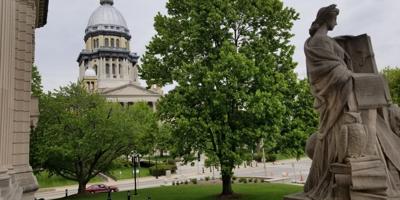


Illinois Capitol, seen from steps of Illinois Supreme Court, Springfield
CHICAGO — The justices on the Democrat-dominated Illinois Supreme Court are asking a federal judge to declare they have the constitutional authority to abruptly kick a judge off Cook County's court for a column he authored when he was not a judge which expressed support for President Donald Trump, in part, because they say the judge’s pro-Trump, anti-Democrat comments make him unsuited for Cook County’s courts.
On April 3, attorneys from the office of Illinois Attorney General Kwame Raoul filed a motion in Chicago federal court, seeking to toss a lawsuit filed against Illinois' state Supreme Court justices by former Cook County Judge James R. Brown.
In a brief filed in support of that motion, the Illinois Supreme Court justices argue their interests in ensuring Illinois state courts remain free of even the "appearance of impropriety" and bias override the ability of retired judges to exercise First Amendment rights, at least if they expect to be able to land temporary judicial assignments in the future.
Further, they argue federal courts have no jurisdiction over decisions the Illinois Supreme Court may make concerning the rights of Illinois state judges or how they are appointed to the court or removed, regardless of whether those targeted by those decisions may believe those actions may otherwise violate the law or the Constitution.
The Illinois Supreme Court's motion came about a month and a half after Brown filed suit in federal court, seeking a court order to reverse the state high court's decision to abruptly toss him from the bench.
Brown's lawsuit accuses the Illinois Supreme Court of trampling his official rights as a judge and his constitutional speech rights as a citizen, by weaponizing Illinois' judicial conduct code against him to suppress his speech and punish him for supporting President Donald Trump.
Brown is represented in the action by attorneys from the nonprofit constitutional rights advocacy group, the Liberty Justice Center, of Chicago.
Brown had retired from the Cook County Circuit Court in 2020, after 18 years on the bench.
However, the Illinois Supreme Court recalled Brown to active service five years later, appointing him to a temporary assignment on Cook County's traffic courts in December 2025.
According to the Illinois Supreme Court at the time, Brown's temporary appointment was needed to help Cook County's overburdened courts deal with a shortage of judges amid a crush of backlogged cases.
However, in January 2026, the court suddenly decided to retract that assignment, amid a public pressure campaign mounted by Chicago Democrat lawyers.
At least two legal organizations, including the Cook County Bar Association, which represents the interests of black lawyers and judges in Chicago, and the Chicago Council of Lawyers issued statements and sent letters to the Illinois Supreme Court demanding the court rescind Brown's appointment.
In those communications, the organizations claimed Brown had demonstrated himself to be unfit to hear cases in Cook County due to bias. As proof, they pointed to a column Brown published in an online publication operated by former Chicago Tribune columnist John Kass in September — four weeks before he applied for the judicial recall.
In that column, titled "His Judgment Cometh, and That Right Soon," Brown assailed what he called "lawfare" waged by Democratic activists and politicians in Illinois and elsewhere in the U.S. against President Donald Trump and his supporters.
He further singled out for criticism the controversial criminal prosecutorial and policy decisions of former Cook County State's Attorney Kim Foxx and other prosecutors, who Brown agreed had been propped up by billionaire left-wing activist George Soros and his political organizations to advance left-wing criminal justice reforms in Chicago and nationwide.
The complaining legal organizations asserted the column — which Brown authored and published when he was no longer a judge and before his recall — amounted to violations of the Illinois Code of Judicial Conduct, which require judges to "promote public confidence" in the courts.
The groups asserted the column was "wildly inappropriate for a member of the judiciary to be making" and showed Brown lacked "the temperament, judgment, independence, competence, impartiality and respect for the rule of law necessary for those who serve in the judiciary."
in his complaint, Brown asserts the state Supreme Court lacked the authority to simply remove him as it did.
He argues the Illinois state constitution alone provides the process for the removal of judges: impeachment by the Illinois General Assembly or a removal action through the Illinois Courts Commission, following the investigation of a formal complaint of misconduct against a judge.
In either instance, a judge accused of conduct which could result in removal should be afforded hearings and due process.
In this case, Brown said, he received neither. Further, the complaint asserts the Courts Commission received no misconduct complaints against Brown.
In the complaint, Brown asserts the Illinois Supreme Court exceeded the bounds of its authority under the state constitution in removing him as they did.
"The justices on the Illinois Supreme Court clearly lacked the authority and subject matter jurisdiction to circumvent the removal procedures prescribed by the Illinois Constitution and unilaterally remove Judge Brown, a sitting judge," Brown claims in his lawsuit.
And by allegedly exceeding their authority, Brown argues the justices of the Illinois Supreme Court should also not be afforded judicial immunity for taking such actions.
Further, Brown accused the state Supreme Court of violating his rights to free speech.
Essentially, he said, the removal amounts to illegal and unconstitutional retaliation against him for expressing political views disfavored by Illinois Democrats and perhaps disfavored by all seven of the justices, as well.
Brown's complaint notes Brown published the column, which should amount to constitutionally protected political speech "on a matter of public concern," while he was still considered a retired judge and before he applied for judicial recall.
Allowing the justices to boot him from the bench in an allegedly extra-constitutional manner, citing Illinois' Code of Judicial Conduct, would in turn signal that Illinois Supreme Court and activists can use Illinois' judicial codes to police the speech of all current and former state judges.
"Application of the Illinois Code of Judicial Conduct to Judge Brown and all retired Illinois judges forces a stark choice: refuse to speak on any matters of public concern during retirement or exercise one’s First Amendment right and foreclose any future opportunity to return to the bench," Brown wrote in his complaint.
Too ‘unmanageable’ for Cook County?
In response, however, Raoul and the Illinois Supreme Court justices argued Brown's constitutional rights as a retired judge are less important than the state high court's obligation to ensure Illinois state courts remain free of perceived bias.
Specifically, the attorney general's office argued Brown, by publishing the pro-Trump column, essentially forfeited his ability to ever again hear cases in famously Democrat-dominated Cook County.
They assert that, even in traffic court, Brown would need to recuse himself from hearing "an unmanageable number of cases," because either defendants or prosecutors who come before him may be Democratic or among those he criticized in his column.
"... Judge Brown’s comments specifically demeaned and insulted a broad swath of the population of Cook County — individuals who would inevitably appear before him in court —and specifically challenged the integrity of other judges and of prosecutors (and Cook County prosecutors in particular)," the attorney general wrote in the brief filed in support of the motion to dismiss.
"And even in matters involving neither prosecutors nor members of any of the groups Judge Brown insulted, there was an 'obvious . . . threat' that a member of the public might reasonably question his impartiality.
"Accordingly, Judge Brown’s comments would undoubtedly create 'problems in maintaining . . . harmony' in the courts of Cook County," they said.
The justices further argued that, if the federal courts allow Brown's lawsuit to proceed, it would amount to unconstitutionally butting into the internal administration of Illinois state courts.
And they argued Brown also has no rights to even a hearing on the matter, because temporary judicial recall assignments are "discretionary." They argued that because the Illinois Supreme Court appointed Brown to the role, the court could also decide to end the assignment whenever it wished and for any reason, regardless of the otherwise lengthy and difficult process of removing nearly all other judges from the bench, even for instances of ethical or criminal misconduct.
"The Justices did not seek to 'limit the speech of a retired judge,'" the attorney general wrote in the brief. "Judge Brown does not allege that the Justices took any action whatsoever during his retirement.
"Rather, the Justices ended his recall assignment upon learning of the significant disruption and concern Judge Brown’s statements had caused after his reassignment to the bench; Judge Brown was a sitting judge when he was terminated, not a retired judge."
High court’s own ‘impartiality’ concerns
The justices of the Illinois Supreme Court include five Democrats and two Republicans.
Two of the Democratic justices, Elizabeth M. Rochford and Mary K. O'Brien, notably ran highly partisan campaigns when they were elected to the court in 2022, accepting millions of dollars in campaign donations from Democratic Gov. JB Pritzker. They also trumpeted endorsements from Democratic politicians and a variety of left-wing activist organizations, even as the state high court prepared to hear volatile cases challenging controversial state laws, including the state's ban on so-called "assault weapons" and Pritzker's signature criminal justice reforms abolishing cash bail in the state.
Both Rochford and O'Brien refused requests from challengers to the gun ban law to recuse themselves, rejecting claims their clear alignment with Pritzker and other Democrats and progressive causes would cause parties and observers to question their impartiality on such hot partisan topics.
In September 2023, Rochford also spoke at a political fundraiser in Lake County, appearing in her capacity as a new justice of the Illinois Supreme Court. The event supported the Lake County Women’s Political Action Committee, a group which explicitly declares it exists to elect female Democratic candidates to office in Lake County and elsewhere.
Rochford came under a hail of criticism for speaking at the event, with critics and other observers familiar with the rules of judicial conduct both asserting Rochford's appearance at the fundraiser likely violated those rules of judicial ethics.
Specifically, they said it violated rules requiring judges to maintain at least the appearance of neutrality.
Rules in that Code of Judicial Conduct appear to explicitly prohibit such speeches by Illinois state judges, no matter their judicial office, saying:
“Except as may be specifically authorized in the context of judicial election campaigns, Rule 4.1 prohibits judges and judicial candidates from 'publicly' endorsing or making 'speeches' on behalf of political candidates or organizations.
“Paragraphs (A)(2) and (A)(3) prohibit judges and judicial candidates from making speeches on behalf of political organizations to prevent them from misusing the prestige of judicial office to advance the interests of others.”
Rochford did not apologize for the event, but rather asserted she did nothing wrong.
"The content of my speech was not political in any way and so should not be construed to have been provided on behalf of any political candidate or organization," Rochford said in a statement at the time in response to the criticism.
No public action has been taken by judicial regulators against Rochford stemming from her appearance at the political fundraiser.
Neither the Chicago Council of Lawyers nor the Cook County Bar Association issued public statements questioning Rochford's appearance at the political fundraiser, or the decisions by Rochford and O'Brien to accept explicitly partisan support from prominent Democrats and left-wing activist groups as they campaigned to serve on the state's highest court, or their refusal to recuse themselves despite those campaign donations.