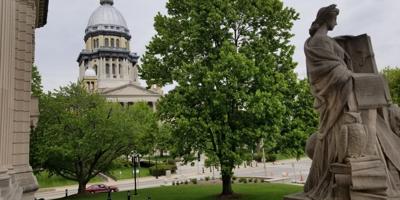


Illinois Capitol, seen from steps of Illinois Supreme Court, Springfield
CHICAGO — A retired Cook County judge has sued the Illinois Supreme Court, saying the state high court justices violated his rights, both as a judge and a citizen, when they first recalled him to service and then booted him from the bench just a few weeks later after left-wing activists and two Chicago legal organizations complained about a column he wrote when he was not serving as a judge, calling for an end to Democrats' so-called "lawfare" against President Trump.
On Feb. 19, retired Cook County Judge James R. Brown filed his lawsuit in Chicago federal court against all of the justices on the Illinois Supreme Court.
The lawsuit seeks a court order declaring the state high court trampled his official rights as a judge and his constitutional speech rights as a citizen, by weaponizing Illinois' judicial conduct code against him to suppress his speech and punish him for supporting President Donald Trump.
The lawsuit further seeks a court order forcing the Illinois Supreme Court to reinstate him to the judicial role they abruptly stripped from him.
Brown is represented in the action by attorneys from the nonprofit constitutional rights advocacy group, the Liberty Justice Center, of Chicago.
“By removing Judge James Brown from the bench, the justices of the Illinois Supreme Court chose politics over the rule of law,” said Brendan Philbin, senior counsel at the Liberty Justice Center, who is representing Brown.
The lawsuit centers on the Illinois Supreme Court's order, dated Jan. 26, purporting to vacate its decision to recall Judge Brown out of retirement and back to active service.
The court had issued the initial recall order in December 2025, saying Brown's services were needed to address a backlog of cases in the beleaguered massive Cook County courts.
According to Brown's complaint, he was selected after he responded to a "recall notice" from the state Supreme Court, or a call for former judges to apply for potential reinstatement.
According to Brown's complaint, the recall notice indicated recalled judges could expect to earn an annual salary of $258,158. Their judicial pensions would be suspended during the term of service.
According to the complaint, Brown applied on Oct. 3.
Brown then heard nothing further from the court until he was notified in December that he had been recalled to service in Cook County Circuit Court.
Brown had been assigned to handle cases in Cook County traffic court.
However, after the state high court announced his recall, at least two legal organizations, including the Cook County Bar Association, which represents the interests of black lawyers and judges in Chicago, and the Chicago Council of Lawyers issued statements and sent letters to the Illinois Supreme Court demanding the court rescind its appointment of Brown.
In those communications, the organizations claimed Brown had demonstrated himself to be unfit to hear cases in Cook County due to bias. As proof, they pointed to a column Brown published in an online publication operated by former Chicago Tribune columnist John Kass in September — four weeks before he applied for the judicial recall.
In that column, titled "His Judgment Cometh, and That Right Soon," Brown assailed what he called "lawfare" waged by Democratic activists and politicians in Illinois and elsewhere in the U.S. against President Donald Trump and his supporters.
He further singled out for criticism the controversial criminal prosecutorial and policy decisions of former Cook County State's Attorney Kim Foxx and other prosecutors, who Brown agreed had been propped up by billionaire left-wing activist George Soros and his political organizations to advance left-wing criminal justice reforms in Chicago and nationwide.
The complaining legal organizations asserted the column — which Brown authored and published when he was no longer a judge and before his recall — amounted to violations of the Illinois Code of Judicial Conduct, which require judges to "promote public confidence" in the courts.
The groups asserted the column was "wildly inappropriate for a member of the judiciary to be making" and showed Brown lacked "the temperament, judgment, independence, competence, impartiality and respect for the rule of law necessary for those who serve in the judiciary."
Seemingly in response to the uproar, the state Supreme Court issued its order removing Brown from the bench.
However, in his complaint, Brown asserts the state Supreme Court lacked the authority to simply remove him as it did.
He argues the Illinois state constitution alone provides the process for the removal of judges: impeachment by the Illinois General Assembly or a removal action through the Illinois Courts Commission, following the investigation of a formal complaint of misconduct against a judge.
In either instance, a judge accused of conduct which could result in removal should be afforded hearings and due process.
In this case, Brown said, he received neither. Further, the complaint asserts the Courts Commission received no misconduct complaints against Brown.
In the complaint, Brown asserts the Illinois Supreme Court exceeded the bounds of its authority under the state constitution in removing him as they did.
"The justices on the Illinois Supreme Court clearly lacked the authority and subject matter jurisdiction to circumvent the removal procedures prescribed by the Illinois Constitution and unilaterally remove Judge Brown, a sitting judge," Brown claims in his lawsuit.
And by allegedly exceeding their authority, Brown argues the justices of the Illinois Supreme Court should also not be afforded judicial immunity for taking such actions.
Further, Brown accused the state Supreme Court of violating his rights to free speech.
Essentially, he said, the removal amounts to illegal and unconstitutional retaliation against him for expressing political views disfavored by Illinois Democrats and perhaps disfavored by all seven of the justices, as well.
Brown's complaint notes Brown published the column, which should amount to constitutionally protected political speech "on a matter of public concern," while he was still considered a retired judge and before he applied for judicial recall.
Allowing the justices to boot him from the bench in an allegedly extra-constitutional manner, citing Illinois' Code of Judicial Conduct, would in turn signal that Illinois Supreme Court and activists can use Illinois' judicial codes to police the speech of all current and former state judges.
"Application of the Illinois Code of Judicial Conduct to Judge Brown and all retired Illinois judges forces a stark choice: refuse to speak on any matters of public concern during retirement or exercise one’s First Amendment right and foreclose any future opportunity to return to the bench," Brown wrote in his complaint.
In a statement announcing the lawsuit, Philbin at the Liberty Justice Center added: “In a frantic rush to obey the partisan directives of the Cook County Bar Association and Chicago Council of Lawyers, the justices ignored the Illinois Constitution and trampled on the First Amendment rights of Judge Brown. Considering Judge Brown’s long career of judicial service, he deserves better.”
The Illinois Supreme Court has not yet responded to the lawsuit in court.