
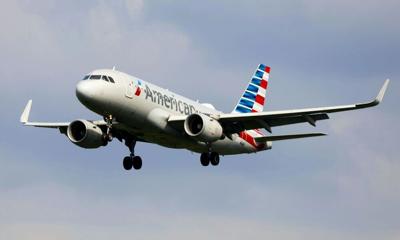



An American Airlines plane landing at Pittsburgh International Airport.
CHICAGO — A federal judge has largely grounded a lawsuit from an American Airlines passenger who sought to hold the carrier liable for sexual harassment and assault she endured at the hands of a drunk male passenger.
Renee Solofra’s lawsuit stems from a September 2023 flight from Chicago’s O’Hare International Airport to Southwest Florida International Airport in Fort Myers, Florida. According to Solofra, American Airlines staff continued to serve alcohol to and flirted with the other passenger seated next to her, Daniel McAdams, but did nothing to intervene when McAdams wouldn’t stop talking to her and eventually began touching and fondling her, until another passenger across the aisle told McAdams to stop.
Solofra said she reported the assault to police in Florida, who detained and questioned McAdams and collected corroborating testimony from other passengers. McAdams ultimately pleaded no contest to criminal charges. Solofra sued the airline in September 2025 and filed an amended complaint in December, alleging negligence, fraudulent concealment and violations of two Illinois laws: the Consumer Fraud and Deceptive Business Practice Act and Gender Violence Act.
In an opinion filed July 23, U.S. District Judge John Blakey granted American’s motion to dismiss the latter three counts of the complaint for failure to state a claim.
In arguing for dismissal, American said the federal Airline Deregulation Act preempts the Illinois state consumer fraud law and fraudulent concealment claims, because the federal law bars all state law litigation connected to “a price, route or service of an air carrier that may provide air transportation,” Blakey wrote.
Of significant relevance is a 1995 U.S. Supreme Court Opinion, American Airlines v. Wolens, which noted “the potential for intrusive regulation of airline business practices inherent in state consumer protection legislation,” which runs counter to the federal law’s intent to “leave largely to the airlines themselves, and not at all to states, the selection and design of marketing mechanisms appropriate to the furnishing of air transportation services.”
Because Solofra’s Consumer Fraud Act claim targets “how American Airlines should market and represent itself through its website, ticketing process, Conditions of Carriage, safety messaging and pre-boarding practices about expectations of service,” Blakey wrote, the ADA pre-empts that part of the complaint as well as the fraudulent concealment claim, as it directly aims at the airline’s services.
“Representations about passenger safety involve bargained-for or anticipated provisions of labor from one party to another,” Blakey wrote. “When purchasing an airline ticket, customers reasonably anticipate an air carrier will provide a safe travel experience — just as they anticipate helpful baggage handling, quality food and drink and effective customer service.”
As to the Illinois Gender Violence Act, Solofra argued American was liable for the acts of its employees and alleged they “personally encouraged and assisted the gender-based violence” because they continued serving McAdams alcohol, didn’t move him from the seat next to Solofra, and failed “to intervene during an ongoing assault.”
However, Blakey said, American successfully argued that, as a corporation, it isn’t a “person” as the Illinois Gender Violence Act would have defined the term at the time of the flight. Although the General Assembly amended the law in 2024, Blakey said the dismissal is in line with the statutory language in effect at the time of the incident.
Solofra “was the victim of monstrous conduct,” Blakey concluded, but she brought “claims for which relief cannot be granted as a matter of law,” and he therefore dismissed her three claims with prejudice.
Solofra is represented in the case by attorneys from the firm of Romanucci & Blandin, of Chicago.
American Airlines has been represented by attorneys from the firm of Amundsen Davis, of Chicago.