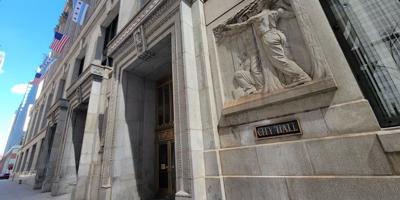


Chicago City Hall
CHICAGO — Saying the U.S. Supreme Court will decide soon if the lawsuit is even allowed, a group of oil and gas companies have asked a Cook County judge to bottle up, for now, the city of Chicago's lawsuit seeking a potentially massive payout from the energy companies for allegedly "deceiving" people and businesses into using oil and gas to heat and power their homes, cars, factories and other necessities of modern life.
On Feb. 27, attorneys for Chevron, Shell, B.P., ExxonMobil and others filed a motion in Cook County Circuit Court, requesting a stay in the proceedings in the city's "climate disinformation" case against the companies.
The motion relies entirely on the U.S. Supreme Court's decision to take up a case out of Boulder, Colorado, centered entirely on one overarching question:
Whether federal law prohibits cities, like Chicago, Boulder and a growing number of others, from using accusations of alleged "deception" over climate change to use municipal ordinances and state laws to extract potentially huge paydays from the companies.
"If the Supreme Court decides that federal law precludes state-law claims seeking relief for injuries allegedly caused by the effects of interstate and international greenhouse-gas emissions, Defendants’ federal preemption and preclusion arguments in this case will prevail, and this Court would need only give effect to the Supreme Court’s decision by dismissing Plaintiff’s claims," the energy companies wrote in their joint motion. "That is because it is undisputed that all of Plaintiff’s claims are premised on, and seek damages for, the cumulative impact of 'global warming' as a result of historical emissions' throughout the country and world.
"... And even if the Supreme Court does not side with the petitioners in Boulder, its decision would still provide important guidance that would undoubtedly shape this Court’s consideration of Defendants’ motions to dismiss."
The motion comes as the city seeks to move ahead with the legal action it filed against the oil and gas producers about two years ago.
In that lawsuit, the city, the city, joined by a collection of prominent trial lawyers, seeks to make Chevron, BP and other petroleum producers and distributors pay for allegedly misleading consumers and the public for decades about the alleged climate altering affects of using oil and gas products in transportation and many other economic sectors.
The lawsuit claims so-called "climate change" has in turn led to more frequent bad weather events, such as floods, droughts and severe storms, among other alleged harms, costing the city large amounts of money to address.
The Chicago lawsuit asserts this makes oil and gas use a "public nuisance" by allegedly also contributing to racial and social "inequities" for the city's low income and minority communities.
The lawsuit particularly takes aim at what it calls "disinformation" from the oil companies, which the city claims has misled consumers into continuing to use the products for decades after the energy companies allegedly knew of the supposed harms caused by the use of their fuels.
"This successful climate deception campaign had the purpose and effect of inflating and sustaining the market for fossil fuels, which - in turn - drove up greenhouse gas emissions, accelerated global warming, and brought about devastating climate change impacts to the city of Chicago," the city wrote in its lawsuit at the time.
The city's lawsuit largely copies a path blazed by other local government lawsuits against the same energy companies, as well as by earlier litigation against tobacco companies, pharmaceutical companies and others who have supplied many of the products common to American life.
The city is joined in the action by trial lawyers from the firms of DiCello Levitt LLP, of Chicago, and Sher Edling LLP, of San Francisco.
The Sher Edling firm has also served as counsel on dozens of virtually identical climate-related lawsuits against the oil and gas industry throughout the country. Published reports indicate Sher Edling has received millions of dollars in funding from a dark money group backed by billionaires, known as the Collective Action Fund for Accountability, Resilience and Adaptation." That funding has drawn scrutiny from members of Congress, who have noted it pays for the firm's lawsuits on behalf of local governments aimed at bankrupting the nation's oil and gas companies.
Those cases have met with mixed results, to date.
The energy companies have succeeded in snuffing out a number of such municipal and state-level "climate disinformation" lawsuits, notably in Pennsylvania, New York, Maryland and New Jersey.
In those jurisdictions, the judges have determined the cases to be improper attempts to use lawsuits to regulate federally controlled emissions standards.
However, in other locales, the cities and other local governments have been allowed to move forward with their cases.
Notably, the state Supreme Courts of Colorado and Hawaii have allowed the actions to move ahead.
Famously, in May 2025, the Colorado state high court ruled Boulder's lawsuit could continue because state law-based "nuisance" and consumer protection-based "disinformation" claims are not preempted by the federal Clean Air Act. They found the lawsuits aren't seeking to restrict or regulate emissions, but rather seek only to make the companies pay enormous sums of money for producing and selling the products that cause the emissions and the allegedly related climate change problems.
The energy companies, however, have essentially called that finding a legal hair-splitting distinction without a difference. They argue Democrat-dominated cities and state governments are attempting to use such lawsuits and the accompanying threat of large and potentially crippling court-ordered payments or settlements to sidestep federal regulation under the Clean Air Act and force undemocratic changes in the behavior of energy companies and consumers, achieving national energy policy and emissions goals desired by left-wing activists and politicians.
With courts divided on that question, the U.S. Supreme Court in February agreed to take up the Boulder, Colorado, case. When the high court delivers a ruling in the case, justices could deliver a final answer one way or another on whether Boulder and other cities can advance such legal actions in state or federal court.
Chicago's litigation is likely tied to the fate of the Boulder case, as well.
Last year, the city relied heavily on the reasoning advanced in the Colorado case to persuade a former Cook County judge who now serves as a federal district judge in Chicago to send the Chicago lawsuit back to Cook County Circuit Court.
In that decision, U.S. District Judge Franklin Valderrama agreed, like the Colorado court, that the Chicago lawsuit doesn't seek to directly regulate emissions or fuel production, but instead is about the companies' "alleged campaign of deception and misrepresentation ... of the dangers of fossil fuel..."
Valderrama allowed the city to take the case back to Cook County court, a jurisdiction famously stacked by Democratic judges, including many nominated, supported or even appointed by the Democratic party bosses in Chicago and Springfield.
The case is currently being heard by Cook County Circuit Judge Allen P. Walker,
Walker has also been assigned to hear another big money "disinformation" related case brought by the city of Chicago against gunmaker, Glock. In that case, Walker has already ruled the city can keep suing Glock, even though the gunmaker has argued the city's suit seeks to essentially use lawsuits and the courts to sidestep the Second Amendment and outlaw certain kinds of guns. That ruling has been appealed by Glock.
The city of Chicago has not yet responded to the request by the oil companies to pause the case against them.
And Walker also hasn't ruled on the request.
The oil and gas companies are represented in the action by attorney Patricia Brown Holmes and others with the firms of Riley Safer Holmes & Cancila, of Chicago; Gibson Dunn & Crutcher, of Los Angeles, Washington, D.C., New York and San Francisco; Susman Godfrey LLP, of Houston; and Stern Kilcullen & Rufolo, of Fordham Park, New Jersey.
The city is represented by attorney Chelsey B. Metcalf, and others with the city's Department of Law; attorney Daniel R. Flynn, and others with the DiCello Levitt firm; and Matthew K. Edling and Victor M. Sher, and others with the Sher Edling firm.