
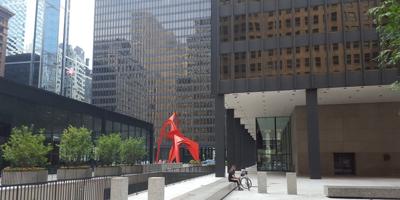



Dirksen Federal Courthouse, Chicago
CHICAGO — A federal appeals panel won’t let a woman sue her lawyer, even though the judges expressed concerns about the attorney's conduct while representing her in patent litigation.
Amanda Sima retained Justin Barker, of Benesch, Friedlander, Coplan & Aronoff, to lead her litigation against Novolex Holdings because she believed one of its companies copied and sold a spill-proof cup lid of her design. She said that while Barker represented her, he was negotiating a move to Novolex’s outside counsel, Nelson Mullins Riley & Scarborough.
Sima, without representation, sued Benesch in federal court in Chicago. After U.S. District Judge John Robert Blakey dismissed her second amended complaint, Sima retained new attorneys and brought her concerns to the U.S. Seventh Circuit Court of Appeals. Judge Nancy Maldonado wrote the panel’s opinion, filed Aug. 28; Judges David Hamilton and Rebecca Taibleson concurred.
According to court records, Sima said Waddington North America marketed and then patented a product identical to the “JoJo Cups” lids she designed for children in 2013 and started pitching to manufacturers, including Waddington, in 2017. Waddington secured a utility patent for its lid in 2022. When she contacted Novolex — by then Waddington’s corporate parent — the company’s lawyers indicated it might be open to a settlement and directed her to Nelson Mullins.
About that same time, Sima contacted multiple law firms about the possibility of suing Novolex for trade secret theft and other claims. She spoke with three Benesch lawyers on Oct. 6, 2022, retaining Barker and Alyssa Moscarino for $20,000 to research claims and negotiate. Unable to pay monthly legal bills, Sima contacted litigation funders. Benesch lawyers had unfruitful discussions with the funders and wouldn’t consider the lawsuit without money in place.
In late 2022, according to Sima, Benesch lawyers floated a “newly devised legal path” that they allegedly said could yield more than $100 million from a jury trial, and in January 2023, they told Nelson Mullins Sima would want well more than $1 million to settle. When a Nelson Mullins attorney, Ashley Summer, informed Benesch of a document disproving the claims, Sima and Benesch clashed over whether it was falsified.
“Sima expressed concerns to Barker and Moscarino about their ‘bias’ in favor of opposing counsel, but she declined their offer to discuss these concerns further in a call,” Maldonado wrote. “Sima also requested to have a third party inspect the document but was told that the arrangement specified that Novolex must consent to any forensic review. Sima then ‘reached the peak of suspicion’ and confronted Moscarino about ‘the integrity of the representation’ and the ‘multiple months of fruitless engagement,’ which had resulted in ‘over $50,000 in fees.’ ”
On April 26, 2023, Benesch said it would stop representing Sima. A few weeks later, when she contracted a new firm and directed them to Barker for background, Sima learned he’d announced his move to Nelson Mullins the day Benesch dropper her as a client. Six weeks later she sued Benesch, Barker and Moscarino — whom she agreed to dismiss on appeal — seeking $25 million in compensatory damages and $50 million in punitive damages. Sima also sued Nelson Mullins while the motion to dismiss was pending.
Moscarino principally practices in Ohio, and the appellate panel agreed that state’s law predominates, even though Sima filed her suit in Chicago. It also noted “Sima has pivoted from the 11 counts asserted in her complaint, arguing instead that she adequately stated a single claim for legal malpractice against Barker and that Benesch is vicariously liable for Barker’s conduct,” a repackaging Maldonado said is acceptable under Ohio law for malpractice suits.
The panel also said the Benesch firm “wisely do not argue” about two requirements for legal malpractice claims, acknowledging Baker had an obligation to Sima and also that he breached that duty, but rather focus entirely “on the argument that there were not adequate allegations that Barker’s misconduct caused Sima any harm.” On that front, the panel agreed with Judge Blakey.
The record, Maldonado wrote, showed the trade secret claims Sima wanted to pursue. But she also told the appeals panel “the Benesch attorneys assessed that she did not have a viable trade secret claim. Sima then presented ‘other viable legal paths’ to the attorneys, who agreed to pursue that ‘new approach’ instead of ‘looking at this as a trade secret case,’ as Barker had done. From these allegations, we infer Sima to be saying that the attorneys found her claims for unfair business practices, unjust enrichment, and/or breach of contract to be viable — but not her trade secrets claim.”
Barker didn’t deprive her of the chance to bring an unfair business practices claim, the panel said, because any statutory limitations expired before she first contacted the firm. An unjust enrichment claim against Novolex also would’ve failed. But she had two more years under Ohio law to bring an unjust enrichment claim after Benesch dropped her, which was “hardly ‘too close’ to the expiration date so as to prevent Sima from pursuing the claim as she alleges,” Maldonado wrote.
The panel further rejected agreements regarding the $20,000 retainer, noting she paid it up front so any subsequent misconduct didn’t cause her to make that payment, and said her emotional distress allegations lack the required level of significance.
“The allegations here about Barker failing to screen himself off a case in which he was conflicted, though ethically questionable, do not plausibly rise to that level,” Maldonado wrote. “And with no path to compensatory damages, Sima’s quest for punitive damages fails too.”
The panel also said the failure to state a legal malpractice claim against Baker means Sima cannot sustain a vicarious liability allegation against Benesch.
